Gevers-Montoro Carlos, Romero-Santiago Mar, Losapio Lisa, Conesa-Buendía Francisco Miguel, Newell Dave, Álvarez-Galovich Luis, Piché Mathieu, Ortega-De Mues Arantxa
Madrid College of Chiropractic - RCU María Cristina, Madrid, Spain.
Department of Anatomy, Université du Québec à Trois-Rivières, Trois-Rivières, QC, Canada.
Front Integr Neurosci. 2022 Apr 12;16:879083. doi: 10.3389/fnint.2022.879083. eCollection 2022.
Low back pain is the leading cause of years lived with disability worldwide. Chiropractors employ different interventions to treat low back pain, including spinal manipulative therapy, although the mechanisms through which chiropractic care improves low back pain are still unclear. Clinical research and animal models suggest that spinal manipulation might modulate plasma levels of inflammatory cytokines, which have been involved in different stages of low back pain. More specifically, serum levels of Tumor Necrosis Factor-alpha (TNF-α) have been found to be elevated in patients with chronic low back pain. We aimed to investigate whether urine from chronic low back pain patients could be an appropriate medium to measure concentrations of TNF-α and to examine possible changes in its levels associated to chiropractic care.
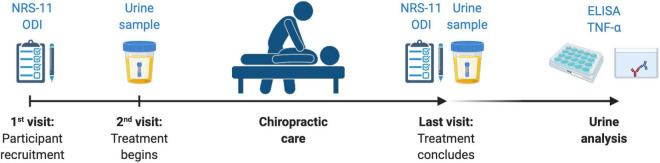
Urine samples were collected from 24 patients with chronic low back pain and TNF-α levels were analyzed by ELISA before and after 4-6 weeks of care compared to a reference value obtained from 5 healthy control subjects, by means of a Welch's -test. Simultaneously, pain intensity and disability were also evaluated before and after care. Paired -tests were used to compare mean pre and post urinary concentrations of TNF-α and clinical outcomes.
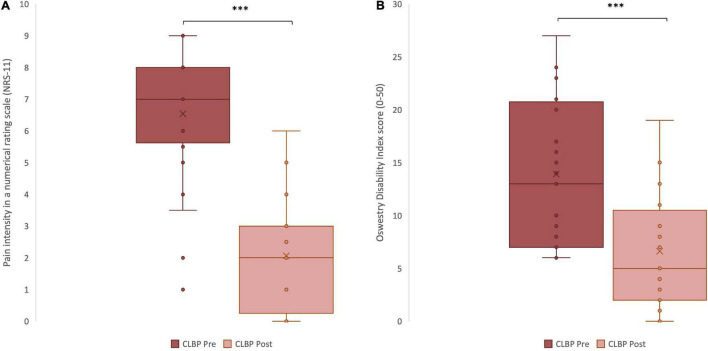
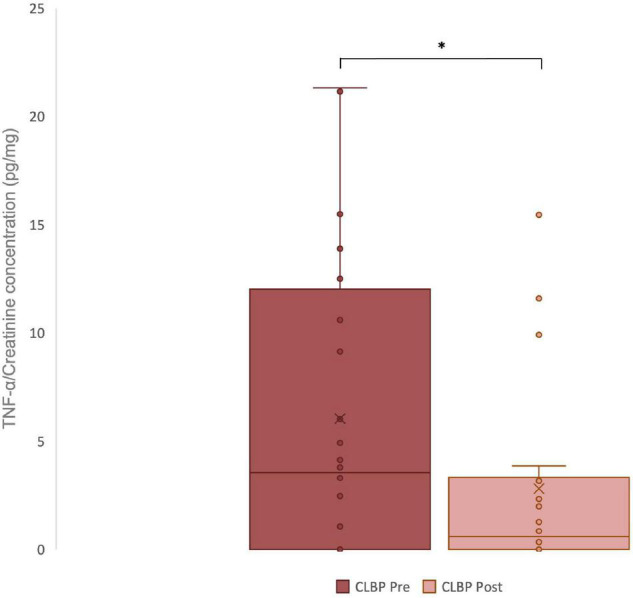
Significantly higher baseline levels of urinary TNF-α were observed in chronic low back pain patients when compared to our reference value ( < 0.001), which were significantly lower after the period of chiropractic treatment ( = 0.03). Moreover, these changes were accompanied by a significant reduction in pain and disability (both < 0.001). However, levels of urinary TNF-α were not correlated with pain intensity nor disability.
These results suggest that urine could be a good milieu to assess TNF-α changes, with potential clinical implications for the management of chronic low back pain.
下背痛是全球导致残疾生存年数的首要原因。脊椎按摩师采用不同的干预措施来治疗下背痛,包括脊柱手法治疗,尽管脊椎按摩疗法改善下背痛的机制仍不清楚。临床研究和动物模型表明,脊柱手法治疗可能会调节炎症细胞因子的血浆水平,这些细胞因子参与了下背痛的不同阶段。更具体地说,已发现慢性下背痛患者的血清肿瘤坏死因子-α(TNF-α)水平升高。我们旨在研究慢性下背痛患者的尿液是否可能是测量TNF-α浓度的合适介质,并检查其水平与脊椎按摩疗法相关的可能变化。
收集24例慢性下背痛患者的尿液样本,通过酶联免疫吸附测定法(ELISA)在治疗4-6周前后分析TNF-α水平,并与5名健康对照受试者的参考值进行比较,采用韦尔奇检验。同时,在治疗前后还评估了疼痛强度和残疾程度。配对检验用于比较尿液中TNF-α的平均治疗前和治疗后浓度以及临床结果。
与我们的参考值相比,慢性下背痛患者尿液中TNF-α的基线水平显著更高(<0.001),在脊椎按摩治疗期后显著降低(=0.03)。此外,这些变化伴随着疼痛和残疾的显著减轻(两者均<0.001)。然而,尿液中TNF-α的水平与疼痛强度和残疾程度均无相关性。
这些结果表明,尿液可能是评估TNF-α变化的良好环境,对慢性下背痛的管理具有潜在的临床意义。