School of Public Health and Management, Chongqing Medical University, Chongqing, China.
Department of Epidemiology and Medicine, West China School of Public Health and West China Fourth Hospital, Sichuan University, Chengdu, China.
Front Immunol. 2022 Apr 14;13:860703. doi: 10.3389/fimmu.2022.860703. eCollection 2022.
Genetic studies have linked polymorphisms in the interleukin 6 receptor () gene to the risk of multiple human diseases and phenotypes, yet have reported inconsistent results. We aimed to synthesize current knowledge of variants in the gene on the risk of diseases and phenotypes.
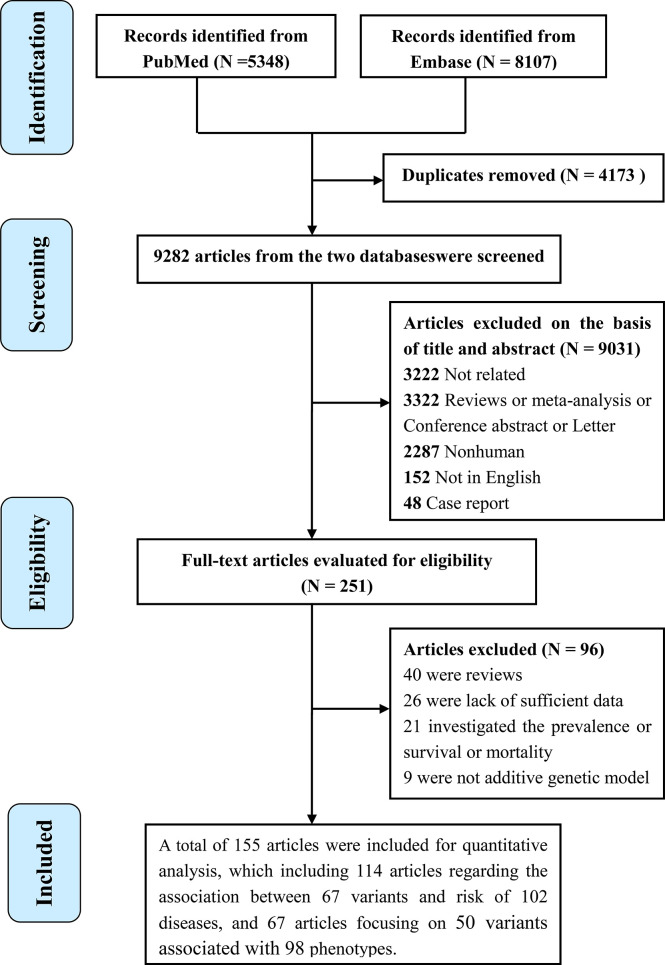
We searched the Medline and Embase databases to identify relevant publications. Meta-analysis was performed utilizing DerSimonian and Laird random-effects model. We also graded cumulative evidence for significant associations. Furthermore, phenome-wide analyses and functional annotations were performed for variants with strong evidence.
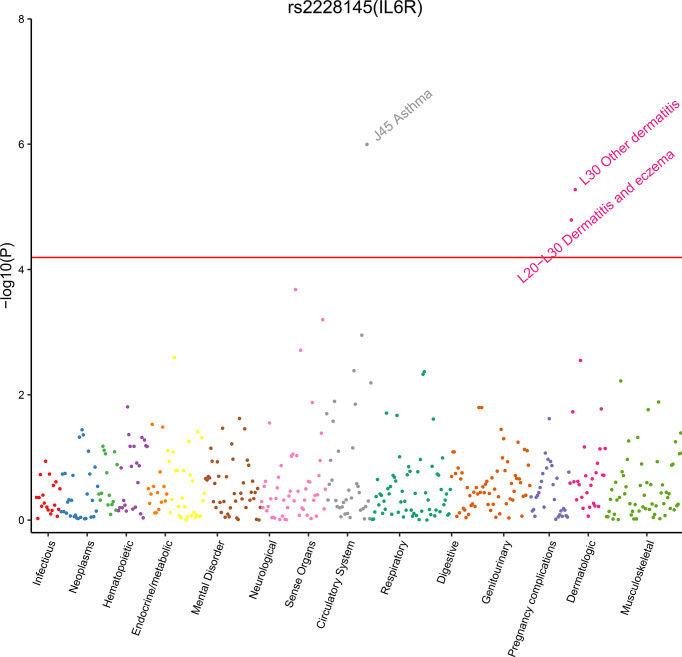
We included 155 studies for evaluating the associations between 80 polymorphisms in the gene and the risk of 102 human diseases and 98 phenotypes. We conducted 58 main meta-analyses, and 41 significant associations were identified. Strong evidence was assigned to 29 associations that investigated ten variants (rs2228145, rs4129267, rs7529229, rs4537545, rs7518199, rs4845625, rs4553185, rs4845618, rs4845371, and rs6667434) related to the risk of four cardiovascular diseases (coronary heart disease, coronary artery disease, atherosclerosis, and abdominal aortic aneurysms), four inflammatory diseases (rheumatoid arthritis, Crohn's disease, dermatitis, and asthma), and concentration of four phenotypes (C-reactive protein, fibrinogen, IL-6, and sIL-6R). Furthermore, phenome-wide analysis verified that rs2228145 associated with asthma and dermatitis risk. Functional analyses indicated that these polymorphisms fall within exon, enhancer regions.
Our study comprehensively summarizes current data on the genetic architecture of the gene and highlights the pharmacological targeting potential of IL-6R on cardiovascular and inflammatory diseases.
白细胞介素 6 受体()基因中的多态性与多种人类疾病和表型的风险相关,但研究结果不一致。本研究旨在综合分析基因中变体与疾病和表型风险的关系。
我们检索了 Medline 和 Embase 数据库以确定相关文献。采用 DerSimonian 和 Laird 随机效应模型进行荟萃分析。我们还对具有显著关联的证据进行了分级。此外,对具有强证据的变异进行了表型全基因组分析和功能注释。
我们纳入了 155 项研究,以评估 基因中 80 个多态性与 102 种人类疾病和 98 种表型风险之间的关系。我们进行了 58 项主要的荟萃分析,确定了 41 个有统计学意义的关联。我们将强证据分配给了 29 个研究 10 个变体(rs2228145、rs4129267、rs7529229、rs4537545、rs7518199、rs4845625、rs4553185、rs4845618、rs4845371 和 rs6667434)与 4 种心血管疾病(冠心病、冠状动脉疾病、动脉粥样硬化和腹主动脉瘤)、4 种炎症性疾病(类风湿关节炎、克罗恩病、皮炎和哮喘)以及 4 种表型(C 反应蛋白、纤维蛋白原、白细胞介素 6 和可溶性白细胞介素 6 受体)的风险之间的关联。此外,表型全基因组分析验证了 rs2228145 与哮喘和皮炎风险相关。功能分析表明,这些多态性位于外显子、增强子区域。
本研究全面总结了基因遗传结构的现有数据,并强调了白细胞介素 6 受体在心血管和炎症性疾病中的药物靶向潜力。