Gaudreault Mathieu, Chang David, Hardcastle Nicholas, Jackson Price, Kron Tomas, Hanna Gerard G, Hofman Michael S, Siva Shankar
Department of Physical Sciences, Peter MacCallum Cancer Centre, Melbourne, VIC, Australia.
Sir Peter MacCallum Department of Oncology, the University of Melbourne, Melbourne, VIC, Australia.
Front Oncol. 2022 Apr 12;12:854589. doi: 10.3389/fonc.2022.854589. eCollection 2022.
Biology-guided radiotherapy (BgRT) uses real-time functional imaging to guide radiation therapy treatment. Positron emission tomography (PET) tracers targeting prostate-specific membrane antigen (PSMA) are superior for prostate cancer detection than conventional imaging. This study aims at describing nodal and distant metastasis distribution from prostate cancer and at determining the proportion of metastatic lesions suitable for BgRT.
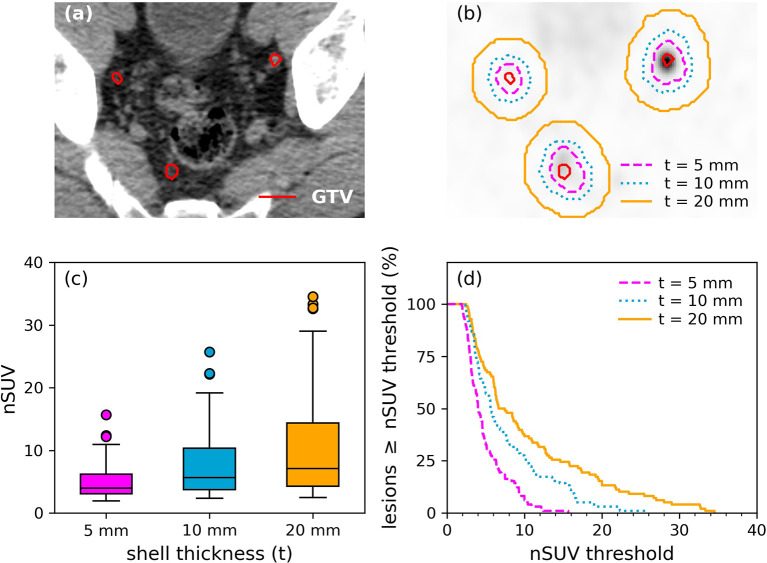
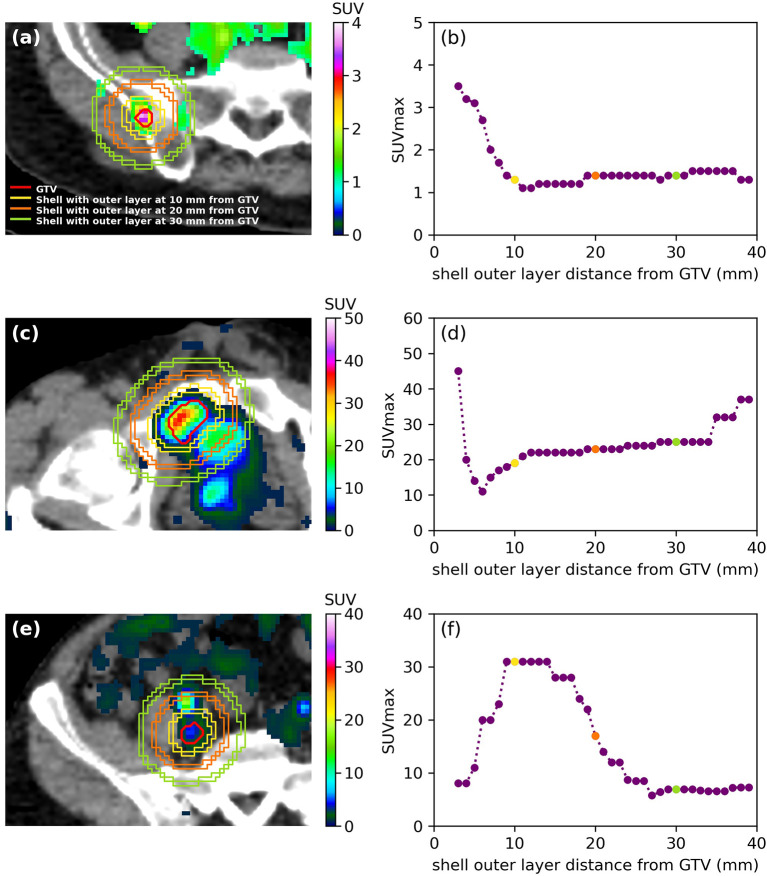
A single-institution patient subset from the ProPSMA trial (ID ACTRN12617000005358) was analysed. Gross tumour volumes (GTV) were delineated on the CT component of a PSMA PET/CT scan. To determine the suitability of BgRT tracking zones, the normalized SUV (nSUV) was calculated as the ratio of SUVmax inside the GTV to the SUVmean of adjacent three-dimensional shells of thickness 5 mm/10 mm/20 mm as a measure of signal to background contrast. Targets were suitable for BgRT if (1) nSUV was larger than an nSUV threshold and (2) non-tumour tissue inside adjacent shell was free of PET-avid uptake.
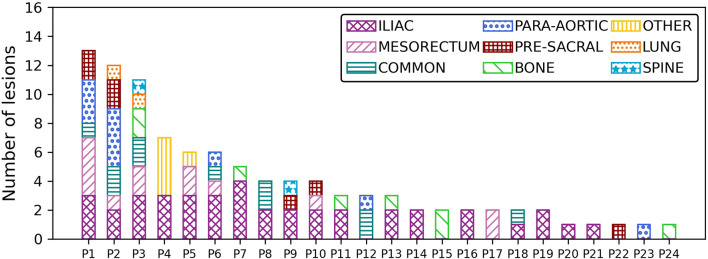
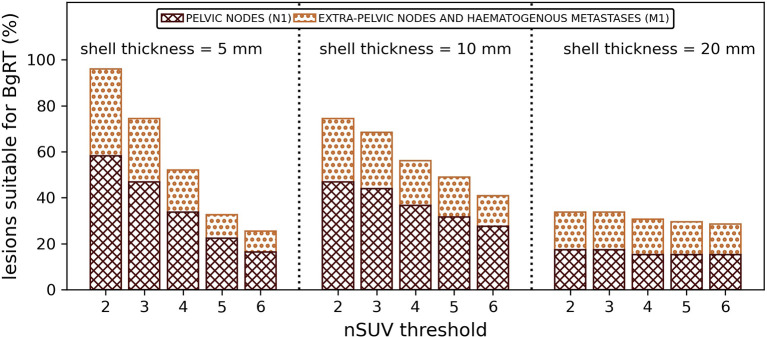
Of this cohort of 84 patients, 24 had at least one pelvic node or metastatic site disease, 1 to 13 lesions per patient, with a total of 98 lesions (60 pelvic nodes/38 extra-pelvic nodal diseases and haematogenous metastases). Target volumes ranged from 0.08 to 9.6 cm while SUVmax ranged from 2.1 to 55.0. nSUV ranged from 1.9 to 15.7/2.4 to 25.7/2.5 to 34.5 for the 5 mm/10 mm/20 mm shell expansion. Furthermore, 74%/68%/34% of the lesions had nSUV ≥ 3 and were free of PSMA PET uptake inside the GTV outer shell margin expansion of 5 mm/10 mm/20 mm. Adjacent avid organs were another lesion, bladder, bowel, ureter, prostate, and liver.
The majority of PSMA PET/CT-defined radiotherapy targets would be suitable for BgRT by using a 10-mm tracking zone in prostate cancer. A subset of lesions had adjacent non-tumour uptake, mainly due to the proximity of ureter or bladder, and may require exclusion from emission tracking during BgRT.
生物引导放疗(BgRT)利用实时功能成像来指导放射治疗。靶向前列腺特异性膜抗原(PSMA)的正电子发射断层扫描(PET)示踪剂在前列腺癌检测方面优于传统成像。本研究旨在描述前列腺癌的淋巴结和远处转移分布,并确定适合BgRT的转移病灶比例。
分析了来自ProPSMA试验(ID ACTRN12617000005358)的单机构患者亚组。在PSMA PET/CT扫描的CT部分勾勒出大体肿瘤体积(GTV)。为了确定BgRT追踪区域的适用性,计算标准化SUV(nSUV),即GTV内SUVmax与相邻厚度为5mm/10mm/20mm的三维壳层SUVmean的比值,作为信号与背景对比度的度量。如果(1)nSUV大于nSUV阈值,且(2)相邻壳层内的非肿瘤组织无PET摄取,则靶区适合BgRT。
在这84例患者队列中,24例至少有一个盆腔淋巴结或转移部位疾病,每位患者有1至13个病灶,共98个病灶(60个盆腔淋巴结/38个盆腔外淋巴结疾病和血行转移)。靶区体积范围为0.08至9.6cm,而SUVmax范围为2.1至55.0。对于5mm/10mm/20mm的壳层扩展,nSUV范围为1.9至15.7/2.4至25.7/2.5至34.5。此外,74%/68%/34%的病灶nSUV≥3,且在GTV外壳边缘扩展5mm/10mm/20mm内无PSMA PET摄取。相邻的摄取活跃器官还有另一个病灶、膀胱、肠道、输尿管、前列腺和肝脏。
在前列腺癌中,通过使用10mm的追踪区域,大多数PSMA PET/CT定义的放疗靶区将适合BgRT。一部分病灶有相邻的非肿瘤摄取,主要是由于输尿管或膀胱的 proximity,在BgRT期间可能需要排除在发射追踪之外。 (注:原文中“proximity”未翻译完整,可能是“接近”的意思,推测此处想表达因输尿管或膀胱接近导致有相邻非肿瘤摄取情况)