Hrinivich William T, Phillips Ryan, Da Silva Angela J, Radwan Noura, Gorin Michael A, Rowe Steven P, Pienta Kenneth J, Pomper Martin G, Wong John, Tran Phuoc T, Kang-Hsin Wang Ken
Radiation Oncology and Molecular Radiation Sciences, Johns Hopkins Medicine, Baltimore, Maryland.
RefleXion Medical, Hayward, California.
Adv Radiat Oncol. 2019 Nov 6;5(2):260-268. doi: 10.1016/j.adro.2019.10.006. eCollection 2020 Mar-Apr.
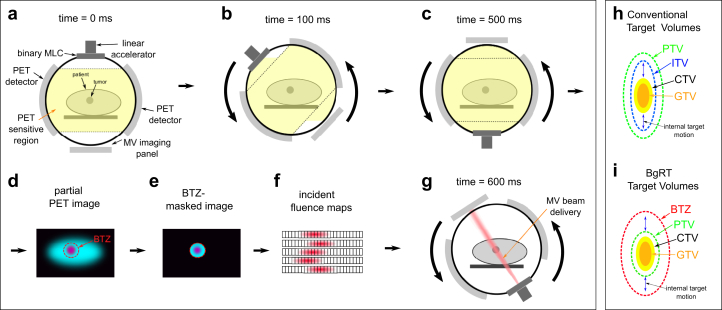
Stereotactic ablative radiation therapy (SABR) for oligometastatic prostate cancer (OMPC) may improve clinical outcomes, but current challenges in intrafraction tracking of multiple small targets limits treatment accuracy. A biology-guided radiation therapy (BgRT) delivery system incorporating positron emission tomography (PET) detectors is being developed to use radiotracer uptake as a biologic fiducial for intrafraction tumor tracking to improve geometric accuracy. This study simulates prostate-specific membrane antigen (PSMA)-directed BgRT using a cohort from our phase II randomized trial of SABR in men with recurrent hormone sensitive OMPC and compares dose distributions to clinical SABR (CSABR).
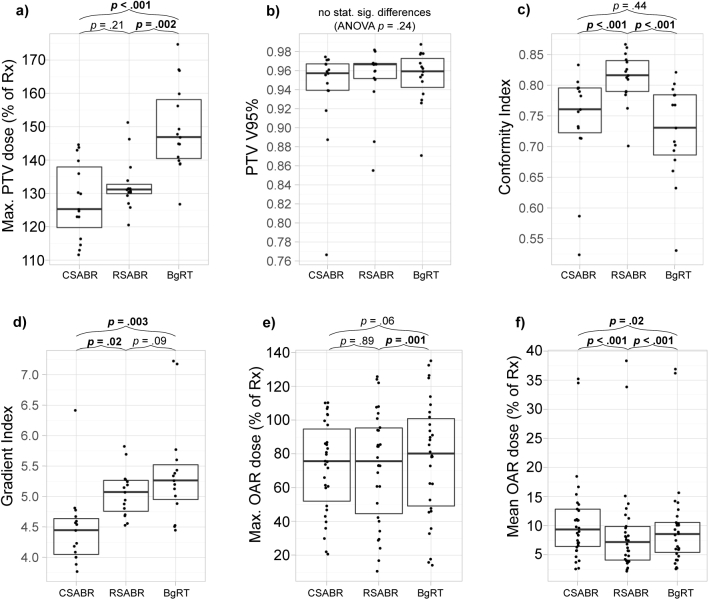
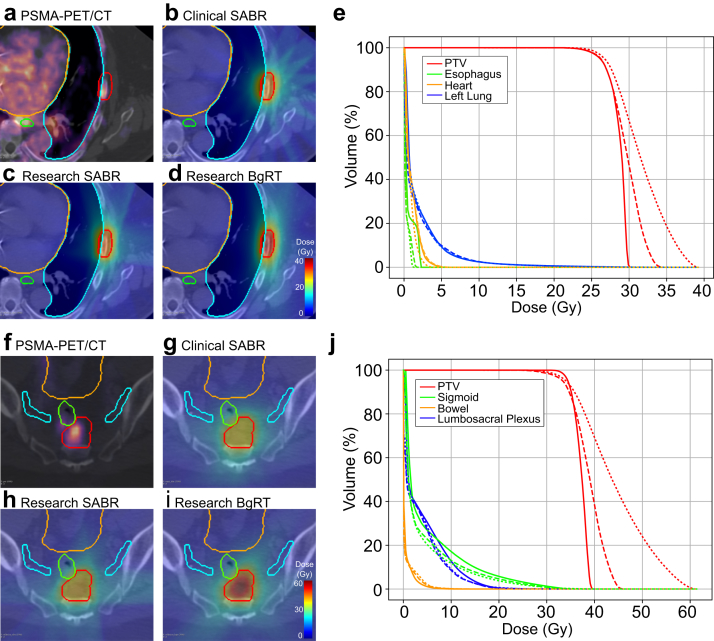
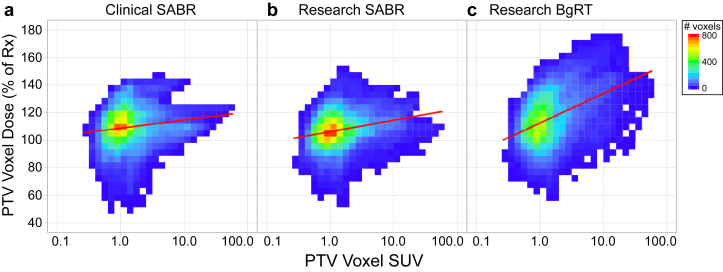
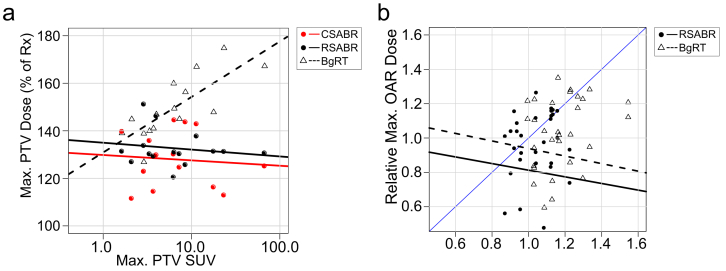
A research treatment planning system (RTPS) was used to replan 15 patients imaged with PSMA-targeted F-DCFPyL PET/computed tomography and previously treated with CSABR using conventional linear accelerators (linacs). The RTPS models a prototype ring-mounted linac incorporating PET and kilo-voltage computed tomography imaging subsystems and can be used to optimize BgRT plans, as well as research SABR (RSABR) plans, which use the prototype linac without radiotracer guidance. CSABR, RSABR, and BgRT plans were compared in terms of maximum planning target volume (PTV) dose (D), mean dose to proximal organs at risk (D), conformity index, as well as voxel-wise correlation of dose with PET specific uptake values to investigate possible dose-painting effects.
RSABR and BgRT plans resulted in mean ± standard deviation increases in D of 4 ± 11% ( = .21) and 18 ± 15% ( < .001) and reductions in D of -20 ± 19% ( <.001) and -10 ± 19% ( = .02) compared with CSABR. Similar target coverage was maintained with conformity indices of 0.81 ± 0.04 ( < .001) and 0.72 ± 0.08 ( = .44) for RSABR and BgRT compared with 0.74 ± 0.08 for CSABR. Dose and log (specific uptake values) had Pearson correlation coefficients of 0.10 (CSABR), 0.16 (RSABR), and 0.31 (BgRT).
BgRT plans provided similar PTV coverage and conformity compared with CSABR while incorporating underlying PET activity. These results demonstrate feasibility of BgRT optimization enabling online PSMA-targeted, PET-based tracked dose delivery for OMPC.
立体定向消融放疗(SABR)用于寡转移前列腺癌(OMPC)可能改善临床结局,但目前在多个小靶区的分次内追踪方面存在挑战,限制了治疗准确性。正在开发一种结合正电子发射断层扫描(PET)探测器的生物引导放疗(BgRT)输送系统,以利用放射性示踪剂摄取作为分次内肿瘤追踪的生物基准,提高几何精度。本研究使用我们在复发性激素敏感性OMPC男性患者中进行的SABR II期随机试验队列,模拟前列腺特异性膜抗原(PSMA)导向的BgRT,并将剂量分布与临床SABR(CSABR)进行比较。
使用研究性治疗计划系统(RTPS)对15例患者重新规划,这些患者接受了PSMA靶向的F-DCFPyL PET/计算机断层扫描成像,并先前使用传统直线加速器(直线加速器)接受了CSABR治疗。RTPS模拟了一个结合PET和千伏计算机断层扫描成像子系统的原型环形安装直线加速器,可用于优化BgRT计划以及研究性SABR(RSABR)计划,RSABR计划使用无放射性示踪剂引导的原型直线加速器。比较了CSABR、RSABR和BgRT计划的最大计划靶体积(PTV)剂量(D)、近端危及器官的平均剂量(D)、适形指数,以及剂量与PET特异性摄取值的体素相关性,以研究可能的剂量描绘效应。
与CSABR相比,RSABR和BgRT计划导致D的均值±标准差分别增加4±11%(P = 0.21)和18±15%(P < 0.001),D分别降低-20±19%(P < 0.001)和-10±19%(P = 0.02)。RSABR和BgRT的适形指数分别为0.81±0.04(P < 0.001)和0.72±0.08(P = 0.44),与CSABR的0.74±0.08相似,维持了相似的靶区覆盖。剂量与log(特异性摄取值)的Pearson相关系数分别为0.10(CSABR)、0.16(RSABR)和0.31(BgRT)。
与CSABR相比,BgRT计划在纳入潜在PET活性的同时,提供了相似的PTV覆盖和适形性。这些结果证明了BgRT优化的可行性,能够实现针对OMPC的在线PSMA靶向、基于PET的追踪剂量输送。