Marathe Anuj, Patel Shiv J, Song Bo, Sliepka Joseph M, Shybut Theodore S, Lee Brendan H, Jayaram Prathap
H. Ben Taub Dept of Physical Medicine & Rehabilitation, Baylor College of Medicine, Houston, Texas, U.S.A.
Texas Children's Hospital, Houston, Texas, U.S.A.
Arthrosc Sports Med Rehabil. 2021 Dec 10;4(2):e335-e341. doi: 10.1016/j.asmr.2021.10.004. eCollection 2022 Apr.
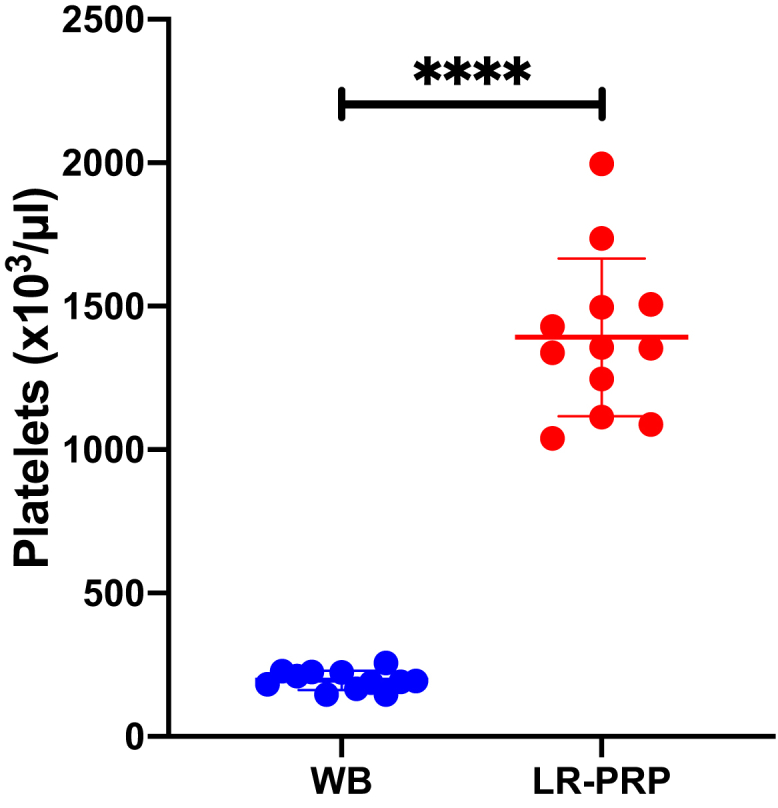
To comprehensively characterize a double-spin leukocyte-rich platelet-rich plasma (LR-PRP) formulation and to compare it with whole blood (WB) by quantitatively assessing platelet and WB cell subtype concentrations in each.
Prospective human ex vivo analysis with 12 healthy adult men with ages ranging from 25 to 31 was performed in a controlled laboratory setting. The main outcome measure was the leukocyte profile of human LR-PRP.
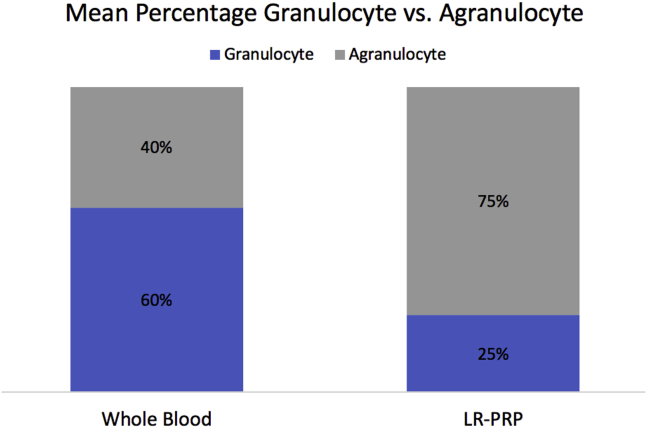
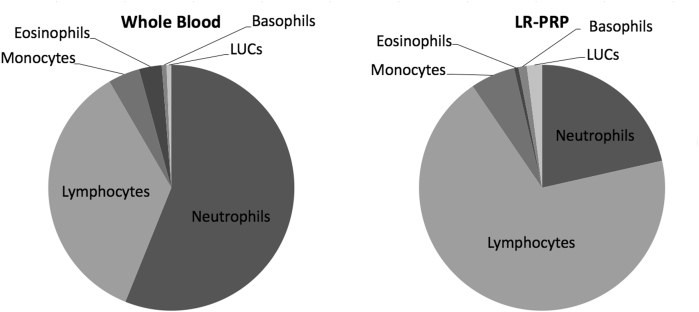
In LR-PRP, lymphocytes were the predominant WB cell type (11.94 ± 2.97 × 10 cells/μL) followed by neutrophils (3.72 ± 1.28 × 10 cells/μL). The mean cumulative percentage of granulocytes was 23% ± 8% and agranulocytes was 77% ± 18%. There was a significant difference observed between granulocyte and agranulocyte percentage within both WB ( = .004, [95% CI: (7%,31%)]) and LR-PRP ( < .0001, [95% CI: (42%,66%)]) groups. In addition, there was a significant difference observed between the WB and LR-PRP granulocyte percentages ( < .0001, [95% CI: (29%,43%)]) and between the WB and LR-PRP agranulocyte percentages ( < .0001, [95% CI: (30%,42%)]).
Our study found that LR-PRP is predominantly lymphocyte rich with notable concentrations of other WB cell subtypes, including neutrophils, monocytes, eosinophils, basophils, and large unstained cells. While these subtypes are not routinely reported, they may play a role in modulating the local inflammatory environment. We also found significant differences in WB cell subtype concentrations between WB and LR-PRP.
PRP has been routinely used in many clinical practices without clear indications for its use and lacks standardization in its formulation. This study provides a comprehensive characterization of a broadly used PRP, LR-PRP, and further characterizes subtypes of WBC cells present in LR-PRP that have not been previously reported. Comprehensively reporting these subtypes in clinical trials of PRP is crucial to understanding how these cells participate in PRP's therapeutic potential. This type of data can help standardize future PRP formulations and improve patient outcomes.
全面表征富含白细胞的富血小板血浆(LR-PRP)制剂,并通过定量评估其中的血小板和全血细胞亚型浓度,将其与全血(WB)进行比较。
在可控的实验室环境中,对12名年龄在25至31岁之间的健康成年男性进行前瞻性人体离体分析。主要观察指标是人类LR-PRP的白细胞谱。
在LR-PRP中,淋巴细胞是主要的全血细胞类型(11.94±2.97×10个细胞/μL),其次是中性粒细胞(3.72±1.28×10个细胞/μL)。粒细胞的平均累积百分比为23%±8%,无粒细胞为77%±18%。在全血组(P = 0.004,[95%置信区间:(7%,31%)])和LR-PRP组(P < 0.0001,[95%置信区间:(42%,66%)])中,粒细胞和无粒细胞百分比之间均观察到显著差异。此外,全血组与LR-PRP组的粒细胞百分比之间(P < 0.0001,[95%置信区间:(29%,43%)])以及全血组与LR-PRP组的无粒细胞百分比之间(P < 0.0001,[95%置信区间:(30%,42%)])均观察到显著差异。
我们的研究发现,LR-PRP主要富含淋巴细胞,且含有其他显著浓度的全血细胞亚型,包括中性粒细胞、单核细胞、嗜酸性粒细胞、嗜碱性粒细胞和大的未染色细胞。虽然这些亚型未被常规报道,但它们可能在调节局部炎症环境中发挥作用。我们还发现全血组与LR-PRP组之间全血细胞亚型浓度存在显著差异。
PRP已在许多临床实践中常规使用,但使用时缺乏明确指征,其制剂也缺乏标准化。本研究全面表征了一种广泛使用的PRP,即LR-PRP,并进一步表征了LR-PRP中存在的此前未报道的白细胞亚型。在PRP的临床试验中全面报告这些亚型对于理解这些细胞如何参与PRP的治疗潜力至关重要。这类数据有助于规范未来的PRP制剂并改善患者预后。