Zhao Zhuoya, Lu Enmeng, Zhao Feifei, Zeng Yi, Zhao Yuxuan
Research Center for Brain-Inspired Intelligence, Institute of Automation, Chinese Academy of Sciences, Beijing, China.
School of Future Technology, University of Chinese Academy of Sciences, Beijing, China.
Front Neurosci. 2022 Apr 14;16:753900. doi: 10.3389/fnins.2022.753900. eCollection 2022.
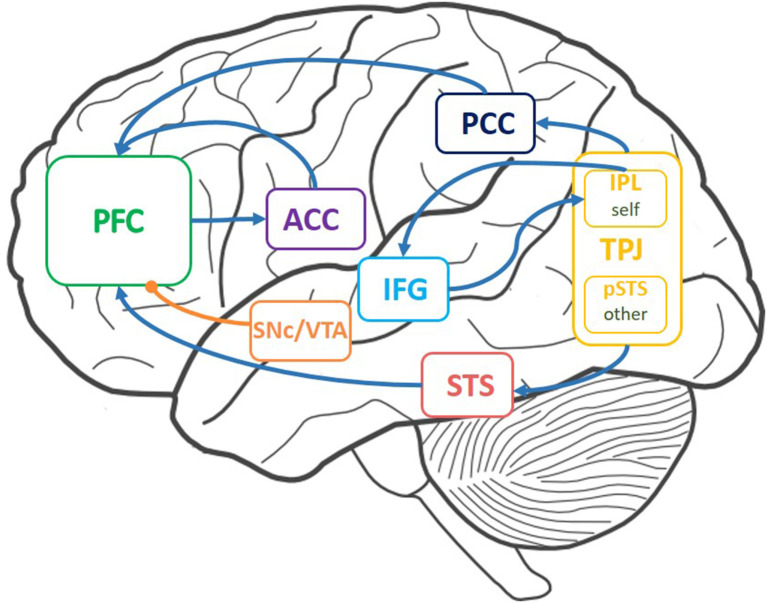
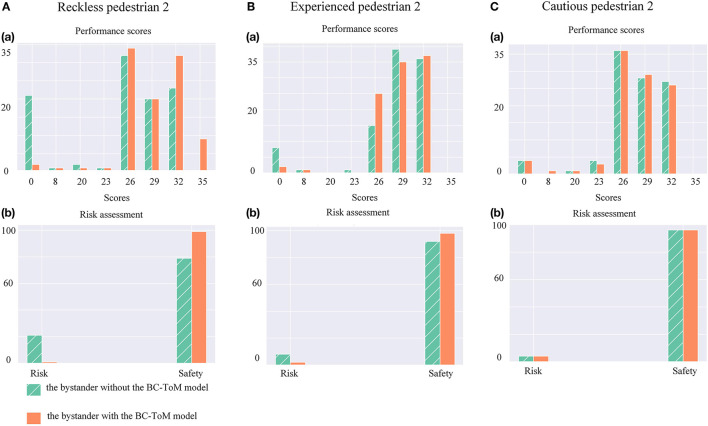
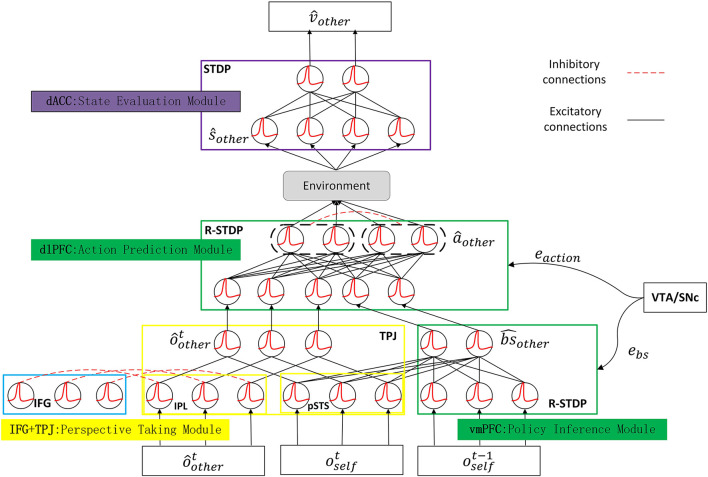
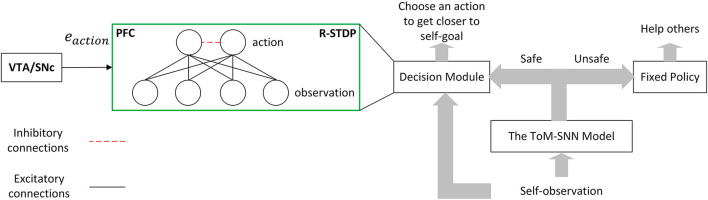
Artificial Intelligence (AI) systems are increasingly applied to complex tasks that involve interaction with multiple agents. Such interaction-based systems can lead to safety risks. Due to limited perception and prior knowledge, agents acting in the real world may unconsciously hold false beliefs and strategies about their environment, leading to safety risks in their future decisions. For humans, we can usually rely on the high-level theory of mind (ToM) capability to perceive the mental states of others, identify risk-inducing errors, and offer our timely help to keep others away from dangerous situations. Inspired by the biological information processing mechanism of ToM, we propose a brain-inspired theory of mind spiking neural network (ToM-SNN) model to enable agents to perceive such risk-inducing errors inside others' mental states and make decisions to help others when necessary. The ToM-SNN model incorporates the multiple brain areas coordination mechanisms and biologically realistic spiking neural networks (SNNs) trained with Reward-modulated Spike-Timing-Dependent Plasticity (R-STDP). To verify the effectiveness of the ToM-SNN model, we conducted various experiments in the gridworld environments with random agents' starting positions and random blocking walls. Experimental results demonstrate that the agent with the ToM-SNN model selects rescue behavior to help others avoid safety risks based on self-experience and prior knowledge. To the best of our knowledge, this study provides a new perspective to explore how agents help others avoid potential risks based on bio-inspired ToM mechanisms and may contribute more inspiration toward better research on safety risks.
人工智能(AI)系统越来越多地应用于涉及与多个智能体交互的复杂任务。这种基于交互的系统可能会导致安全风险。由于感知和先验知识有限,在现实世界中行动的智能体可能会无意识地持有关于其环境的错误信念和策略,从而在其未来决策中导致安全风险。对于人类而言,我们通常可以依靠高级心理理论(ToM)能力来感知他人的心理状态,识别诱发风险的错误,并及时提供帮助以使他人远离危险情况。受ToM的生物信息处理机制启发,我们提出了一种受大脑启发的心理理论脉冲神经网络(ToM-SNN)模型,以使智能体能够感知他人心理状态中的此类诱发风险的错误,并在必要时做出帮助他人的决策。ToM-SNN模型纳入了多个脑区协调机制以及通过奖励调制的脉冲时间依赖可塑性(R-STDP)训练的具有生物现实性的脉冲神经网络(SNN)。为了验证ToM-SNN模型的有效性,我们在具有随机智能体起始位置和随机阻挡墙的网格世界环境中进行了各种实验。实验结果表明,具有ToM-SNN模型的智能体基于自身经验和先验知识选择救援行为来帮助他人避免安全风险。据我们所知,本研究为探索智能体如何基于受生物启发的ToM机制帮助他人避免潜在风险提供了一个新视角,并可能为更好地研究安全风险贡献更多灵感。