Denicolò Sara, Vogi Verena, Keller Felix, Thöni Stefanie, Eder Susanne, Heerspink Hiddo J L, Rosivall László, Wiecek Andrzej, Mark Patrick B, Perco Paul, Leierer Johannes, Kronbichler Andreas, Steger Marion, Schwendinger Simon, Zschocke Johannes, Mayer Gert, Jukic Emina
Department of Internal Medicine IV (Nephrology and Hypertension), Medical University Innsbruck, Innsbruck, Austria.
Institute of Human Genetics, Medical University Innsbruck, Innsbruck, Austria.
Kidney Int Rep. 2022 Feb 3;7(4):876-888. doi: 10.1016/j.ekir.2022.01.1064. eCollection 2022 Apr.
The disease trajectory of diabetic kidney disease (DKD) shows a high interindividual variability not sufficiently explained by conventional risk factors. Clonal hematopoiesis of indeterminate potential (CHIP) is a proposed novel cardiovascular risk factor. Increased kidney fibrosis and glomerulosclerosis were described in mouse models of CHIP. Here, we aim to analyze whether CHIP affects the incidence or progression of DKD.
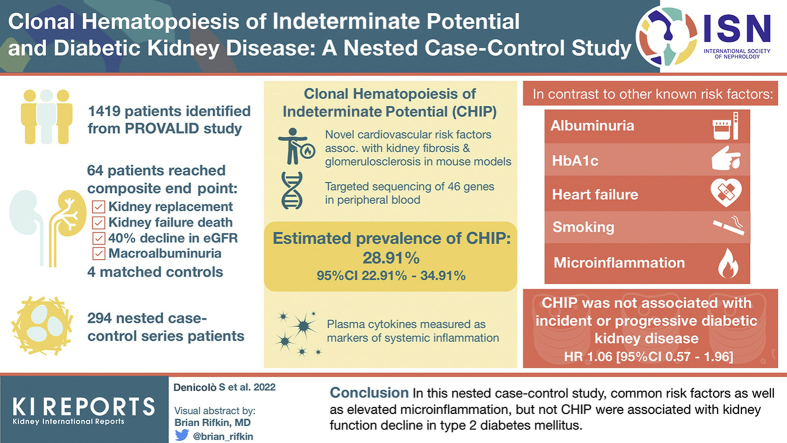
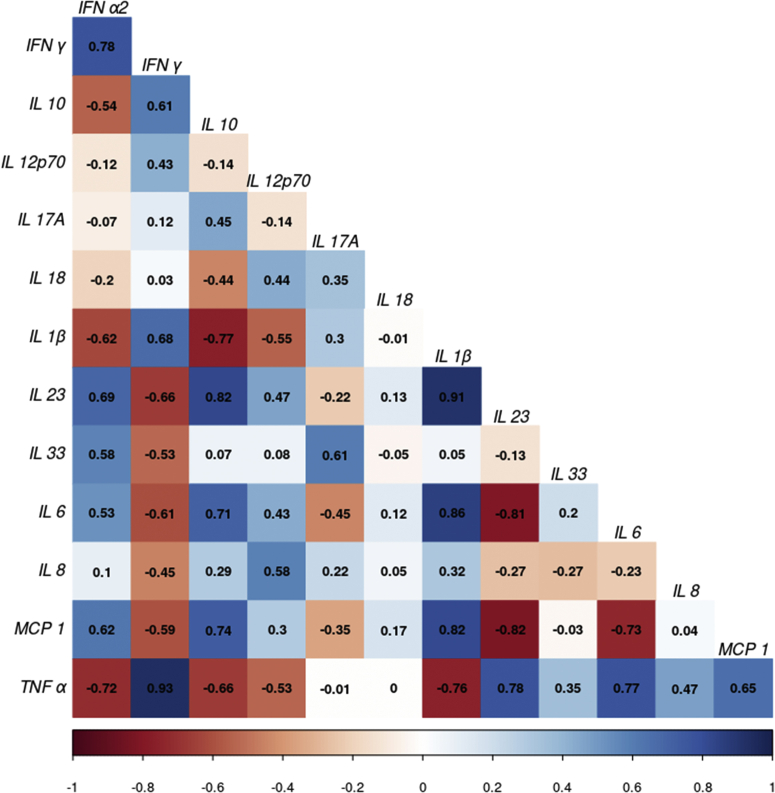
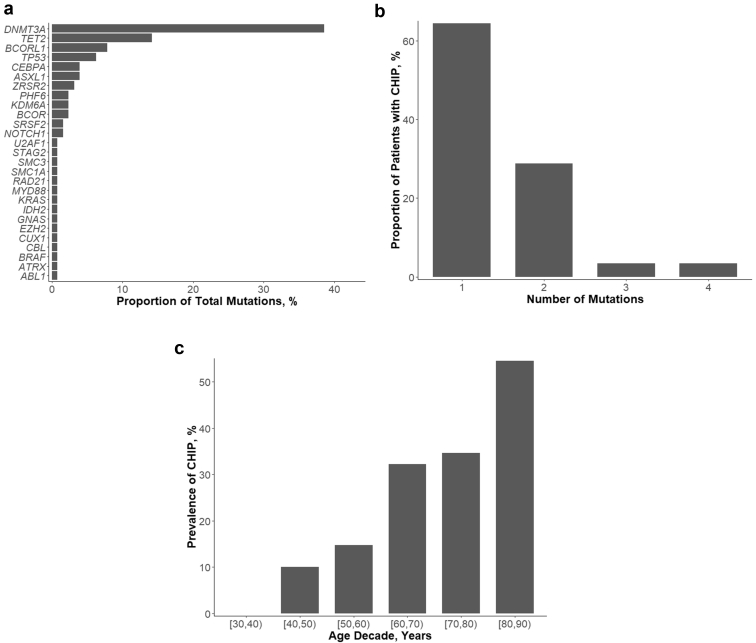
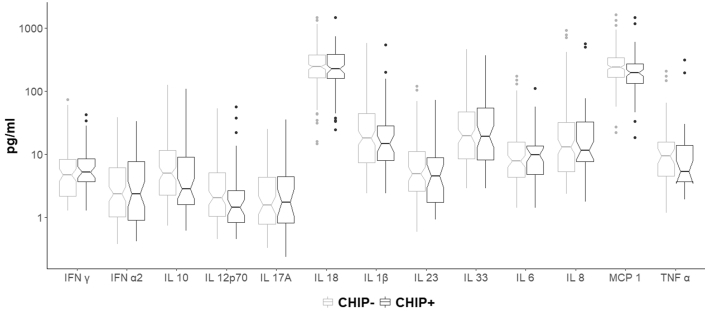
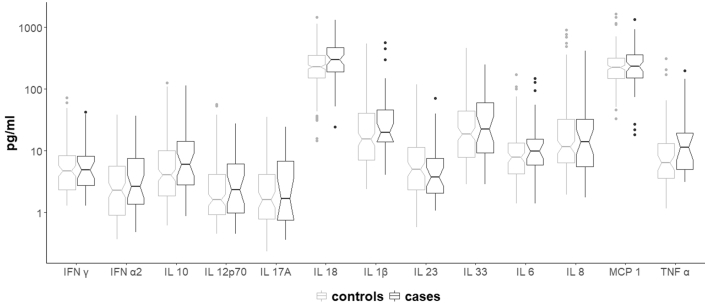
A total of 1419 eligible participants of the PROVALID Study were the basis for a nested case-control (NCC) design. A total of 64 participants who reached a prespecified composite endpoint within the observation period (initiation of kidney replacement therapy, death from kidney failure, sustained 40% decline in estimated glomerular filtration rate or sustained progression to macroalbuminuria) were identified and matched to 4 controls resulting in an NCC sample of 294 individuals. CHIP was assessed via targeted amplicon sequencing of 46 genes in peripheral blood. Furthermore, inflammatory cytokines were analyzed in plasma via a multiplex assay.
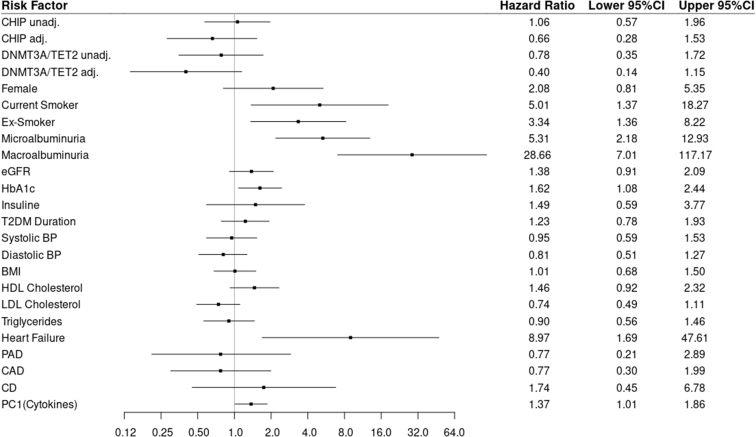
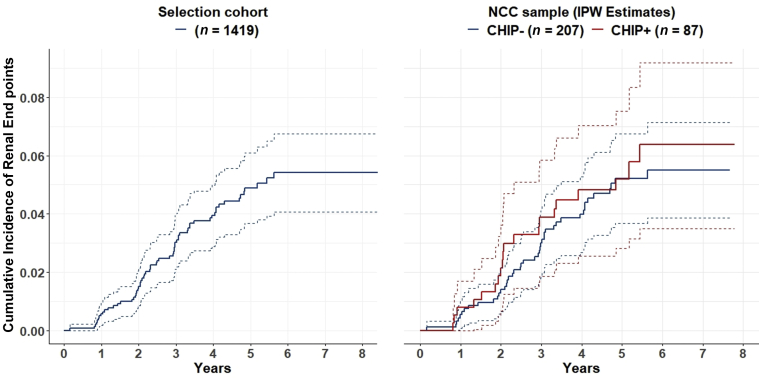
The estimated prevalence of CHIP was 28.91% (95% CI 22.91%-34.91%). In contrast to other known risk factors (albuminuria, hemoglobin A1c, heart failure, and smoking) and elevated microinflammation, CHIP was not associated with incident or progressive DKD (hazard ratio [HR] 1.06 [95% CI 0.57-1.96]).
In this NCC study, common risk factors as well as elevated microinflammation but not CHIP were associated with kidney function decline in type 2 diabetes mellitus.
糖尿病肾病(DKD)的疾病轨迹显示个体间存在高度变异性,传统风险因素无法充分解释这一现象。不确定潜能的克隆造血(CHIP)是一种新提出的心血管风险因素。在CHIP小鼠模型中,肾脏纤维化和肾小球硬化有所增加。在此,我们旨在分析CHIP是否会影响DKD的发病率或进展。
PROVALID研究的1419名符合条件的参与者是巢式病例对照(NCC)设计的基础。在观察期内达到预先设定的复合终点(开始肾脏替代治疗、死于肾衰竭、估计肾小球滤过率持续下降40%或持续进展为大量蛋白尿)的64名参与者被确定,并与4名对照进行匹配,从而得到一个包含294名个体的NCC样本。通过对外周血中46个基因进行靶向扩增测序来评估CHIP。此外,通过多重检测法分析血浆中的炎性细胞因子。
CHIP的估计患病率为28.91%(95%可信区间22.91%-34.91%)。与其他已知风险因素(蛋白尿、糖化血红蛋白、心力衰竭和吸烟)以及微炎症升高不同,CHIP与新发或进展性DKD无关(风险比[HR]为1.06[95%可信区间0.57-1.96])。
在这项NCC研究中,2型糖尿病患者的肾功能下降与常见风险因素以及微炎症升高有关,但与CHIP无关。