Subramanian Saraswathi, Srinivasan Sreenidhi, Ramaiyan Selvaraju Kathiravan, Vinoli Priyadharshini Michael, Selladurai Suganya, Ramasamy Boominathan, Kumaragurubaran Karthik, Bakker Douwe, Vordermeier Martin, Kapur Vivek, Gopal Dhinakar Raj
Translational Research Platform for Veterinary Biologicals, Centre for Animal Health Studies, Tamil Nadu Veterinary and Animal Sciences University, Chennai, India.
The Huck Institutes of the Life Sciences, The Pennsylvania State University, University Park, PA, United States.
Front Vet Sci. 2022 Apr 13;9:814227. doi: 10.3389/fvets.2022.814227. eCollection 2022.
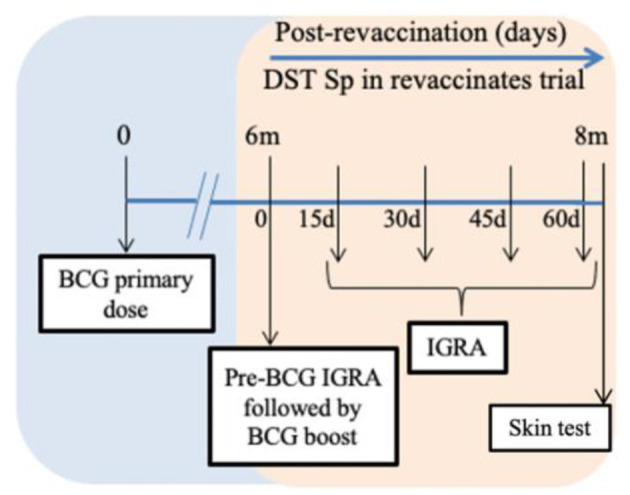
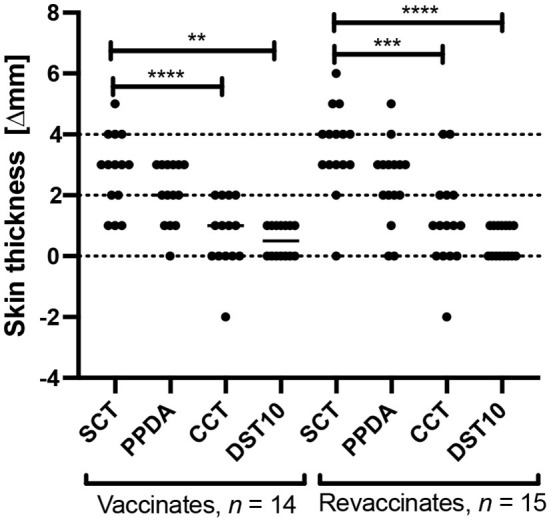
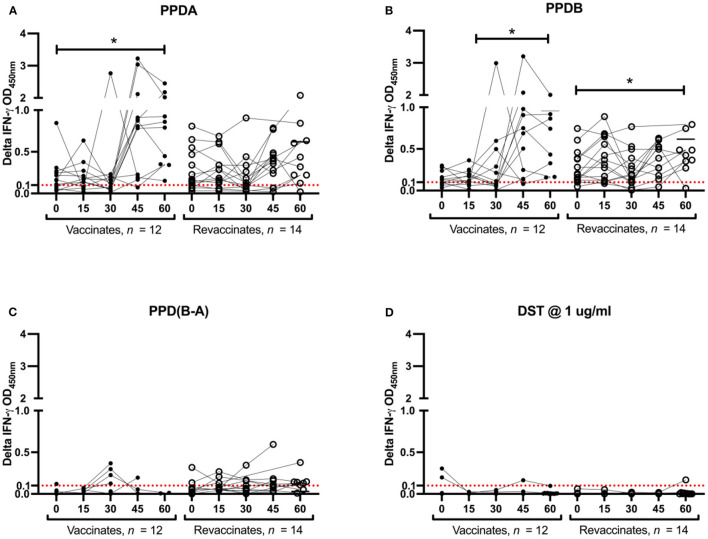
The Bacillus Calmette-Guérin (BCG) vaccination provides partial protection against, and reduces severity of pathological lesions associated with bovine tuberculosis (bTB) in cattle. Accumulating evidence also suggests that revaccination with BCG may be needed to enhance the duration of immune protection. Since BCG vaccine cross-reacts with traditional tuberculin-based diagnostic tests, a peptide-based defined antigen skin test (DST) comprising of ESAT-6, CFP-10, and Rv3615c to detect the infected among the BCG-vaccinated animals (DIVA) was recently described. The DST reliably identifies bTB-infected animals in experimental challenge models and in natural infection settings, and differentiated these from animals immunized with a single dose of BCG in both skin tests and interferon-gamma release assay (IGRA). The current investigation sought to assess the diagnostic specificity of DST in calves ( ssp. × . ssp. ; = 15) revaccinated with BCG 6 months after primary immunization. The results show that none of the 15 BCG-revaccinated calves exhibited a delayed hypersensitivity response when skin tested with DST 61 days post-revaccination, suggesting 100% diagnostic specificity (one-tailed lower 95% CI: 82). In contrast, 8 of 15 (diagnostic specificity = 47%; 95% CI: 21, 73) BCG-revaccinated calves were positive per the single cervical tuberculin (SCT) test using bovine tuberculin. Together, these results show that the DST retains its specificity even after revaccination with BCG and confirms the potential for implementation of BCG-based interventions in settings where test-and-slaughter are not economically or culturally feasible.
卡介苗(BCG)接种可为牛提供部分保护,并减轻与牛结核病(bTB)相关的病理损伤严重程度。越来越多的证据还表明,可能需要再次接种卡介苗以延长免疫保护期。由于卡介苗与传统的基于结核菌素的诊断测试存在交叉反应,最近描述了一种基于肽的确定抗原皮肤试验(DST),该试验由ESAT-6、CFP-10和Rv3615c组成,用于检测卡介苗接种动物中的感染情况(鉴别感染动物)。在实验性攻毒模型和自然感染环境中,DST能够可靠地识别出感染bTB的动物,并通过皮肤试验和干扰素-γ释放试验(IGRA)将这些动物与单剂量接种卡介苗的动物区分开来。当前的研究旨在评估在初次免疫6个月后再次接种卡介苗的犊牛(种×种;=15)中DST的诊断特异性。结果显示,15头再次接种卡介苗的犊牛在再次接种后61天用DST进行皮肤试验时,均未表现出迟发型超敏反应,提示诊断特异性为100%(单尾下限95%CI:82)。相比之下,15头再次接种卡介苗的犊牛中有8头(诊断特异性=47%;95%CI:21,73)使用牛结核菌素进行单颈结核菌素(SCT)试验呈阳性。总之,这些结果表明,即使再次接种卡介苗,DST仍保持其特异性,并证实了在检测和扑杀在经济或文化上不可行的情况下实施基于卡介苗的干预措施的潜力。