Institut Pasteurgrid.428999.7, Université Paris Cité, CNRS, Mycologie Moléculaire, Centre National de Référence Mycoses Invasives et Antifongiques, UMR 2000, Paris, France.
Laboratoire de Parasitologie-Mycologie, Hôpital Saint Louis, Assistance Publique-Hôpitaux De Paris (AP-HP), Paris, France.
mBio. 2022 Jun 28;13(3):e0092022. doi: 10.1128/mbio.00920-22. Epub 2022 May 2.
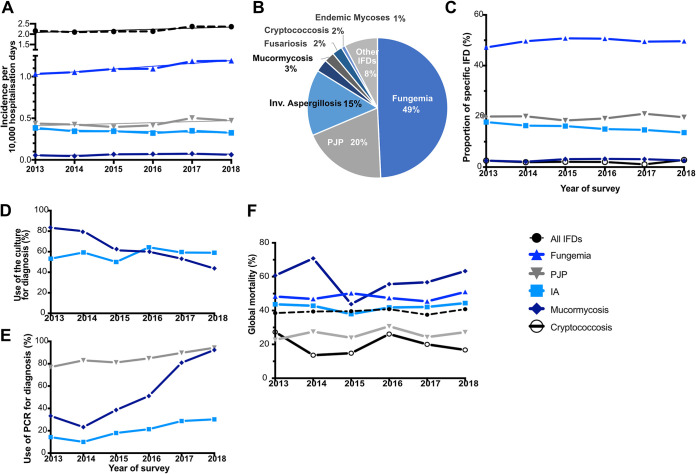
The French National Reference Center for Invasive Mycoses and Antifungals leads an active and sustained nationwide surveillance program on probable and proven invasive fungal diseases (IFDs) to determine their epidemiology in France. Between 2012 and 2018, a total of 10,886 IFDs were recorded. The incidence increased slightly over time (2.16 to 2.36/10,000 hospitalization days, = 0.0562) in relation with an increase of fungemia incidence (1.03 to 1.19/10,000, = 0.0023), while that of other IFDs remained stable. The proportion of ≥65-year-old patients increased from 38.4% to 45.3% ( < 0.0001). Yeast fungemia ( = 5,444) was due mainly to Candida albicans (55.6%) with stable proportions of species over time. Echinocandins became the main drug prescribed (46.7% to 61.8%), but global mortality rate remained unchanged (36.3% at 1 month). Pneumocystis jirovecii pneumonia ( = 2,106) was diagnosed mostly in HIV-negative patients (80.7%) with a significantly higher mortality than in HIV-positive patients (21.9% versus 5.4% at 1 month, < 0.0001). Invasive aspergillosis ( = 1,661) and mucormycosis ( = 314) were diagnosed mostly in hematology (>60% of the cases) with a global mortality rate of 42.5% and 59.3%, respectively, at 3 months and significant changes in diagnosis procedure over time. More concurrent infections were also diagnosed over time (from 5.4% to 9.4% for mold IFDs, = 0.0115). In conclusion, we observed an aging of patients with IFD with a significant increase in incidence only for yeast fungemia, a trend toward more concurrent infections, which raises diagnostic and therapeutic issues. Overall, global survival associated with IFDs has not improved despite updated guidelines and new diagnostic tools. The epidemiology of invasive fungal diseases (IFDs) is hard to delineate given the difficulties in ascertaining the diagnosis that is often based on the confrontation of clinical and microbiological criteria. The present report underlines the interest of active surveillance involving mycologists and clinicians to describe the global incidence and that of the main IFDs. Globally, although the incidence of Pneumocystis pneumonia, invasive aspergillosis, and mucormycosis remained stable over the study period (2012 to 2018), that of yeast fungemia increased slightly. We also show here that IFDs seem to affect older people more frequently. The most worrisome observation is the lack of improvement in the global survival rate associated with IFDs despite the increasing use of more sensitive diagnostic tools, the availability of new antifungal drugs very active in clinical trials, and a still low/marginal rate of acquired resistance in France. Therefore, other tracks of improvement should be investigated actively.
法国国家侵袭性真菌病和抗真菌药物参考中心开展了一项积极且持续的全国性侵袭性真菌病(IFD)监测计划,以确定法国的流行病学情况。在 2012 年至 2018 年间,共记录了 10886 例 IFD。发病率随着真菌血症发病率的增加而略有上升(从 2.16 增加到 2.36/10000 住院日,=0.0562),而其他 IFD 的发病率保持稳定。≥65 岁患者的比例从 38.4%增加到 45.3%(<0.0001)。酵母血症(=5444)主要由白色念珠菌引起(55.6%),随着时间的推移,物种比例保持稳定。棘白菌素类药物成为主要的处方药物(46.7%至 61.8%),但全球死亡率保持不变(1 个月时为 36.3%)。卡氏肺孢子菌肺炎(=2106)主要诊断于 HIV 阴性患者(80.7%),死亡率明显高于 HIV 阳性患者(1 个月时为 21.9%和 5.4%,<0.0001)。侵袭性曲霉病(=1661)和毛霉病(=314)主要在血液科诊断(>60%的病例),3 个月时的总体死亡率分别为 42.5%和 59.3%,且诊断程序随时间发生了显著变化。同时也诊断出更多的合并感染(从 mold IFDs 的 5.4%增加到 9.4%,=0.0115)。总之,我们观察到 IFD 患者的老龄化,酵母血症的发病率显著增加,同时合并感染的趋势也有所增加,这提出了诊断和治疗方面的问题。尽管有更新的指南和新的诊断工具,但总体而言,IFD 患者的全球生存率并没有提高。侵袭性真菌病(IFD)的流行病学很难确定,因为确定诊断存在困难,通常基于临床和微生物学标准的对照。本报告强调了涉及真菌学家和临床医生的主动监测的重要性,以描述全球发病率和主要 IFD 的发病率。总体而言,尽管卡氏肺孢子菌肺炎、侵袭性曲霉病和毛霉病的发病率在研究期间(2012 年至 2018 年)保持稳定,但酵母血症的发病率略有上升。我们还在这里表明,IFD 似乎更常影响老年人。最令人担忧的观察结果是,尽管越来越多地使用更敏感的诊断工具、临床试验中非常有效的新型抗真菌药物以及法国抗真菌药物获得性耐药率仍然较低/边缘,与 IFD 相关的全球生存率仍未见改善。因此,应该积极探索其他改进途径。