School of Public Health, University of Texas Health Science Center, Dallas Campus, Dallas, TX, USA.
Center for Pediatric Population Health, UTHealth School of Public Health, Dallas, TX, USA.
Obes Surg. 2022 Jul;32(7):2289-2298. doi: 10.1007/s11695-022-06077-x. Epub 2022 May 2.
Metabolic and bariatric surgery (MBS) is a safe and effective treatment option for severe obesity. The utilization and health and safety outcomes of MBS in the United States (US) during the COVID-19 pandemic versus 2015-2019 among adolescent and adult populations and by ethnic group is largely unknown.
The 2015-2020 Metabolic and Bariatric Surgery Accreditation and Quality Improvement Program (MBSAQIP) longitudinal (30-day) cohort data was used to compare adolescent and adult (N = 1,134,522) post-operative outcomes and to calculate MBS utilization pre-pandemic (2015-2019) versus pandemic (2020). Cochran-Armitage trend tests compared MBS utilization and safety outcomes over time from 2015 to 2020. Logistic regression analysis compared the odds of hospital readmission and MBS completion pre-pandemic versus pandemic by key characteristics.
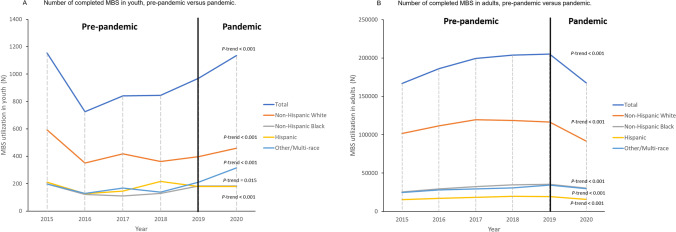
MBS utilization increased by 8.1% among youth (from 970 to 1140 procedures) and decreased by 10.2% among adults (from 205,232 to 167,384) from 2019 to 2020, respectively. MBS increased by 18.5% during the pandemic for youth who identified as other/multiracial (P trend < 0.001). Among US youth, the number of reoperations and reinterventions significantly decreased over the 6-year time frame (P trend < .001). Among US adults, 30-day post MBS mortality, reoperations, readmissions, and reinterventions all showed a significant decrease over time (P trend < .001) while septic shock and sepsis increased from pre-pandemic to the first year of the pandemic (P trend < 0.001).
In comparison to 2019 (or to previous years), US MBS utilization increased for youth but decreased for adults during the first year of the COVID-19 pandemic. Safety outcomes were comparable to those of the pre-pandemic years.
代谢和减重手术(MBS)是治疗严重肥胖症的安全有效方法。在 COVID-19 大流行期间,美国(US)青少年和成年人中 MBS 的利用情况以及健康和安全结果,以及不同种族群体之间的利用情况,在很大程度上是未知的。
使用 2015-2020 年代谢和减重手术认证和质量改进计划(MBSAQIP)的纵向(30 天)队列数据,比较青少年和成年人(N=1,134,522)术后结果,并计算大流行前(2015-2019 年)与大流行期间(2020 年)的 MBS 利用率。Cochran-Armitage 趋势检验比较了 2015 年至 2020 年期间 MBS 利用率和安全结果随时间的变化。逻辑回归分析比较了大流行前与大流行期间(按关键特征)的住院再入院和 MBS 完成的几率。
从 2019 年到 2020 年,青少年 MBS 的利用率分别增加了 8.1%(从 970 例增加到 1140 例),成年人的利用率则下降了 10.2%(从 205,232 例减少到 167,384 例)。从 2019 年到 2020 年,自我认同为其他/多种族的青少年 MBS 的利用率增加了 18.5%(趋势 P < 0.001)。在美国青少年中,6 年内再手术和再干预的数量显著减少(趋势 P < 0.001)。在美国成年人中,30 天 MBS 死亡率、再手术、再入院和再干预均随时间显著下降(趋势 P < 0.001),而脓毒性休克和败血症则从大流行前增加到大流行的第一年(趋势 P < 0.001)。
与 2019 年(或前几年)相比,COVID-19 大流行第一年,美国青少年的 MBS 利用率增加,而成年人的利用率则下降。安全结果与大流行前年份相当。