Universidade Federal de Minas Gerais (UFMG), Belo Horizonte, MG, Brazil.
Universidade Federal de Minas Gerais (UFMG), Belo Horizonte, MG, Brazil.
Braz J Infect Dis. 2022 May-Jun;26(3):102352. doi: 10.1016/j.bjid.2022.102352. Epub 2022 Apr 27.
COVID-19 has been associated with persistent symptoms and functional changes, especially in those surviving severe disease.
We conducted a prospective multicenter study in patients with severe COVID-19 to determine respiratory sequelae. Patients were stratified into two groups: ward admission (WA) and intensive care unit (ICU) admission. In each follow-up visit, the patients where inquired about cough and dyspnea, and performed spirometry, lung volumes, carbon monoxide diffusion capacity (DLCO), 6-minute walk test (6MWT), and respiratory muscle strength (MIP and MEP). Results of pulmonary function tests at 45 days and 6 months after hospital admission were compared using paired analysis.
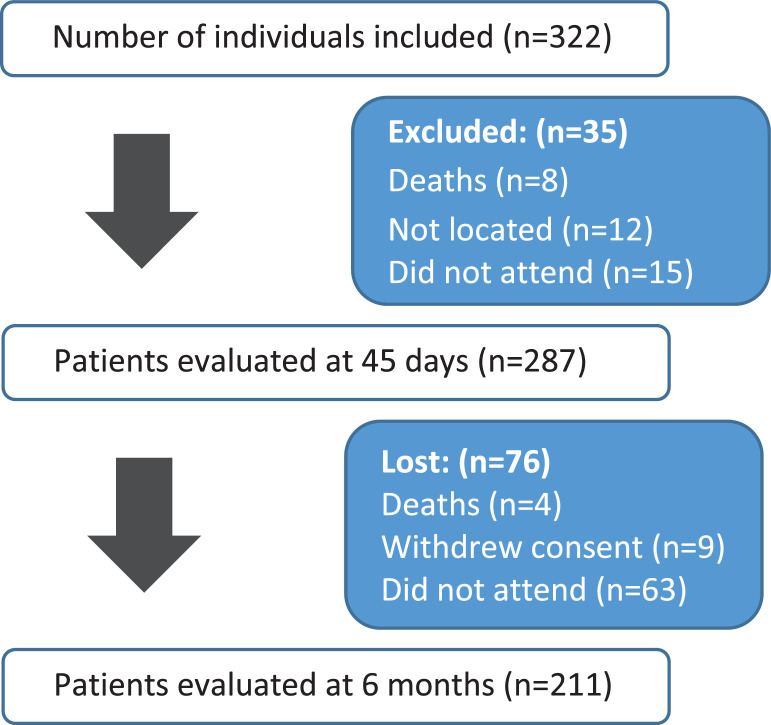
211 patients were included, 112 in WA and 99 in ICU. Dyspnea persisted in 64.7% in the WA and 66.7% in the ICU group after 6 months. Lung function measures showed significant improvement between 45 days and 6 months, both in WA and ICU groups in VC, FVC, FEV1, total lung capacity, and 6MW distance measures. The improvement in the proportions of the altered functional parameters was significant in the ICU group for VC (44.2% 45 d; 20.8% 6 m; p = 0,014), FVC (47.6% 45 d; 28% 6 m; p = 0,003), FEV1 (45.1% 45 d; 28% 6 m; p = 0,044), DLCO (33.8% 45 d; 7.7% 6 m; p < 0,0001).
Six months follow-up of patients with the severe forms of COVID-19 showed significant improvement in the lung function measures compared to 45 days post hospital discharge. The difference was more evident in those requiring ICU admission.
COVID-19 与持续存在的症状和功能变化有关,特别是在那些患有严重疾病的幸存者中。
我们对患有严重 COVID-19 的患者进行了一项前瞻性多中心研究,以确定呼吸后遗症。患者分为两组:病房入院(WA)和重症监护病房(ICU)入院。在每次随访中,患者都会询问咳嗽和呼吸困难的情况,并进行肺活量计检查、肺容积、一氧化碳扩散能力(DLCO)、6 分钟步行试验(6MWT)和呼吸肌肉力量(MIP 和 MEP)。使用配对分析比较入院后 45 天和 6 个月时的肺功能测试结果。
共纳入 211 例患者,WA 组 112 例,ICU 组 99 例。WA 组和 ICU 组在 6 个月后分别有 64.7%和 66.7%的患者仍有呼吸困难。WA 组和 ICU 组的肺活量计、FVC、FEV1、总肺容量和 6MW 距离测量值在 45 天和 6 个月之间均有显著改善。在 ICU 组中,VC(44.2% 45 d;20.8% 6 m;p = 0.014)、FVC(47.6% 45 d;28% 6 m;p = 0.003)、FEV1(45.1% 45 d;28% 6 m;p = 0.044)和 DLCO(33.8% 45 d;7.7% 6 m;p < 0.0001)的功能参数改变比例显著改善。
与出院后 45 天相比,COVID-19 严重患者的肺功能测量在 6 个月随访时显著改善。在需要 ICU 入院的患者中,差异更为明显。