Osakidetza Basque Health Service, Research Unit, Galdakao-Usansolo University Hospital, Barrio Labeaga S/N, 48960, Galdakao, Vizcaya, Spain.
Kronikgune Institute for Health Services Research, Barakaldo, Spain.
Sci Rep. 2022 May 2;12(1):7097. doi: 10.1038/s41598-022-09771-z.
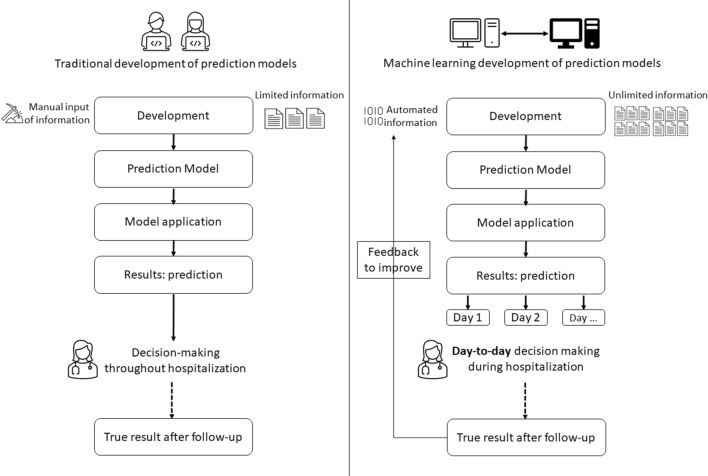
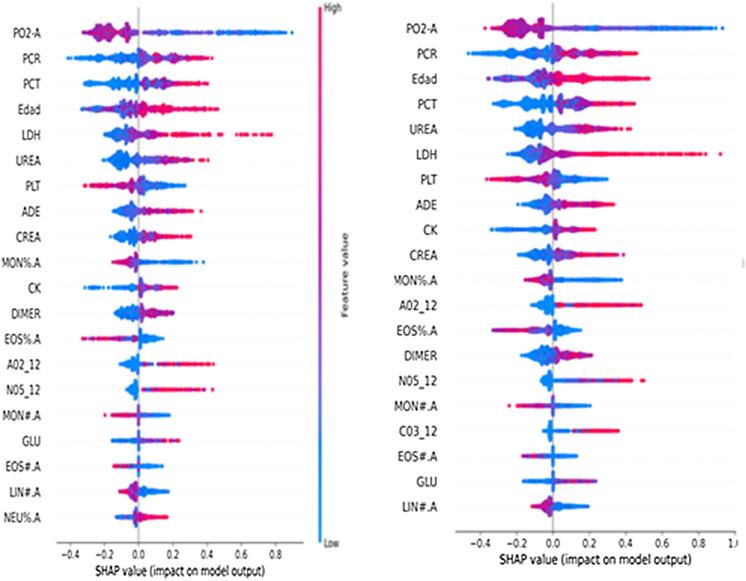
Despite the publication of great number of tools to aid decisions in COVID-19 patients, there is a lack of good instruments to predict clinical deterioration. COVID19-Osakidetza is a prospective cohort study recruiting COVID-19 patients. We collected information from baseline to discharge on: sociodemographic characteristics, comorbidities and associated medications, vital signs, treatment received and lab test results. Outcome was need for intensive ventilatory support (with at least standard high-flow oxygen face mask with a reservoir bag for at least 6 h and need for more intensive therapy afterwards or Optiflow high-flow nasal cannula or noninvasive or invasive mechanical ventilation) and/or admission to a critical care unit and/or death during hospitalization. We developed a Catboost model summarizing the findings using Shapley Additive Explanations. Performance of the model was assessed using area under the receiver operating characteristic and prediction recall curves (AUROC and AUPRC respectively) and calibrated using the Hosmer-Lemeshow test. Overall, 1568 patients were included in the derivation cohort and 956 in the (external) validation cohort. The percentages of patients who reached the composite endpoint were 23.3% vs 20% respectively. The strongest predictors of clinical deterioration were arterial blood oxygen pressure, followed by age, levels of several markers of inflammation (procalcitonin, LDH, CRP) and alterations in blood count and coagulation. Some medications, namely, ATC AO2 (antiacids) and N05 (neuroleptics) were also among the group of main predictors, together with C03 (diuretics). In the validation set, the CatBoost AUROC was 0.79, AUPRC 0.21 and Hosmer-Lemeshow test statistic 0.36. We present a machine learning-based prediction model with excellent performance properties to implement in EHRs. Our main goal was to predict progression to a score of 5 or higher on the WHO Clinical Progression Scale before patients required mechanical ventilation. Future steps are to externally validate the model in other settings and in a cohort from a different period and to apply the algorithm in clinical practice.Registration: ClinicalTrials.gov Identifier: NCT04463706.
尽管已经有大量工具可以帮助 COVID-19 患者做出决策,但仍缺乏预测临床恶化的良好工具。COVID19-Osakidetza 是一项前瞻性队列研究,招募 COVID-19 患者。我们从基线到出院收集信息:社会人口统计学特征、合并症和相关药物、生命体征、治疗方法和实验室检查结果。结局是需要强化通气支持(至少使用标准高流量面罩加储氧袋 6 小时以上,随后需要更强化的治疗或 Optiflow 高流量鼻导管、无创或有创机械通气)和/或入住重症监护病房和/或住院期间死亡。我们使用 Shapley Additive Explanations 汇总了发现,开发了一个 Catboost 模型。使用接收器操作特征曲线下面积和预测召回曲线(分别为 AUROC 和 AUPRC)评估模型性能,并使用 Hosmer-Lemeshow 检验进行校准。总体而言,1568 例患者纳入推导队列,956 例患者纳入(外部)验证队列。复合终点的患者比例分别为 23.3%和 20%。临床恶化的最强预测因素是动脉血氧分压,其次是年龄、几种炎症标志物(降钙素原、LDH、CRP)水平以及血液计数和凝血变化。一些药物,即 ATC AO2(抗酸剂)和 N05(神经阻滞剂)以及 C03(利尿剂)也属于主要预测因素之一。在验证集中,Catboost AUROC 为 0.79,AUPRC 为 0.21,Hosmer-Lemeshow 检验统计量为 0.36。我们提出了一种基于机器学习的预测模型,具有出色的性能特征,可以在电子健康记录中实施。我们的主要目标是在患者需要机械通气之前预测其 WHO 临床进展量表评分达到 5 分或更高。未来的步骤是在其他环境中和不同时期的队列中对模型进行外部验证,并将算法应用于临床实践。注册:ClinicalTrials.gov 标识符:NCT04463706。