Department of Neurology, Donders Institute for Brain, Cognition, and Behaviour, Radboud University Medical Center, Nijmegen, the Netherlands.
Department for Health Evidence, Biostatistics Section, Radboud University Medical Center, Nijmegen, the Netherlands.
Neurotherapeutics. 2022 Jul;19(4):1259-1272. doi: 10.1007/s13311-022-01231-w. Epub 2022 May 2.
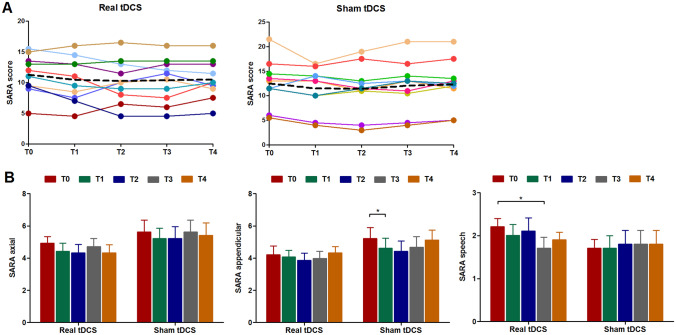
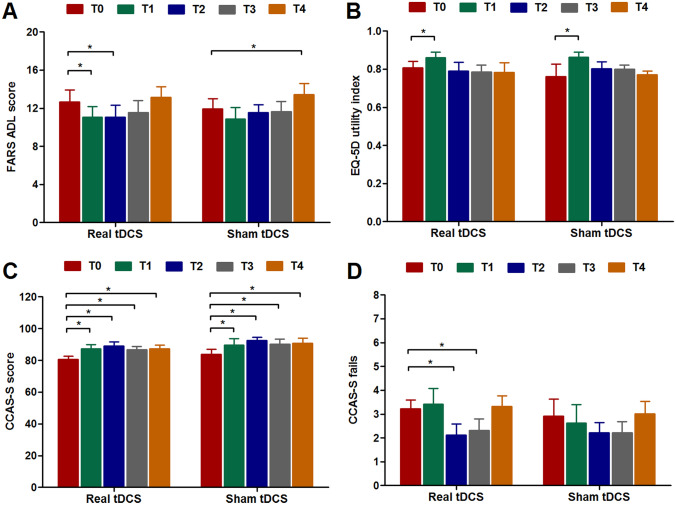
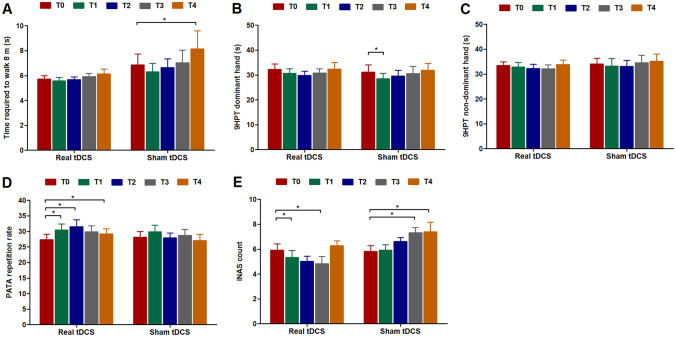
Repeated sessions of cerebellar anodal transcranial direct current stimulation (tDCS) have been suggested to modulate cerebellar-motor cortex (M1) connectivity and decrease ataxia severity. However, therapeutic trials involving etiologically homogeneous groups of ataxia patients are lacking. The objective of this study was to investigate if a two-week regimen of daily cerebellar tDCS sessions diminishes ataxia and non-motor symptom severity and alters cerebellar-M1 connectivity in individuals with spinocerebellar ataxia type 3 (SCA3). We conducted a randomized, double-blind, sham-controlled trial in which twenty mildly to moderately affected SCA3 patients received ten sessions of real or sham cerebellar tDCS (i.e., five days per week for two consecutive weeks). Effects were evaluated after two weeks, three months, six months, and twelve months. Change in Scale for the Assessment and Rating of Ataxia (SARA) score after two weeks was defined as the primary endpoint. Static posturography, SCA Functional Index tests, various patient-reported outcome measures, the cerebellar cognitive affective syndrome scale, and paired-pulse transcranial magnetic stimulation to examine cerebellar brain inhibition (CBI) served as secondary endpoints. Absolute change in SARA score did not differ between both trial arms at any of the time points. We observed significant short-term improvements in several motor, cognitive, and patient-reported outcomes after the last stimulation session in both groups but no treatment effects in favor of real tDCS. Nonetheless, some of the patients in the intervention arm showed a sustained reduction in SARA score lasting six or even twelve months, indicating interindividual variability in treatment response. CBI, which reflects the functional integrity of the cerebellothalamocortical tract, remained unchanged after ten tDCS sessions. Albeit exploratory, there was some indication for between-group differences in SARA speech score after six and twelve months and in the number of extracerebellar signs after three and six months. Taken together, our study does not provide evidence that a two-week treatment with daily cerebellar tDCS sessions reduces ataxia severity or restores cerebellar-M1 connectivity in early-to-middle-stage SCA3 patients at the group level. In order to potentially increase therapeutic efficacy, further research is warranted to identify individual predictors of symptomatic improvement.
小脑阳极经颅直流电刺激(tDCS)的重复疗程已被证明可以调节小脑-运动皮层(M1)的连接,并降低共济失调的严重程度。然而,缺乏涉及共济失调患者病因同质组的治疗试验。本研究的目的是调查为期两周的每日小脑 tDCS 疗程是否可以减轻 3 型脊髓小脑性共济失调(SCA3)患者的共济失调和非运动症状严重程度,并改变小脑-M1 的连接。我们进行了一项随机、双盲、假对照试验,其中 20 名轻度至中度 SCA3 患者接受了 10 次真实或假小脑 tDCS 治疗(即每周 5 天,连续 2 周)。在两周、三个月、六个月和十二个月后评估效果。两周后 SARA 评分的变化定义为主要终点。静态姿势描记术、SCA 功能指数测试、各种患者报告的结果测量、小脑认知情感综合征量表和成对脉冲经颅磁刺激检查小脑脑抑制(CBI)作为次要终点。在任何时间点,两个试验组之间的 SARA 评分绝对变化均无差异。我们观察到两组在最后一次刺激后几个运动、认知和患者报告的结果都有显著的短期改善,但真实 tDCS 没有治疗效果。尽管如此,干预组中的一些患者的 SARA 评分持续降低,持续 6 个月甚至 12 个月,表明治疗反应存在个体差异。CBI 反映了小脑-丘脑-皮质束的功能完整性,在 10 次 tDCS 后保持不变。虽然是探索性的,但在 6 个月和 12 个月时 SARA 言语评分以及在 3 个月和 6 个月时小脑外体征数量方面存在组间差异的一些迹象。总之,我们的研究没有提供证据表明,在早期至中期 SCA3 患者中,为期两周的每日小脑 tDCS 治疗可以降低共济失调的严重程度或恢复小脑-M1 的连接。为了提高治疗效果,有必要进一步研究以确定症状改善的个体预测因素。