Department of Ophthalmology, Osaka University Graduate School of Medicine, Rm. E7, 2-2 Yamadaoka, Suita, Osaka, 565-0871, Japan.
Integrated Frontier Research for Medical Science Division, Institute for Open and Transdisciplinary Research Initiatives, Osaka University, Suita, Osaka, Japan.
BMC Ophthalmol. 2022 May 2;22(1):198. doi: 10.1186/s12886-022-02420-z.
This study aimed to evaluate macular vessel tortuosity using optical coherence tomography angiography (OCTA) and its association with visual outcomes in eyes undergoing surgery for epiretinal membrane (ERM).
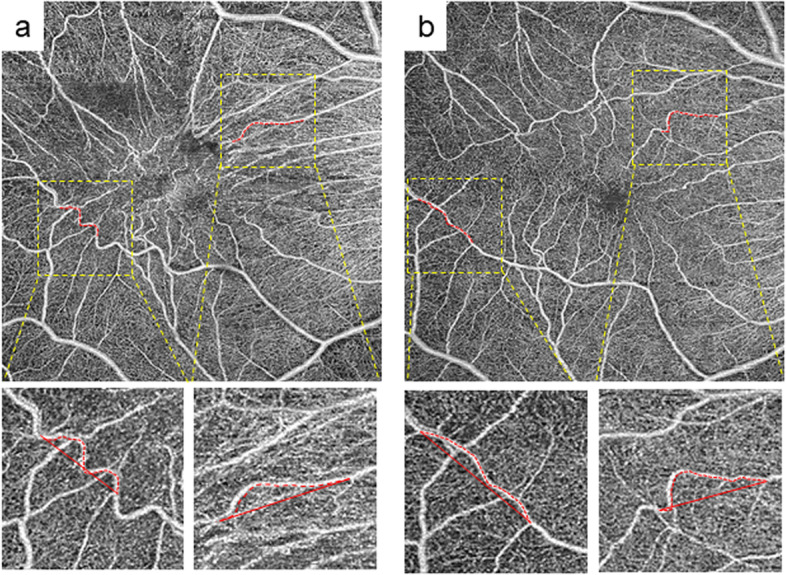
The study included 22 consecutive patients who underwent vitrectomy for ERM between May 2019 and July 2020 and OCTA at Osaka University Hospital. All patients underwent ophthalmologic examinations, including swept-source OCTA. Standard vitrectomy was performed, and the patients were followed up for 6 months postoperatively. Distortion of retinal vessels was calculated using two parameters: the actual vessel length in the vessel section (VL) and the direct vessel branching point distance (BD) in the three quadrants (nasal, temporal, and superior-inferior) of the macula. We analyzed the correlation between these parameters and visual outcomes.
Significantly longer VL was found at 1, 3, and 6 months postoperatively (p = 0.006, 0.008, and 0.022, respectively) in the temporal quadrant compared to baseline temporal VL. Significantly shorter VL was found in nasal quadrants at 1 and 3 months (p = 0.046 and p = 0.018) in the comparison of nasal baseline VL. VL/BDs were correlated with the same postoperative best-corrected visual acuity (BCVA) at 1, 3, and 6 months (p = 0.035, 0.035, and 0.042, respectively) in the superior-inferior quadrant. A significant association of changes in VL and BCVA was found at 3 and 6 months postoperatively in the nasal quadrant (p = 0.018 and 0.0455, respectively).
Changes in vascular distortion after ERM surgery can be measured using OCTA. The change in vessels around the macula became more linear; this was associated with visual outcomes after surgery.
本研究旨在通过光学相干断层扫描血管造影术(OCTA)评估黄斑血管迂曲,并评估其与接受外膜切除术(ERM)的眼的视力结果之间的关系。
该研究纳入了 2019 年 5 月至 2020 年 7 月期间在大阪大学医院接受 ERM 玻璃体切除术的 22 例连续患者,并进行了 OCTA 检查。所有患者均接受了眼科检查,包括扫频 OCTA。标准玻璃体切除术,术后随访 6 个月。使用两个参数计算视网膜血管扭曲:血管节段的实际血管长度(VL)和黄斑三个象限(鼻侧、颞侧和上下侧)中直接血管分支点的距离(BD)。我们分析了这些参数与视力结果之间的相关性。
与基线颞侧 VL 相比,术后 1、3 和 6 个月(p=0.006、0.008 和 0.022)颞侧 VL 明显延长。与鼻侧基线 VL 相比,术后 1 和 3 个月(p=0.046 和 p=0.018)鼻侧 VL 明显缩短。VL/BDs 与术后 1、3 和 6 个月的最佳矫正视力(BCVA)呈正相关(p=0.035、0.035 和 0.042),上-下象限。术后 3 个月和 6 个月,鼻侧 VL 和 BCVA 的变化有显著相关性(p=0.018 和 0.0455)。
ERM 手术后血管扭曲的变化可以通过 OCTA 测量。黄斑周围血管的变化变得更加线性;这与手术后的视力结果相关。