Savastano Maria Cristina, Vagni Marica, Carlà Matteo Mario, Tran Huong Elena, Fossataro Claudia, Cestrone Valentina, Boselli Francesco, Giannuzzi Federico, Marcelli Sofia, Biagini Ilaria, Boldrini Luca, Rizzo Stanislao
Ophthalmology Department, "Fondazione Policlinico Universitario A. Gemelli, IRCCS," Rome, Italy.
Catholic University "Sacro Cuore," Rome, Italy.
Ophthalmol Sci. 2025 Jan 21;5(3):100716. doi: 10.1016/j.xops.2025.100716. eCollection 2025 May-Jun.
To explore the correlation between radiomics features extracted from OCT angiography (OCTA) of epiretinal membranes (ERMs) and baseline best-corrected visual acuity (BCVA).
Retrospective observational monocentric study.
Eighty-three eyes affected by idiopathic ERMs, categorized into low (≤70 letters) and high (70 letters) BCVA groups.
The central 3 × 3 mm crop of structural and vascular en-face OCTA scans of superficial and deep retina slab, and choriocapillaris of each eye was selected. PyRadiomics was used to extract 86 features belonging to 2 different families: intensity-based statistical features describing the gray-level distribution, and textural features capturing the spatial arrangement of pixels. By employing a greedy strategy, 4 radiomic features were selected to build the final logistic regression model. The ability of the model to discriminate between low and high baseline BCVA was quantified in terms of area under the receiver operating characteristics curve (AUC).
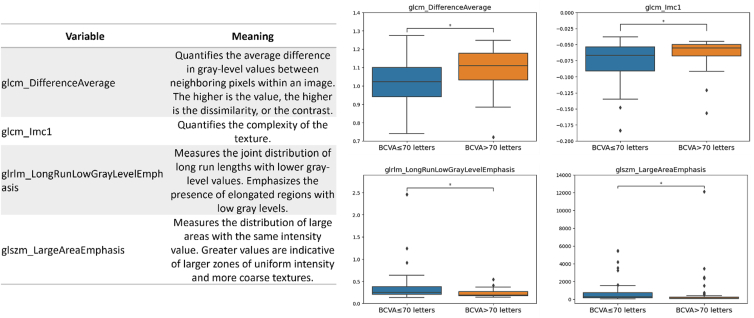
The 4 selected informative radiomic features were as follows: the difference average (glcm_DifferenceAverage), quantifying the average difference in gray-level between neighboring pixels; the informational measure of correlation (glcm_Imc1), giving information about the spatial correlation of pixel intensities inside the image; the long run low gray-level emphasis (glrlm_LongRunLowGrayLevelEmphasis), highlighting long segments of low gray-level values within the image; and the large area emphasis (glszm_LargeAreaEmphasis), which quantifies the tendency for larger zones of uniform intensity to occur.
No features exhibited a statistically significant difference between low and high BCVA values for the superficial and deep retinal slabs. Conversely, in the choriocapillaris layer, the glcm_DifferenceAverage and glcm_Imc1 features were significantly higher in the high BCVA group ( = 0.047), whereas higher values for the glrlm_LongRunLowGrayLevelEmphasis and glszm_LargeAreaEmphasis were associated with the low BCVA group ( = 0.047). Overall, these radiomic features predicted BCVA with an AUC (95% confidence interval) of 0.74 (0.63-0.85) and sensitivity/specificity of 0.67/0.75. During the cross-validation, the metrics remained stable.
Radiomics features of the choriocapillaris in idiopathic ERMs showed a correlation with BCVA, with lower structural complexity and higher homogeneity, together with the presence of homogeneous areas with low-intensity pixel values, reflecting flow voids due to reduced microvascular perfusion, and were correlated with lower visual acuity.
The author(s) have no proprietary or commercial interest in any materials discussed in this article.
探讨从视网膜前膜(ERM)的光学相干断层扫描血管造影(OCTA)中提取的影像组学特征与基线最佳矫正视力(BCVA)之间的相关性。
回顾性观察单中心研究。
83只患有特发性ERM的眼睛,分为低视力(≤70字母)和高视力(>70字母)BCVA组。
选取每只眼睛的浅层和深层视网膜平板以及脉络膜毛细血管层的结构和血管正面OCTA扫描的中央3×3mm区域。使用PyRadiomics提取属于2个不同类别的86个特征:基于强度的统计特征,描述灰度分布;纹理特征,捕捉像素的空间排列。采用贪心策略,选择4个影像组学特征来构建最终的逻辑回归模型。根据受试者工作特征曲线下面积(AUC)对模型区分低基线和高基线BCVA的能力进行量化。
选取的4个信息丰富的影像组学特征如下:差异平均值(glcm_DifferenceAverage),量化相邻像素之间灰度的平均差异;相关信息度量(glcm_Imc1),提供有关图像内像素强度空间相关性的信息;长期低灰度强调(glrlm_LongRunLowGrayLevelEmphasis),突出图像内低灰度值的长片段;大面积强调(glszm_LargeAreaEmphasis),量化出现均匀强度较大区域的趋势。
对于浅层和深层视网膜平板,低视力和高视力BCVA值之间没有特征表现出统计学上的显著差异。相反,在脉络膜毛细血管层,高BCVA组的glcm_DifferenceAverage和glcm_Imc1特征显著更高(P = 0.047),而glrlm_LongRunLowGrayLevelEmphasis和glszm_LargeAreaEmphasis的较高值与低BCVA组相关(P = 0.047)。总体而言,这些影像组学特征预测BCVA的AUC(95%置信区间)为0.74(0.63 - 0.85),敏感性/特异性为0.67/0.75。在交叉验证期间,这些指标保持稳定。
特发性ERM中脉络膜毛细血管的影像组学特征与BCVA相关,结构复杂性较低且同质性较高,同时存在低强度像素值的均匀区域,反映了由于微血管灌注减少导致的血流缺失,并且与较低的视力相关。
作者对本文中讨论的任何材料均无专有或商业利益。