Wang Ruining, Ye Baojuan, Wang Peiyi, Tang Chunyan, Yang Qiang
Center of Mental Health Education and Research, Preschool Education Research Center, School of Psychology, School of Education, Jiangxi Normal University, 99 Ziyang Avenue, Nanchang, 330022, China.
Department of Psychological Science, University of California, Irvine, 92617, 4201 Social and Behavioral Sciences Gateway, Irvine, CA, 92697-7085, USA.
J Eat Disord. 2022 May 1;10(1):59. doi: 10.1186/s40337-022-00584-z.
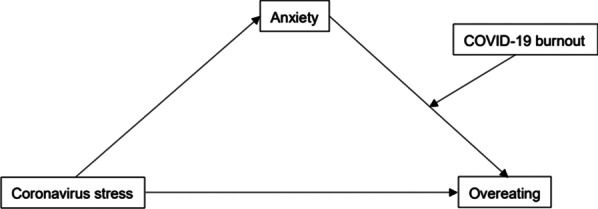
This study examined the role of anxiety and coronavirus disease 2019 (COVID-19) burnout in the relationship between coronavirus stress and overeating among Chinese college students during the COVID-19 pandemic.
Chinese college students (N = 2926; M = 19.90, SD = 1.47, range = 18-25 years old; 54.34% female) completed self-reported online questionnaires regarding coronavirus stress, anxiety, COVID-19 burnout, and overeating.
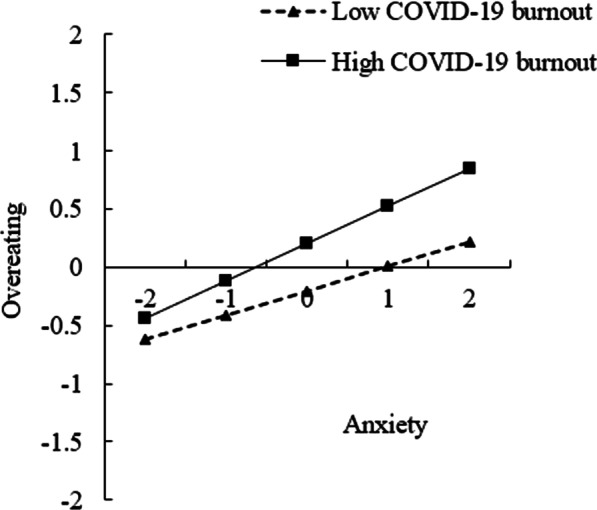
Anxiety showed partially indirect effect on the association between coronavirus stress and overeating. COVID-19 burnout exacerbated the indirect pathway between coronavirus stress and overeating via anxiety.
This is the first study, to our knowledge, that examines the underlying mechanisms of the coronavirus stress and overeating behavior association among Chinese college students. The results support several existing theories on stress and problematic eating behaviors and provide practical implications for prevention and intervention programs of overeating during the COVID-19 pandemic.
本研究探讨了在2019年冠状病毒病(COVID-19)大流行期间,焦虑和COVID-19倦怠在中国大学生的冠状病毒应激与暴饮暴食关系中所起的作用。
中国大学生(N = 2926;平均年龄M = 19.90,标准差SD = 1.47,年龄范围 = 18 - 25岁;54.34%为女性)完成了关于冠状病毒应激、焦虑、COVID-19倦怠和暴饮暴食的自填式在线问卷。
焦虑对冠状病毒应激与暴饮暴食之间的关联具有部分间接影响。COVID-19倦怠加剧了冠状病毒应激通过焦虑与暴饮暴食之间的间接路径。
据我们所知,这是第一项研究中国大学生冠状病毒应激与暴饮暴食行为关联潜在机制的研究。研究结果支持了一些关于应激和问题饮食行为的现有理论,并为COVID-19大流行期间暴饮暴食的预防和干预项目提供了实际意义。