Department of Urology, Shanghai Tenth People's Hospital, School of Medicine, Tongji University, Shanghai 200072, China.
Department of Special Medical, Shanghai Fourth People's Hospital, School of Medicine, Tongji University, Shanghai 200434, China.
Oxid Med Cell Longev. 2022 Apr 23;2022:8145173. doi: 10.1155/2022/8145173. eCollection 2022.
Mortality from noncancer causes in patients with prostate cancer (PCa) is unclear. This study assesses the causes and risks of noncancer death with each follow-up time period after PCa diagnosis.
Data from the Surveillance, Epidemiology, and End Results (SEER) program were analyzed for noncancer causes of death in PCa patients from 2000 to 2016. The standard mortality ratio (SMR) was calculated for noncancer mortality.
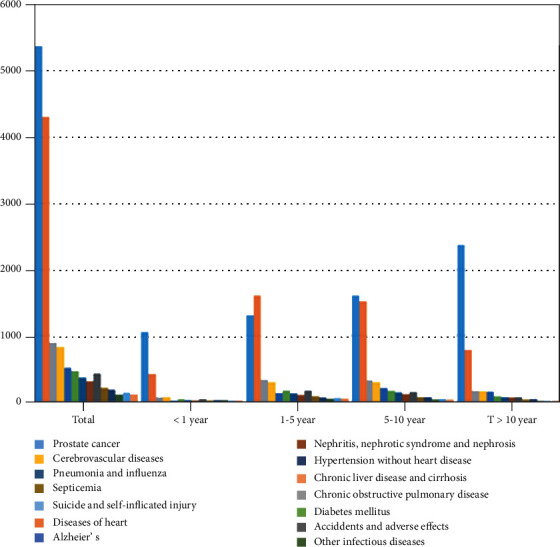
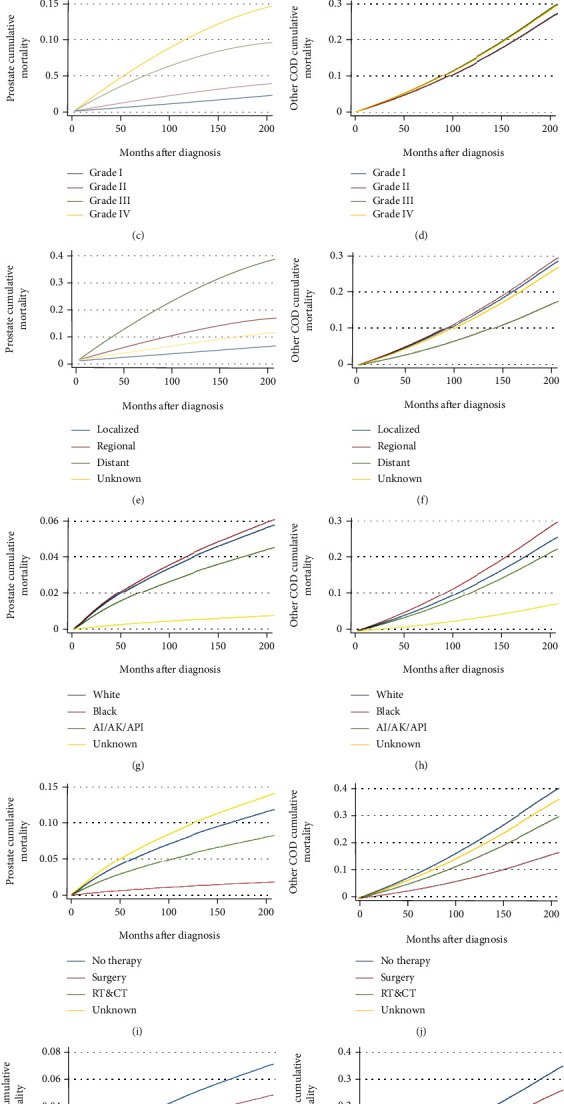
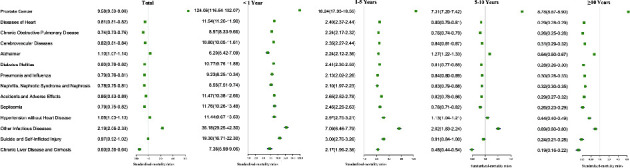
Altogether, 752,352 patients with PCa were identified, and 180,862 (24.0%) died during follow-up. The largest proportion of deaths from noncancer causes (36%) occurred within 5 to 10 years after diagnosis. The most common causes of noncancer death are cardiovascular and cerebrovascular diseases and chronic obstructive pulmonary disease (COPD). Compared with the general age-matched male population, patients with PCa had a higher risk of death from any noncancer cause within 5 years, in particular other infectious diseases and suicide and self-inflicted injury. However, the risk of death from noncancer causes of PCa for more than 5 years is lower, except for Alzheimer's disease and hypertension from 5 to 10 years after diagnosis. In addition, the risk of death from noncancer causes was influenced by treatment, ethnicity, and staging differences. In particular, compared with the general population, many noncancer causes of death have higher risk of death in patients with or without treatment within 1 to 5 years after diagnosis, whereas patients undergoing radical prostatectomy (RP) with or without radiotherapy (RT) or chemotherapy (CTx) are not at high risk of death from COPD, pneumonia and influenza, nephritis, nephrotic syndrome and nephrosis, septicemia, and atherosclerosis.
The risk of death from noncancer causes gradually decreased in all patients with PCa during each follow-up period after diagnosis In addition, the risk of dying from noncancer causes are influenced by differences in stage, ethnicity, and treatment. In particular, patients undergoing RP±RT/CTx and RT/CTx have a lower risk of death compared to the general population. These findings provide important implications for the healthcare management of patients with PCa.
前列腺癌(PCa)患者的非癌症死因尚不清楚。本研究评估了每个随访时间段后 PCa 诊断后非癌症死亡的原因和风险。
分析了 2000 年至 2016 年期间来自监测、流行病学和最终结果(SEER)计划的 PCa 患者非癌症死亡的原因。计算了非癌症死亡率的标准化死亡率比(SMR)。
共确定了 752352 例 PCa 患者,其中 180862 例(24.0%)在随访期间死亡。非癌症死亡中最大比例(36%)发生在诊断后 5 至 10 年内。非癌症死亡的最常见原因是心血管和脑血管疾病以及慢性阻塞性肺疾病(COPD)。与一般年龄匹配的男性人群相比,PCa 患者在 5 年内死于任何非癌症原因的风险更高,特别是其他传染病和自杀和自残。然而,除了诊断后 5 至 10 年内的阿尔茨海默病和高血压外,超过 5 年的 PCa 非癌症死亡风险较低。此外,非癌症死亡的风险受到治疗、种族和分期差异的影响。特别是与一般人群相比,许多非癌症死因的死亡风险在诊断后 1 至 5 年内接受或未接受治疗的患者中更高,而接受根治性前列腺切除术(RP)的患者,无论是否接受放疗(RT)或化疗(CTx),死于 COPD、肺炎和流感、肾炎、肾病综合征和肾病、败血症和动脉粥样硬化的风险均不高。
在所有 PCa 患者中,诊断后每个随访期间的非癌症死亡风险逐渐降低。此外,非癌症死因的风险受到分期、种族和治疗差异的影响。特别是,与一般人群相比,接受 RP±RT/CTx 和 RT/CTx 的患者死亡风险较低。这些发现为 PCa 患者的医疗保健管理提供了重要意义。