Zheng Xueer, Zhang Anlai, Xiao Yao, Guo Kaibo, Sun Leitao, Ruan Shanming, Fang Fang
The First School of Clinical Medicine, Zhejiang Chinese Medical University, Hangzhou, Zhejiang, P. R. China.
Department of medical oncology, The First Affiliated Hospital of Zhejiang Chinese Medical University (Zhejiang Provincial Hospital of Traditional Chinese Medicine), Hangzhou, Zhejiang, P. R. China.
J Cancer. 2022 Oct 17;13(13):3485-3494. doi: 10.7150/jca.78004. eCollection 2022.
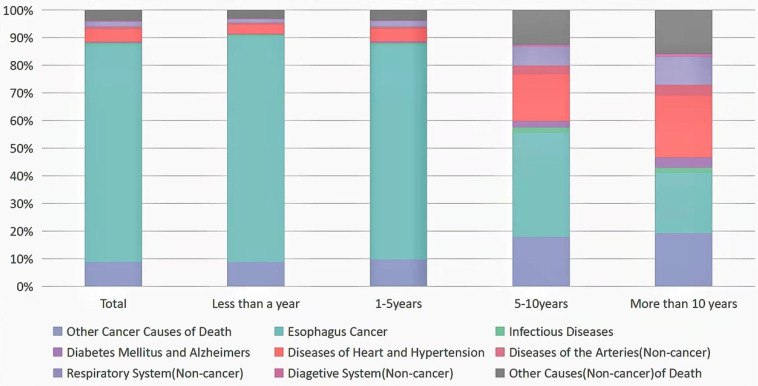
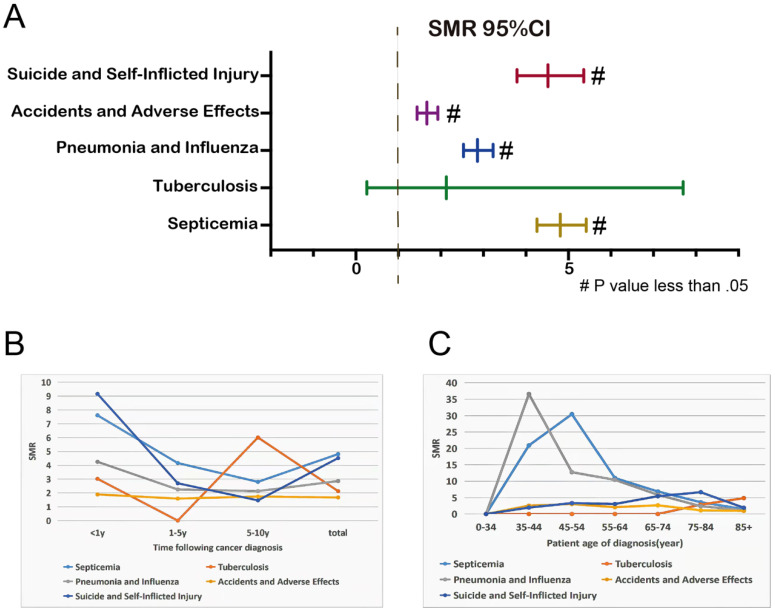
Researches on noncancer causes of death in patients with esophageal cancer (EC) are not in-depth. The objective of this paper is to broadly and deeply explore the causes of death in patients with EC, especially noncancer causes. Information about the demographics, tumor-related characteristics, and causes of death of patients with EC who met the inclusion criteria were extracted from the Surveillance, Epidemiology, and End Results (SEER) database. Calculated standardized mortality ratio (SMR) for all causes of death at different follow-up times and performed subgroup analyses. In total, 63,560 patients with EC were retrieved from the public database. And 52,503 died during the follow-up period. Most deaths were due to EC itself within 5 years after diagnosis, but over 10 years, 59% EC patients died from noncancer causes. Cardiovascular disease was the major noncancer cause of death in patients with EC, accounting for 43%. Suicide and self-injury (2%) of EC patients should not be ignored. During the 1-year follow-up period, patients with EC had statistically highest risk of death from septicemia (SMR: 7.61; 95% CI: 6.38-9.00). Within more than 10 years after EC diagnosis, more and more patients died from chronic obstructive pulmonary disease (SMR: 2.38; 95% CI: 1.79-3.10). Although most patients with EC still died from the cancer itself, the role of noncancer causes of death should not be underestimated. These prompt clinicians to pay more attention to the risk of death caused by these noncancer causes, which can provide relevant measures in advance to intervene.
对食管癌(EC)患者非癌症死因的研究并不深入。本文的目的是广泛而深入地探究EC患者的死因,尤其是非癌症死因。从监测、流行病学和最终结果(SEER)数据库中提取符合纳入标准的EC患者的人口统计学信息、肿瘤相关特征及死因。计算不同随访时间所有死因的标准化死亡比(SMR)并进行亚组分析。共从公共数据库中检索到63560例EC患者。随访期间有52503例死亡。大多数死亡发生在诊断后5年内,原因是EC本身,但超过10年后,59%的EC患者死于非癌症原因。心血管疾病是EC患者非癌症死亡的主要原因,占43%。EC患者的自杀和自残(2%)也不容忽视。在1年随访期内,EC患者因败血症死亡的风险在统计学上最高(SMR:7.61;95%CI:6.38 - 9.00)。在EC诊断后超过10年,越来越多的患者死于慢性阻塞性肺疾病(SMR:2.38;95%CI:1.79 - 3.10)。虽然大多数EC患者仍死于癌症本身,但非癌症死因的作用不应被低估。这些提示临床医生要更加关注这些非癌症死因导致的死亡风险,从而能够提前采取相关措施进行干预。