Institute of Molecular and Translational Therapeutic Strategies (IMTTS), Hannover Medical School, Hannover, Germany.
REBIRTH-Centre for Translational Regenerative Medicine, Hannover Medical School, Hannover, Germany.
Basic Res Cardiol. 2022 May 3;117(1):26. doi: 10.1007/s00395-022-00931-w.
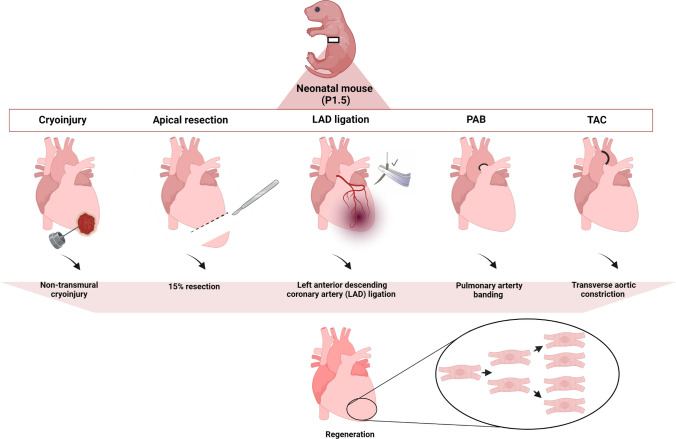
Myocardial injury often leads to heart failure due to the loss and insufficient regeneration of resident cardiomyocytes. The low regenerative potential of the mammalian heart is one of the main drivers of heart failure progression, especially after myocardial infarction accompanied by large contractile muscle loss. Preclinical therapies for cardiac regeneration are promising, but clinically still missing. Mammalian models represent an excellent translational in vivo platform to test drugs and treatments for the promotion of cardiac regeneration. Particularly, short-lived mice offer the possibility to monitor the outcome of such treatments throughout the life span. Importantly, there is a short period of time in newborn mice in which the heart retains full regenerative capacity after cardiac injury, which potentially also holds true for the neonatal human heart. Thus, in vivo neonatal mouse models of cardiac injury are crucial to gain insights into the molecular mechanisms underlying the cardiac regenerative processes and to devise novel therapeutic strategies for the treatment of diseased adult hearts. Here, we provide an overview of the established injury models to study cardiac regeneration. We summarize pioneering studies that demonstrate the potential of using neonatal cardiac injury models to identify factors that may stimulate heart regeneration by inducing endogenous cardiomyocyte proliferation in the adult heart. To conclude, we briefly summarize studies in large animal models and the insights gained in humans, which may pave the way toward the development of novel approaches in regenerative medicine.
心肌损伤通常会导致心力衰竭,原因是心肌细胞的丢失和再生不足。哺乳动物心脏的再生潜能低是心力衰竭进展的主要驱动因素之一,尤其是在伴有大量收缩肌丢失的心肌梗死后。心脏再生的临床前治疗方法很有前景,但仍未应用于临床。哺乳动物模型是测试促进心脏再生的药物和治疗方法的理想转化体内平台。特别是,寿命短的小鼠可以在整个生命周期内监测此类治疗的结果。重要的是,新生小鼠的心脏在心脏损伤后有一段时间内保留完全的再生能力,新生儿的人类心脏也可能如此。因此,体内新生小鼠心脏损伤模型对于深入了解心脏再生过程的分子机制以及设计治疗成年患病心脏的新治疗策略至关重要。在这里,我们提供了已建立的心脏损伤模型的概述,以研究心脏再生。我们总结了开创性的研究,这些研究表明,使用新生心脏损伤模型通过诱导成年心脏内源性心肌细胞增殖来识别可能刺激心脏再生的因素具有潜力。最后,我们简要总结了在大型动物模型和人类中获得的研究进展,这可能为再生医学的新方法的发展铺平道路。