Department of Ecology, TU Berlin, 12165, Berlin, Germany.
Institute of Landscape Ecology, University of Münster, 48149, Münster, Germany.
Oecologia. 2022 May;199(1):165-179. doi: 10.1007/s00442-022-05174-z. Epub 2022 May 4.
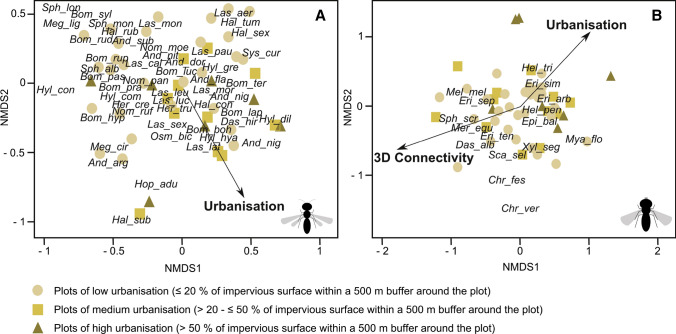
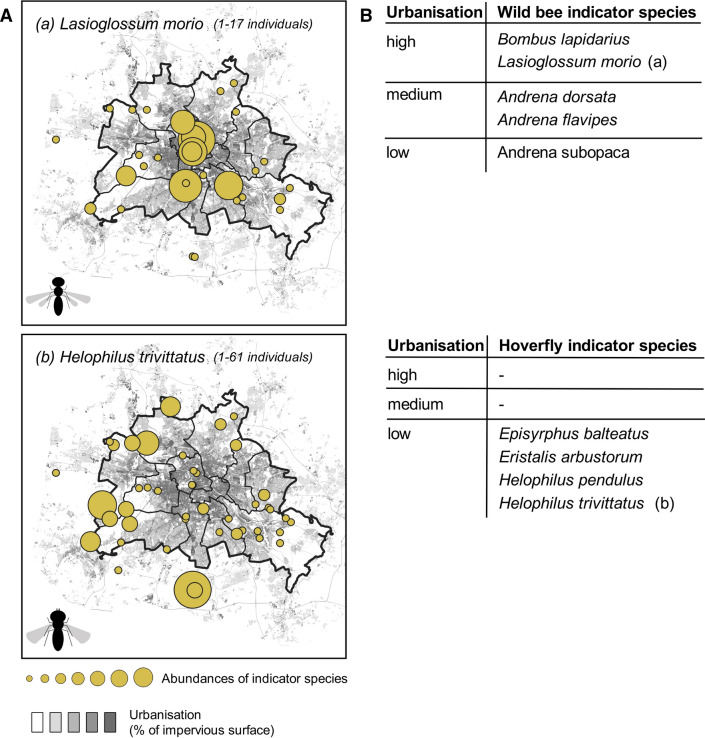
Cities are considered important refuges for insect pollinators. This has been shown repeatedly for wild bees, but may also be true for other diverse taxa such as hoverflies. However, our understanding of how urban environmental filters shape pollinator species communities and their traits is still limited. Here, we used wild bee and hoverfly species, communities and their functional traits to illustrate how environmental filters on the landscape and local scale shape urban species pools. The multi-taxon approach revealed that environmental filtering predominantly occurred at the landscape scale as urbanisation and 3D connectivity significantly structured the taxonomic and functional composition of wild bee (sociality, nesting, diet, body size) and hoverfly (larval food type, migratory status) communities. We identified urban winners and losers attributed to taxon-specific responses to urban filters. Our results suggest that insect pollinator conservation needs to take place primarily at the landscape level while considering species traits, especially by increasing habitat connectivity.
城市被认为是昆虫传粉媒介的重要避难所。这已经在野生蜜蜂中得到了反复证明,但对于其他多样化的类群,如蝇类,也可能是如此。然而,我们对于城市环境过滤器如何塑造传粉媒介物种群落及其特征的理解仍然有限。在这里,我们使用野生蜜蜂和蝇类物种、群落及其功能特征来说明景观和局部尺度上的环境过滤器如何塑造城市物种库。多分类群方法表明,环境过滤主要发生在景观尺度上,因为城市化和 3D 连通性显著构建了野生蜜蜂(社会性、筑巢、饮食、体型)和蝇类(幼虫食物类型、迁徙状态)群落的分类和功能组成。我们确定了城市的赢家和输家,这归因于特定于分类群的对城市过滤器的反应。我们的结果表明,昆虫传粉媒介的保护需要主要在景观层面上进行,同时考虑物种特征,特别是通过增加栖息地的连通性。