Shantou University Medical College, Shantou, Guangdong, China.
Department of Cardiology, Second Affiliated Hospital of Shantou University Medical College, Shantou, Guangdong, China.
Cardiovasc Diabetol. 2022 May 3;21(1):66. doi: 10.1186/s12933-022-01510-y.
A single measurement of the triglyceride-glucose (TyG) index, a simple and reliable surrogate marker of insulin resistance, is associated with ischemic stroke. However, evidence for an effect of a long-term elevation in TyG index on ischemic stroke is limited. Therefore, we evaluated the relationship between cumulative TyG index exposure and the risk of ischemic stroke.
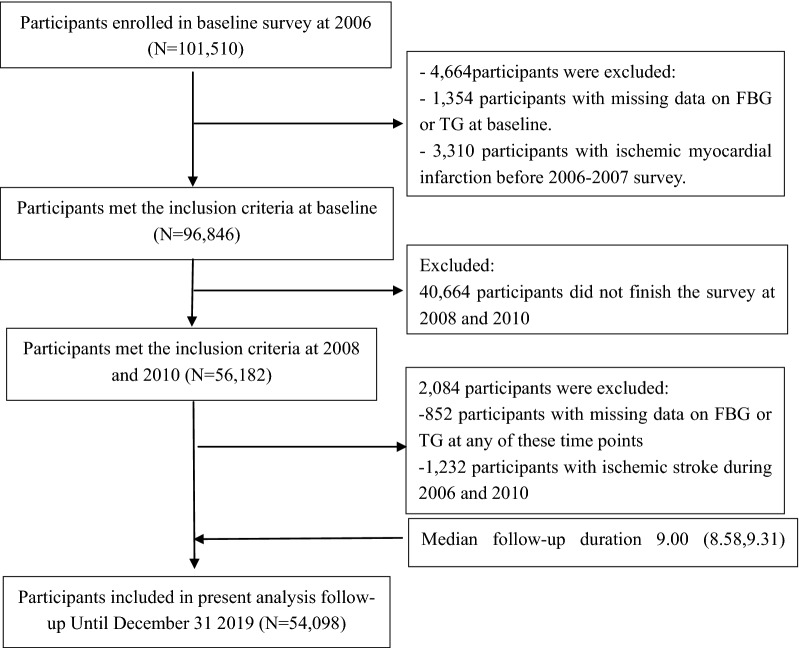
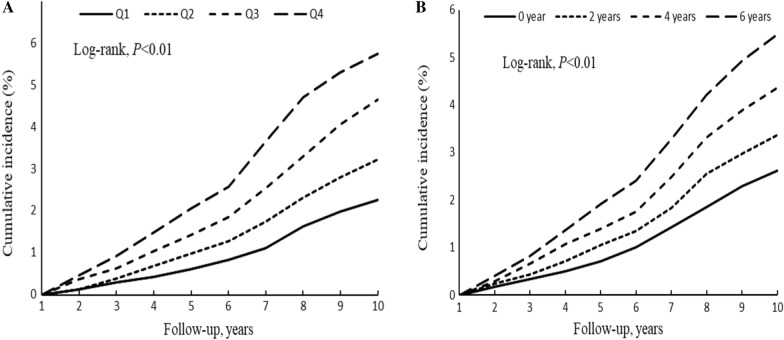
A total of 54,098 participants in the Kailuan study who had not experienced ischemic stroke underwent three measurements of fasting blood glucose and triglycerides during 2006-2007, 2008-2009, and 2010-2011. Cumulative exposure to TyG index was calculated as the weighted sum of the mean TyG index value for each time interval (value × time). Participants were placed into four groups according to the quartile of the weighted mean: Q1 group, < 32.01; Q2 group, 32.01-34.45; Q3 group, 34.45-37.47; and Q4 group, ≥ 37.47. Cox proportional hazard models were used to assess the relationships of the cumulative TyG index with incident ischemic stroke by calculating hazard ratios (HRs) and 95% confidence intervals (95% CIs).
There were 2083 incident ischemic stroke events over the 9 years of follow-up. The risk of ischemic stroke increased with the quartile of cumulative TyG index. After adjustment for multiple potential confounders, participants in groups Q4, Q3, and Q2 had significantly higher risks of ischemic stroke, with HRs (95% CIs) of 1.30 (1.12-1.52), 1.26 (1.09-1.45), and 1.09 (0.94-1.27), respectively (P < 0.05), compared with the Q1 group. The longer duration of high TyG index exposure was significantly associated with increased ischemic stroke.
High cumulative TyG index is associated with a higher risk of ischemic stroke. This finding implies that monitoring and the maintenance of an appropriate TyG index may be useful for the prevention of ischemic stroke.
甘油三酯-葡萄糖(TyG)指数是一种简单可靠的胰岛素抵抗替代标志物,单次测量值与缺血性卒中相关。然而,长期 TyG 指数升高与缺血性卒中之间关系的证据有限。因此,我们评估了 TyG 指数累积暴露与缺血性卒中风险之间的关系。
共有 54098 名未发生缺血性卒中的 Kailuan 研究参与者,在 2006-2007 年、2008-2009 年和 2010-2011 年期间进行了 3 次空腹血糖和甘油三酯测量。TyG 指数的累积暴露量计算为每个时间间隔的平均 TyG 指数值的加权总和(值×时间)。根据加权平均值的四分位数,参与者被分为四组:Q1 组,<32.01;Q2 组,32.01-34.45;Q3 组,34.45-37.47;Q4 组,≥37.47。使用 Cox 比例风险模型通过计算风险比(HRs)和 95%置信区间(95% CIs)来评估累积 TyG 指数与新发缺血性卒中之间的关系。
在 9 年的随访期间,发生了 2083 例缺血性卒中事件。缺血性卒中的风险随着累积 TyG 指数四分位数的增加而增加。在校正了多个潜在混杂因素后,Q4、Q3 和 Q2 组的参与者发生缺血性卒中的风险显著升高,HR(95% CI)分别为 1.30(1.12-1.52)、1.26(1.09-1.45)和 1.09(0.94-1.27)(P<0.05),与 Q1 组相比。较长时间的高 TyG 指数暴露与缺血性卒中风险增加显著相关。
高累积 TyG 指数与缺血性卒中风险增加相关。这一发现表明,监测和维持适当的 TyG 指数可能有助于预防缺血性卒中。