Institute of Public Health, Charité - Universitätsmedizin Berlin, corporate member of Freie Universität Berlin and Humboldt-Universität zu Berlin, Charitéplatz 1, 10117, Berlin, Germany.
Research Department 2, Potsdam Institute for Climate Impact Research (PIK), Member of the Leibniz Association, Potsdam, Germany.
BMC Public Health. 2022 May 4;22(1):887. doi: 10.1186/s12889-022-13124-w.
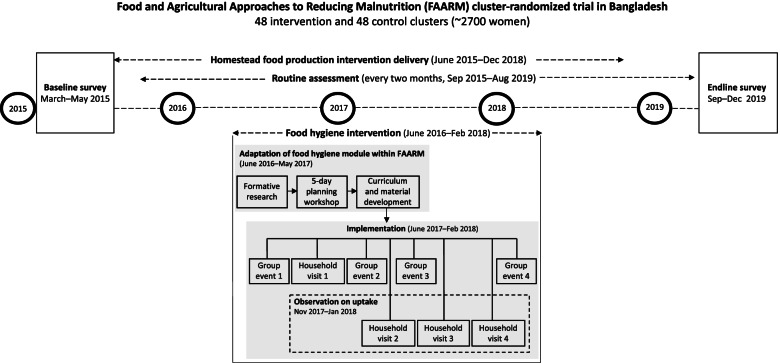
Microbial food contamination, although a known contributor to diarrheal disease and highly prevalent in low-income settings, has received relatively little attention in nutrition programs. Therefore, to address the critical pathway from food contamination to infection to child undernutrition, we adapted and integrated an innovative food hygiene intervention into a large-scale nutrition-sensitive agriculture trial in rural Bangladesh. In this article, we describe the intervention, analyze participation and uptake of the promoted food hygiene behaviors among intervention households, and examine the underlying determinants of behavior adoption.
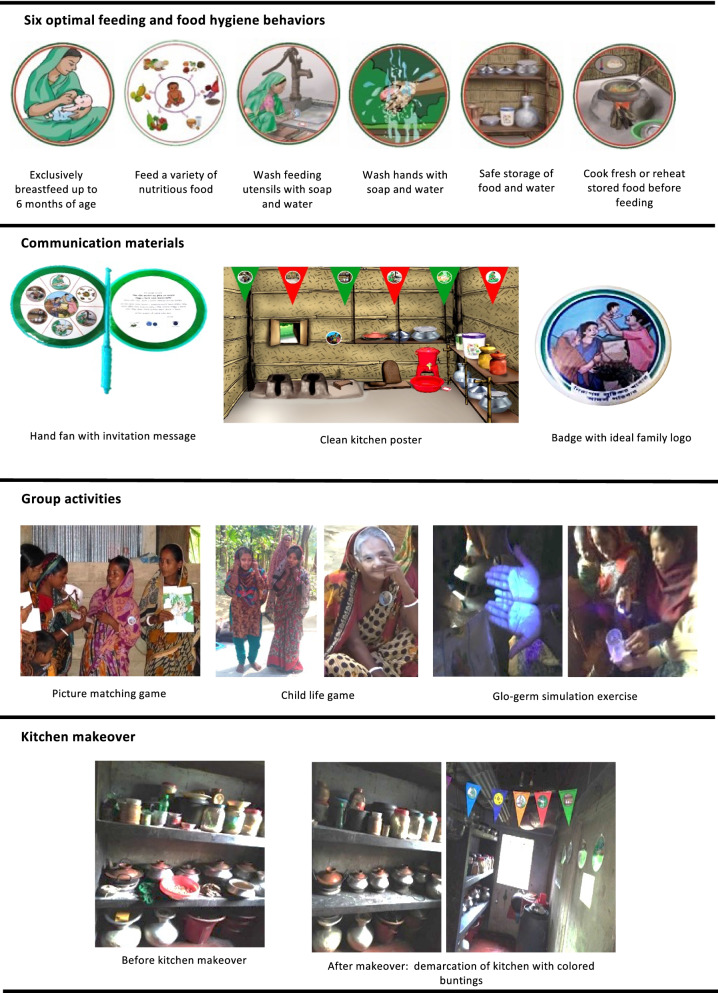
The food hygiene intervention employed emotional drivers, engaging group activities, and household visits to improve six feeding and food hygiene behaviors. The program centered on an 'ideal family' competition. Households' attendance in each food hygiene session was documented. Uptake of promoted behaviors was assessed by project staff on seven 'ideal family' indicators using direct observations of practices and spot checks of household hygiene conditions during household visits. We used descriptive analysis and mixed-effect logistic regression to examine changes in household food hygiene practices and to identify determinants of uptake.
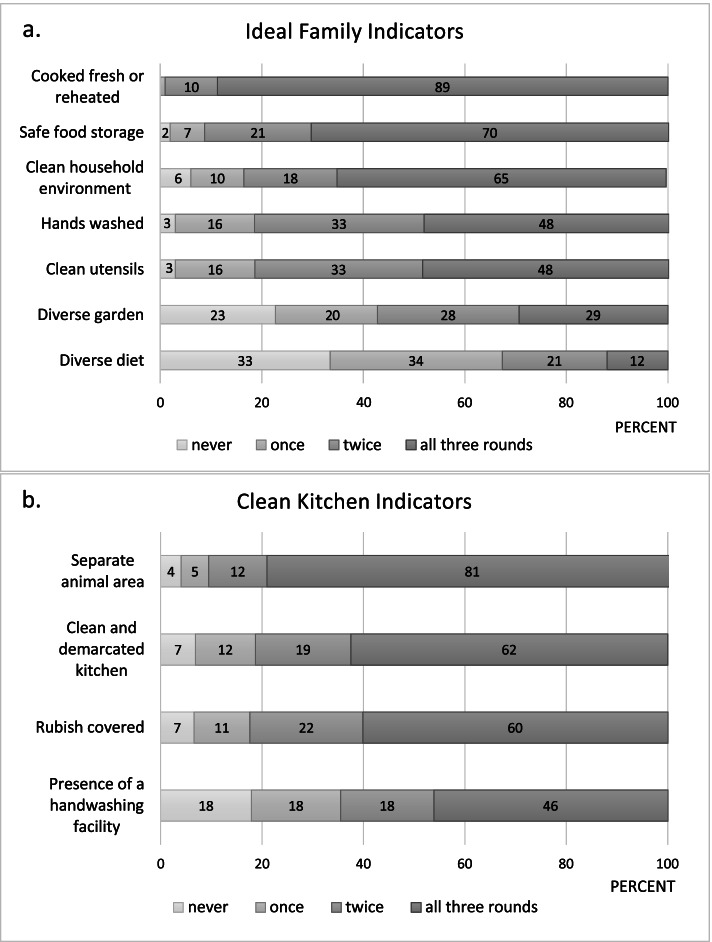
Participation in the food hygiene intervention was high with more than 75% attendance at each session. Hygiene behavior practices increased from pre-intervention with success varying by behavior. Safe storage and fresh preparation or reheating of leftover foods were frequently practiced, while handwashing and cleaning of utensils was practiced by fewer participants. In total, 496 of 1275 participating households (39%) adopted at least 5 of 7 selected practices in all three assessment rounds and were awarded 'ideal family' titles at the end of the intervention. Being an 'ideal family' winner was associated with high participation in intervention activities [adjusted odds ratio (AOR): 11.4, 95% CI: 5.2-24.9], highest household wealth [AOR: 2.3, 95% CI: 1.4-3.6] and secondary education of participating women [AOR: 2.2, 95% CI: 1.4-3.4].
This intervention is an example of successful integration of a behavior change food hygiene component into an existing large-scale trial and achieved satisfactory coverage. Future analysis will show if the intervention was able to sustain improved behaviors over time and decrease food contamination and infection.
微生物食物污染虽然是导致腹泻疾病的已知因素,在低收入环境中也非常普遍,但在营养计划中却很少受到关注。因此,为了解决从食物污染到感染再到儿童营养不良的关键途径,我们在孟加拉国农村的一项大规模营养敏感型农业试验中,改编并整合了一项创新的食物卫生干预措施。在本文中,我们描述了该干预措施,分析了干预家庭对所推广的食物卫生行为的参与和采用情况,并探讨了行为采用的潜在决定因素。
食物卫生干预措施采用情感驱动、开展群体活动和家访,以改善六种喂养和食物卫生行为。该方案以“理想家庭”竞赛为核心。记录了家庭参加每个食物卫生课程的情况。项目工作人员通过直接观察实践和家访期间对家庭卫生条件的抽查,使用七个“理想家庭”指标评估所推广行为的采用情况。我们使用描述性分析和混合效应逻辑回归来检查家庭食物卫生实践的变化,并确定采用的决定因素。
食物卫生干预措施的参与率很高,每次课程的参与率都超过 75%。卫生行为实践从干预前开始增加,成功情况因行为而异。安全储存和新鲜制备或重新加热剩余食物的做法经常被采用,而洗手和清洁餐具的做法则较少被采用。在总共 1275 个参与家庭中,有 496 个家庭(39%)在所有三个评估轮次中都采用了 7 个选定实践中的至少 5 个,并在干预结束时获得了“理想家庭”称号。成为“理想家庭”的获胜者与积极参与干预活动有关(调整后的优势比(AOR):11.4,95%置信区间:5.2-24.9)、家庭财富最高(AOR:2.3,95%置信区间:1.4-3.6)和参与妇女的中等教育(AOR:2.2,95%置信区间:1.4-3.4)。
这项干预措施是将行为改变食物卫生组成部分成功纳入现有大规模试验的一个例子,并取得了令人满意的覆盖率。未来的分析将表明,该干预措施是否能够随着时间的推移保持行为的改善,并减少食物污染和感染。