Weifang Medical University, Weifang, People's Republic of China.
State Key Laboratory for Infectious Disease Prevention and Control (SKLID), National Center for AIDS/STD Control and Prevention (NCAIDS), Chinese Center for Disease Control and Prevention (China CDC), Collaborative Innovation Center for Diagnosis and Treatment of Infectious Diseases, 155 Changbai Road, Changping District, Beijing, 102206, People's Republic of China.
BMC Infect Dis. 2022 May 4;22(1):426. doi: 10.1186/s12879-022-07417-z.
Maintaining plasma HIV RNA suppression below the limit of quantification is the goal of antiretroviral therapy (ART). When viral loads (VL) remain in low-level viremia (LLV), or between 201 and 999 copies/mL, the clinical consequences are still not clear. We investigated the occurrence of LLV with drug resistance and its effect on CD4 cell counts in a large Chinese cohort.
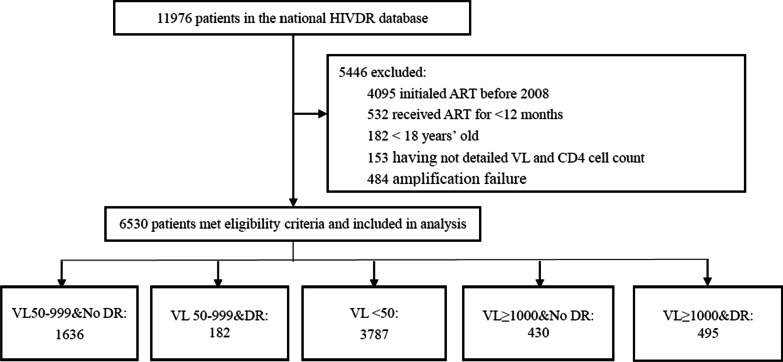
We analysed data of 6,530 ART-experienced patients (42.1 ± 10.9 years; 37.3% female) from the China's national HIV drug resistance (HIVDR) surveillance database. Participants were followed up for 32.9 (IQR 16.7-50.5) months. LLV was defined as the occurrence of at least one viral load (VL) measurement of 50-200 copies/mL during ART. Outcomes were drug resistance associated mutations (DRAM) and CD4 cell counts levels.
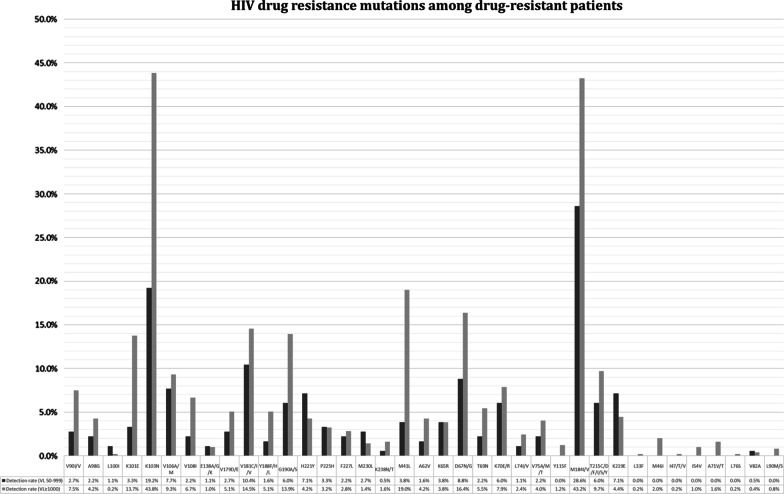
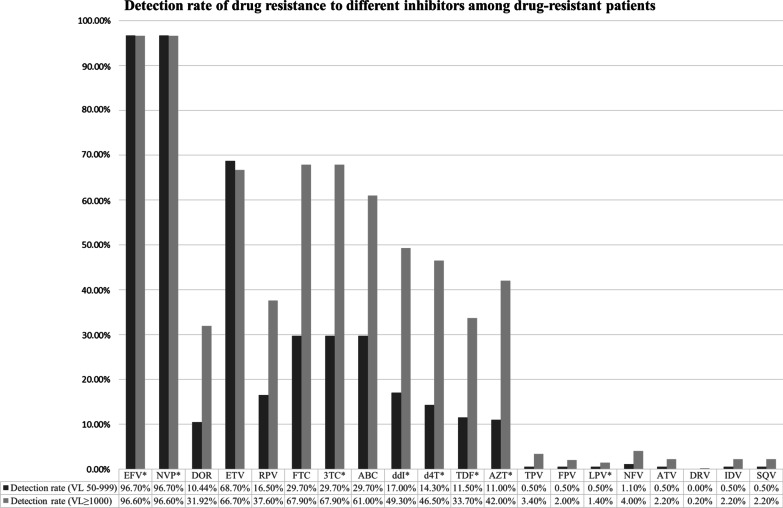
Among 6530 patients, 58.0% patients achieved VL less than 50 copies/mL, 27.8% with VL between 50 and 999 copies/mL (8.6% experienced LLV), and 14.2% had a VL ≥ 1000 copies/mL. Of 1818 patients with VL 50-999 copies/mL, 182 (10.0%) experienced HIVDR, the most common DRAM were M184I/V 28.6%, K103N 19.2%, and V181C/I/V 10.4% (multidrug resistance: 27.5%), and patients with HIVDR had a higher risk of CD4 cell counts < 200 cells/μL (AOR 3.8, 95% CI 2.6-5.5, p < 0.01) comparing with those without HIVDR. Of 925 patients with VL ≥ 1000 copies/mL, 495 (53.5%) acquired HIVDR, the most common DRAM were K103N 43.8%, M184I/V 43.2%, M41L 19.0%, D67N/G 16.4%, V181C/I/V 14.5%, G190A/S 13.9% and K101E 13.7% (multidrug resistance: 75.8%), and patients with HIVDR had a higher risk of CD4 cell counts < 200 cells/μL (AOR 5.8, 95% CI 4.6-7.4, p < 0.01) comparing with those without HIVDR.
Persistent with VL 50-999 copies/mL on ART is associated with emerging DRAM for all drug classes, and patients in this setting were at increased risk of CD4 cell counts < 200 cells/μL, which suggest resistance monitoring and ART optimization be earlier considered.
维持抗逆转录病毒治疗(ART)下的血浆 HIV RNA 抑制低于检测下限是治疗的目标。当病毒载量(VL)处于低水平病毒血症(LLV)或在 201 至 999 拷贝/ml 之间时,其临床后果仍不清楚。我们研究了在中国大型队列中药物耐药性 LLV 的发生及其对 CD4 细胞计数的影响。
我们分析了来自中国国家 HIV 耐药性(HIVDR)监测数据库的 6530 名接受过 ART 治疗的患者(42.1±10.9 岁;37.3%为女性)的数据。参与者的随访时间为 32.9(IQR 16.7-50.5)个月。LLV 定义为在 ART 期间至少有一次 50-200 拷贝/ml 的病毒载量(VL)测量值。结果为耐药相关突变(DRAM)和 CD4 细胞计数水平。
在 6530 名患者中,58.0%的患者 VL 小于 50 拷贝/ml,27.8%的患者 VL 在 50 至 999 拷贝/ml 之间(8.6%发生 LLV),14.2%的患者 VL≥1000 拷贝/ml。在 1818 名 VL 为 50-999 拷贝/ml 的患者中,182 名(10.0%)发生了 HIVDR,最常见的 DRAM 是 M184I/V 28.6%、K103N 19.2%和 V181C/I/V 10.4%(多药耐药:27.5%),且发生 HIVDR 的患者 CD4 细胞计数<200 个/μl 的风险更高(AOR 3.8,95%CI 2.6-5.5,p<0.01)。在 925 名 VL≥1000 拷贝/ml 的患者中,495 名(53.5%)发生了 HIVDR,最常见的 DRAM 是 K103N 43.8%、M184I/V 43.2%、M41L 19.0%、D67N/G 16.4%、V181C/I/V 14.5%、G190A/S 13.9%和 K101E 13.7%(多药耐药:75.8%),且发生 HIVDR 的患者 CD4 细胞计数<200 个/μl 的风险更高(AOR 5.8,95%CI 4.6-7.4,p<0.01)。
ART 治疗时持续的 VL 为 50-999 拷贝/ml 与所有药物类别的新出现的 DRAM 相关,且该人群 CD4 细胞计数<200 个/μl 的风险增加,这表明需要更早考虑耐药监测和 ART 优化。