Bianchi Carolina Paula, Bruno Santiago, Videla Dorna Ignacio, Rodríguez Edgardo, Aba Marcelo Alfredo
Laboratory of Endocrinology, Department of Physiopathology, Faculty of Veterinary Sciences, National University of the Center of Buenos Aires Province, Buenos Aires, Argentina.
National Scientific and Technical Research Council (CONICET), Buenos Aires, Argentina.
J Equine Sci. 2022 Apr;33(1):1-6. doi: 10.1294/jes.33.1. Epub 2022 Apr 19.
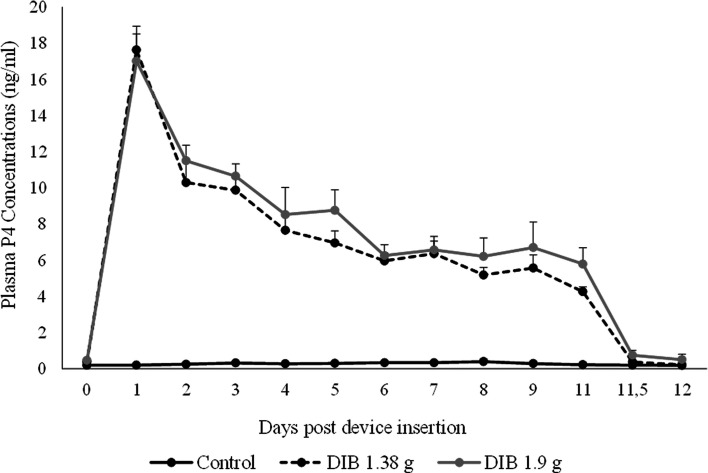
In study I, plasma progesterone concentrations were evaluated in anoestrous mares that received an intravaginal progesterone release device (IPRD) for 10 days. Mares were divided into 3 groups based on the dosage of progesterone (0 g, n=3; 1.38 g, n=5; and 1.9 g, n=5). No statistical differences were found in plasma progesterone concentrations between the two doses tested. In study II, the effects of a protocol based on a short program of artificial light combined with an IPRD containing 1.38 g of progesterone on oestrous behaviour and onset of ovulation were evaluated. IPRDs were inserted into 31 late transitional mares (10 days of treatment). The mares were divided into a control group (n=9, IPRD with 0 g of progesterone) and two treatment groups (T1, n=10, IPRD with 0 g of progesterone and artificial light; T2, n=12, IPRD with 1.38 g of progesterone and artificial light). The percentages of mares in heat within the first 14 days after treatment were 100%, 70%, and 100% in the control, T1, and T2 groups, respectively (P=0.097), and their ovulation rates were 44%, 60%, and 100%, respectively (P≤0.01). In conclusion, a protocol based on artificial light and an IPRD containing 1.38 g of progesterone for 10 days could be considered to advance the first ovulation of the year in late transitional mares, as it ensures a higher rate of ovulation within the first 14 days after treatment.
在研究I中,对接受阴道内孕酮释放装置(IPRD)10天的乏情母马的血浆孕酮浓度进行了评估。母马根据孕酮剂量分为3组(0克,n = 3;1.38克,n = 5;1.9克,n = 5)。在所测试的两种剂量之间,血浆孕酮浓度未发现统计学差异。在研究II中,评估了基于短程序人工光照并结合含1.38克孕酮的IPRD方案对发情行为和排卵开始的影响。将IPRD插入31匹晚过渡母马体内(治疗10天)。母马分为对照组(n = 9,含0克孕酮的IPRD)和两个治疗组(T1,n = 10,含0克孕酮的IPRD和人工光照;T2,n = 12,含1.38克孕酮的IPRD和人工光照)。治疗后前14天内处于发情期的母马百分比在对照组、T1组和T2组中分别为100%、70%和100%(P = 0.097),其排卵率分别为44%、60%和100%(P≤0.01)。总之,基于人工光照和含1.38克孕酮的IPRD持续10天的方案可被认为能使晚过渡母马提前一年首次排卵,因为它确保了治疗后前14天内更高的排卵率。