Osaka Naoya, Mori Yusaku, Terasaki Michishige, Hiromura Munenori, Saito Tomomi, Yashima Hironori, Shiraga Yoshie, Kawakami Raichi, Ohara Makoto, Fukui Tomoyasu, Yamagishi Sho-Ichi
Department of Medicine, Division of Diabetes, Metabolism, and Endocrinology, Showa University School of Medicine, Shinagawa, Tokyo, Japan.
Department of Medicine, Division of Diabetes, Metabolism, and Endocrinology, Anti-glycation Research Section, Showa University School of Medicine, Shinagawa, Tokyo, Japan.
J Int Med Res. 2022 May;50(5):3000605221097490. doi: 10.1177/03000605221097490.
Sodium-glucose cotransporter-2 (SGLT2) inhibitors exhibit cardioprotective properties in patients with diabetes. However, SGLT2 is not expressed in the heart, and the underlying molecular mechanisms are not fully understood. We investigated whether the SGLT2 inhibitor luseogliflozin exerts beneficial effects on high glucose-exposed cardiomyocytes via the suppression of sodium-hydrogen exchanger-1 (NHE-1) activity.
Mouse cardiomyocytes were incubated under normal or high glucose conditions with vehicle, luseogliflozin, or the NHE-1 inhibitor cariporide. NHE-1 activity and gene expression were evaluated by the SNARF assay and real-time reverse transcription-polymerase chain reaction (RT-PCR) analysis, respectively. Six-week-old male db/db mice were treated with vehicle or luseogliflozin for 6 weeks, and the hearts were collected for histological, RT-PCR, and western blot analyses.
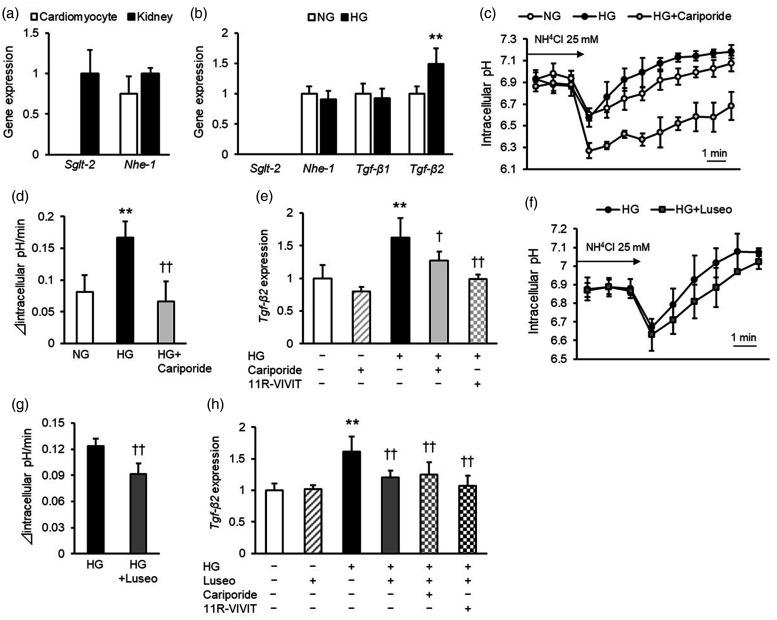
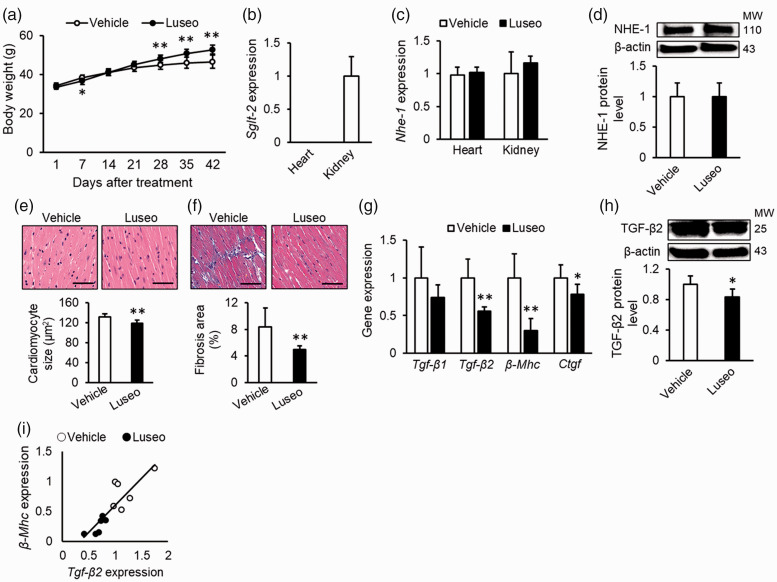
High glucose increased NHE-1 activity and transforming growth factor )-β mRNA levels in cardiomyocytes, both of which were inhibited by luseogliflozin or cariporide, whereas their combination showed no additive suppression of -β2 mRNA levels. Luseogliflozin attenuated cardiac hypertrophy and fibrosis in db/db mice in association with decreased mRNA and protein levels of TGF-β2.
Luseogliflozin may suppress cardiac hypertrophy in diabetes by reducing -β2 expression in cardiomyocytes via the suppression of NHE-1 activity.
钠-葡萄糖协同转运蛋白2(SGLT2)抑制剂对糖尿病患者具有心脏保护作用。然而,心脏中不表达SGLT2,其潜在分子机制尚未完全明确。我们研究了SGLT2抑制剂鲁格列净是否通过抑制钠氢交换体1(NHE-1)活性对高糖暴露的心肌细胞产生有益影响。
将小鼠心肌细胞在正常或高糖条件下与溶剂、鲁格列净或NHE-1抑制剂卡立普多一起孵育。分别通过SNARF分析和实时逆转录-聚合酶链反应(RT-PCR)分析评估NHE-1活性和基因表达。对6周龄雄性db/db小鼠用溶剂或鲁格列净处理6周,然后收集心脏进行组织学、RT-PCR和蛋白质印迹分析。
高糖增加了心肌细胞中NHE-1活性和转化生长因子β mRNA水平,二者均被鲁格列净或卡立普多抑制,而它们联合使用时对β2 mRNA水平无叠加抑制作用。鲁格列净减轻了db/db小鼠的心脏肥大和纤维化,同时伴有TGF-β2 mRNA和蛋白质水平降低。
鲁格列净可能通过抑制NHE-1活性降低心肌细胞中TGF-β2表达,从而抑制糖尿病中的心脏肥大。