Institute for Human Genetics, Department of Psychiatry and Weill Institute for Neurosciences, University of California, San Francisco, California, United States of America.
PLoS Genet. 2022 May 5;18(5):e1010147. doi: 10.1371/journal.pgen.1010147. eCollection 2022 May.
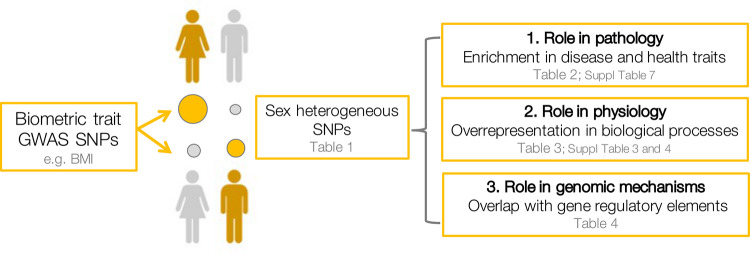
Phenotypic differences across sexes are pervasive, but the genetic architecture of sex differences within and across phenotypes is mostly unknown. In this study, we aimed to improve detection power for sex-differentially contributing SNPs previously demonstrated to be enriched in disease association, and we investigate their functions in health, pathophysiology, and genetic function. We leveraged GIANT and UK Biobank summary statistics and defined a set of 2,320 independent SNPs having sexually dimorphic effects within and across biometric traits (MAF > 0.001, P < 5x10⁻⁸). Biometric trait sex-heterogeneous SNPs (sex-het SNPs) showed enrichment in association signals for 20 out of 33 diseases/traits at 5% alpha compared to sex-homogeneous matched SNPs (empP < 0.001), and were significantly overrepresented in muscle, skeletal and stem cell development processes, and in calcium channel and microtubule complexes (FDR < 0.05, empP < 0.05). Interestingly, we found that sex-het SNPs significantly map to predicted expression quantitative trait loci (Pr-eQTLs) across brain and other tissues, methylation quantitative trait loci (meQTLs) during development, and transcription start sites, compared to sex-homogeneous SNPs. Finally, we verified that the sex-het disease/trait enrichment was not explained by Pr-eQTL enrichment alone, as sex-het Pr-eQTLs were more enriched than matched sex-homogeneous Pr-eQTLs. We conclude that genetic polymorphisms with sexually dimorphic effects on biometric traits not only contribute to fundamental embryogenic processes, but later in life play an outsized role in disease risk. These sex-het SNPs disproportionately influence gene expression and have a greater influence on disorders of body and brain than other expression-regulatory variation. Together, our data emphasize the genetic underpinnings of sexual dimorphism and its role in human health.
性别表型差异普遍存在,但性别差异在表型内和表型间的遗传结构大多未知。在这项研究中,我们旨在提高先前在疾病关联中富集的性别差异贡献 SNP 的检测能力,并研究它们在健康、病理生理学和遗传功能中的作用。我们利用 GIANT 和 UK Biobank 汇总统计数据,定义了一组在生物计量特征内和跨生物计量特征具有性别二态性效应的 2320 个独立 SNP(MAF > 0.001,P < 5x10⁻⁸)。与性别同质匹配 SNP 相比,生物计量特征性别异质 SNP(sex-het SNP)在 33 种疾病/特征中的 20 种疾病/特征的关联信号中表现出富集(empP < 0.001),并且在肌肉、骨骼和干细胞发育过程以及钙通道和微管复合物中显著过表达(FDR < 0.05,empP < 0.05)。有趣的是,我们发现与性别同质 SNP 相比,sex-het SNP 显著映射到大脑和其他组织的预测表达数量性状基因座(Pr-eQTLs)、发育过程中的甲基化数量性状基因座(meQTLs)以及转录起始位点。最后,我们验证了 sex-het 疾病/特征富集不能仅用 Pr-eQTL 富集来解释,因为 sex-het Pr-eQTLs 比匹配的性别同质 Pr-eQTLs 更丰富。我们的结论是,具有生物计量特征性别二态性效应的遗传多态性不仅有助于基本的胚胎发生过程,而且在生命后期在疾病风险中起着更大的作用。这些 sex-het SNP 不成比例地影响基因表达,对身体和大脑的紊乱比其他表达调控变异的影响更大。总的来说,我们的数据强调了性别二态性的遗传基础及其在人类健康中的作用。