MRC Centre for Neuropsychiatric Genetics and Genomics, Division of Psychological Medicine and Clinical Neurosciences, Cardiff University, Cardiff, United Kingdom.
Section of Genetic Medicine, Department of Medicine and Institute for Genomics and Systems Biology, University of Chicago, Chicago, Illinois; Computational Sciences, Janssen Pharmaceuticals, Spring House, Pennsylvania.
Biol Psychiatry. 2021 Jun 15;89(12):1127-1137. doi: 10.1016/j.biopsych.2020.12.024. Epub 2021 Jan 9.
The origin of sex differences in prevalence and presentation of neuropsychiatric and behavioral traits is largely unknown. Given established genetic contributions and correlations, we tested for a sex-differentiated genetic architecture within and between traits.
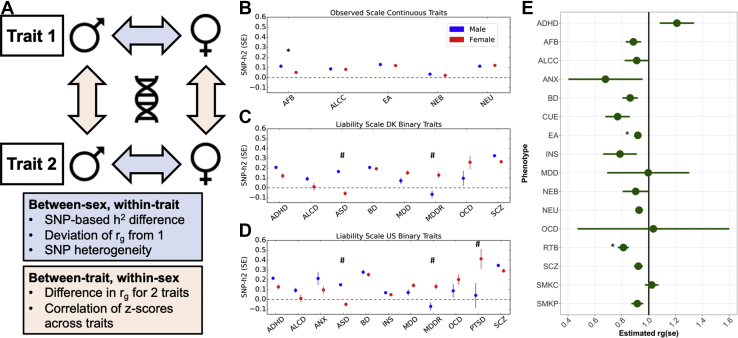
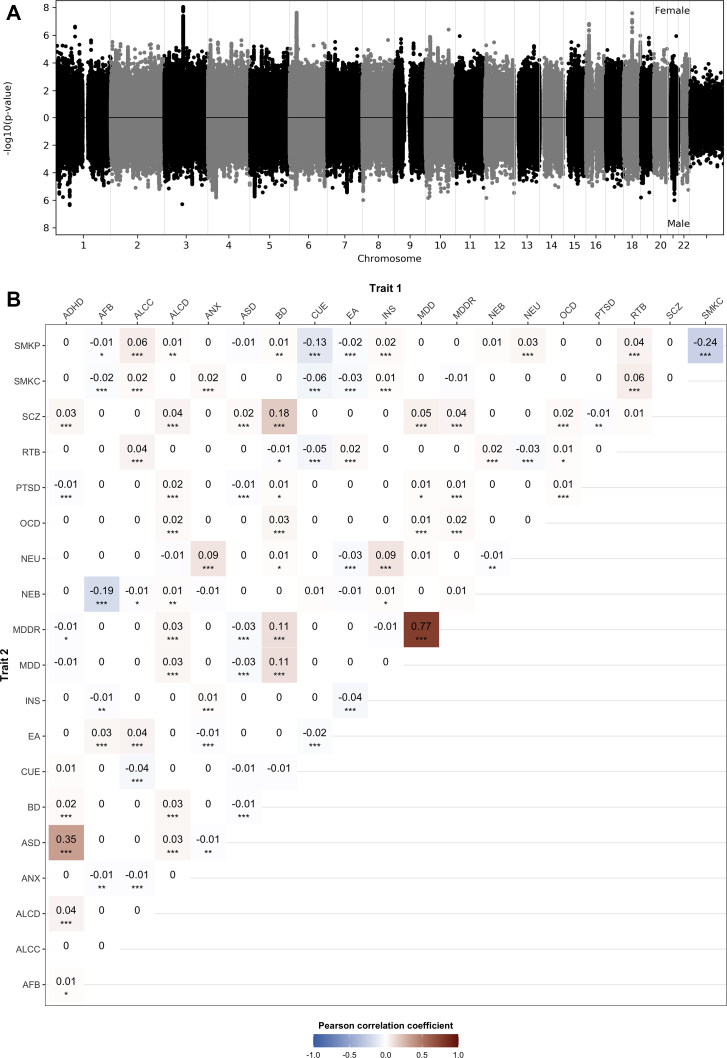
Using European ancestry genome-wide association summary statistics for 20 neuropsychiatric and behavioral traits, we tested for sex differences in single nucleotide polymorphism (SNP)-based heritability and genetic correlation (r < 1). For each trait, we computed per-SNP z scores from sex-stratified regression coefficients and identified genes with sex-differentiated effects using a gene-based approach. We calculated correlation coefficients between z scores to test for shared sex-differentiated effects. Finally, we tested for sex differences in across-trait genetic correlations.
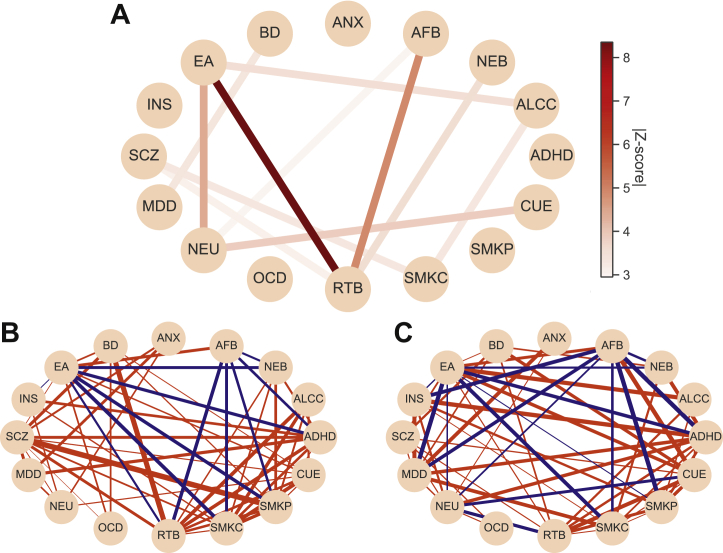
We observed no consistent sex differences in SNP-based heritability. Between-sex, within-trait genetic correlations were high, although <1 for educational attainment and risk-taking behavior. We identified 4 genes with significant sex-differentiated effects across 3 traits. Several trait pairs shared sex-differentiated effects. The top genes with sex-differentiated effects were enriched for multiple gene sets, including neuron- and synapse-related sets. Most between-trait genetic correlation estimates were not significantly different between sexes, with exceptions (educational attainment and risk-taking behavior).
Sex differences in the common autosomal genetic architecture of neuropsychiatric and behavioral phenotypes are small and polygenic and unlikely to fully account for observed sex-differentiated attributes. Larger sample sizes are needed to identify sex-differentiated effects for most traits. For well-powered studies, we identified genes with sex-differentiated effects that were enriched for neuron-related and other biological functions. This work motivates further investigation of genetic and environmental influences on sex differences.
神经精神和行为特征的患病率和表现存在性别差异的原因在很大程度上尚不清楚。鉴于已确定的遗传贡献和相关性,我们在特质内和特质间测试了性别分化的遗传结构。
使用欧洲血统全基因组关联汇总统计数据,对 20 种神经精神和行为特征进行了测试,以检测基于单核苷酸多态性(SNP)的遗传率和遗传相关性(r<1)的性别差异。对于每种特征,我们从性别分层回归系数计算了每个 SNP 的 z 分数,并使用基于基因的方法确定了具有性别差异作用的基因。我们计算了 z 分数之间的相关系数,以测试共享的性别差异作用。最后,我们测试了跨特征遗传相关性的性别差异。
我们没有观察到 SNP 遗传率的一致性别差异。尽管教育程度和冒险行为的遗传相关性<1,但性别间的特质内遗传相关性很高。我们确定了 4 个跨越 3 种特征的具有显著性别差异作用的基因。几个特质对具有性别差异作用。具有性别差异作用的基因的前几个基因富含多种基因集,包括神经元和突触相关基因集。大多数跨特征遗传相关性估计在性别之间没有显著差异,但也有例外(教育程度和冒险行为)。
神经精神和行为表型的常见常染色体遗传结构中的性别差异很小,是多基因的,不太可能完全解释观察到的性别差异属性。需要更大的样本量来确定大多数特征的性别差异作用。对于具有足够效力的研究,我们确定了具有性别差异作用的基因,这些基因富含神经元相关和其他生物学功能。这项工作促使进一步研究遗传和环境对性别差异的影响。