International Institute for Applied Systems Analysis, Schlossplatz 1, A-2361, Laxenburg, Austria.
GFZ German Research Centre for Geosciences, Telegrafenberg, 14473, Potsdam, Germany.
Nat Commun. 2022 May 5;13(1):2459. doi: 10.1038/s41467-022-30099-9.
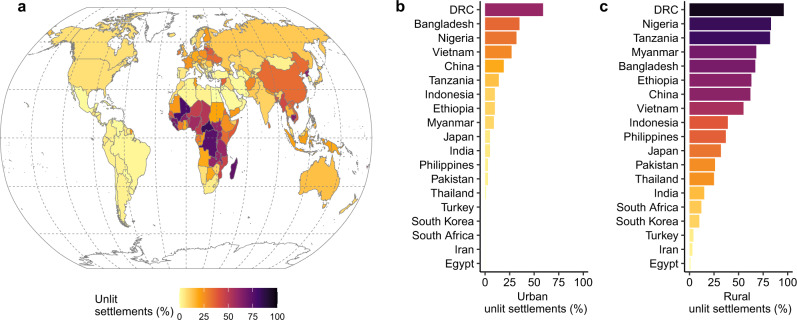
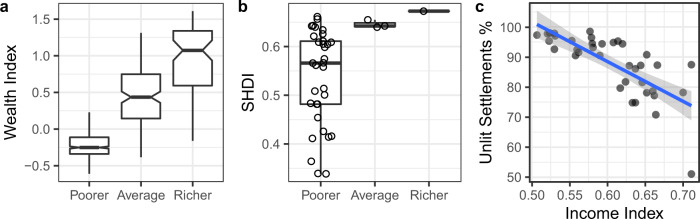
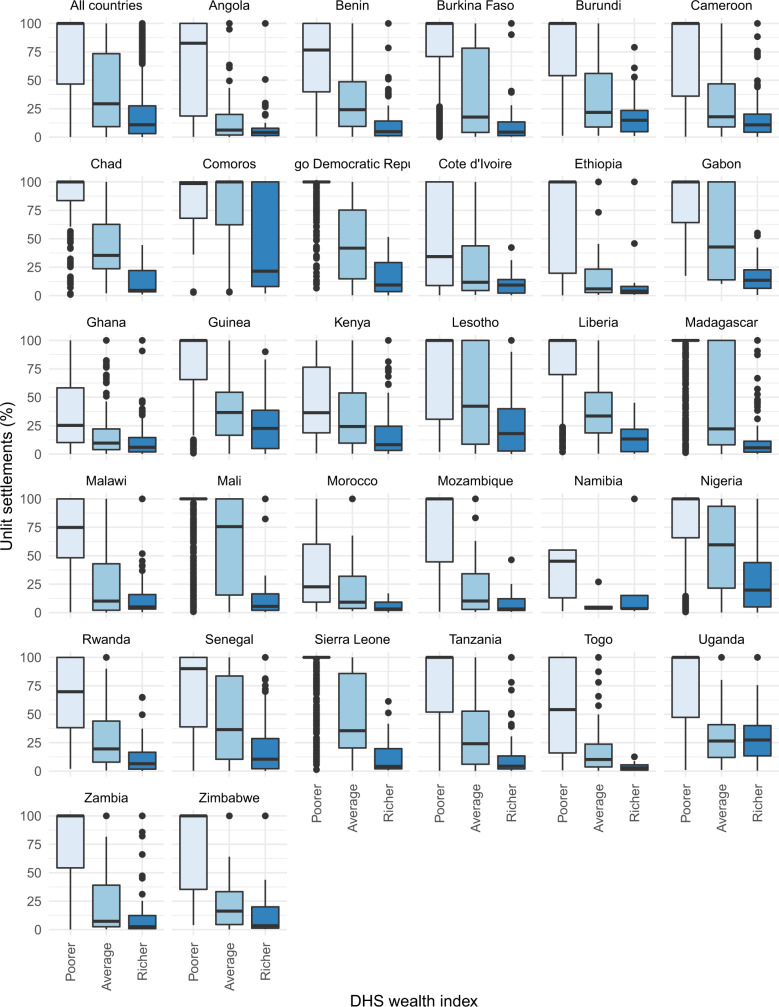
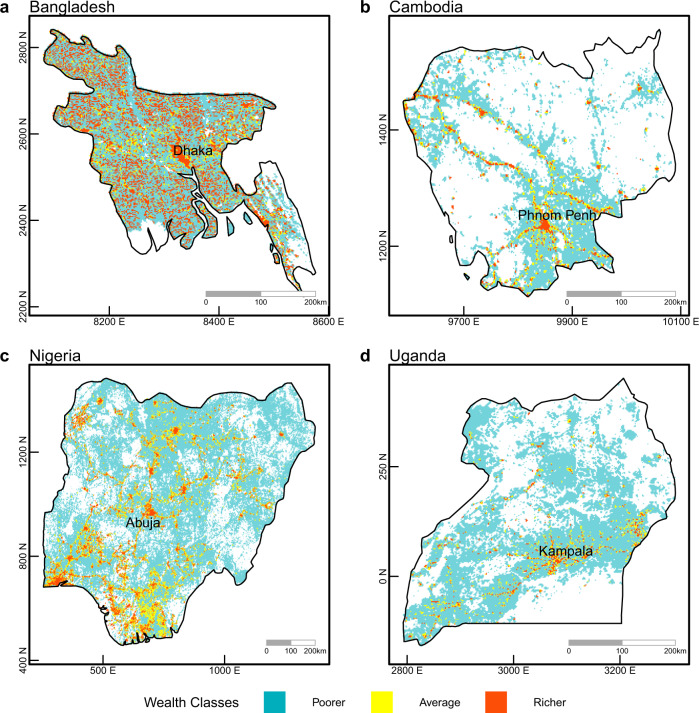
It is well established that nighttime radiance, measured from satellites, correlates with economic prosperity across the globe. In developing countries, areas with low levels of detected radiance generally indicate limited development - with unlit areas typically being disregarded. Here we combine satellite nighttime lights and the world settlement footprint for the year 2015 to show that 19% of the total settlement footprint of the planet had no detectable artificial radiance associated with it. The majority of unlit settlement footprints are found in Africa (39%), rising to 65% if we consider only rural settlement areas, along with numerous countries in the Middle East and Asia. Significant areas of unlit settlements are also located in some developed countries. For 49 countries spread across Africa, Asia and the Americas we are able to predict and map the wealth class obtained from ~2,400,000 geo-located households based upon the percent of unlit settlements, with an overall accuracy of 87%.
众所周知,从卫星测量的夜间辐射与全球经济繁荣密切相关。在发展中国家,检测到的低辐射区域通常表明发展有限——通常不考虑未照明区域。在这里,我们将卫星夜间灯光数据与 2015 年的全球定居点足迹相结合,结果表明,地球上 19%的定居点足迹没有与之相关的可检测人工辐射。大部分没有灯光的定居点足迹都出现在非洲(39%),如果我们只考虑农村定居点,以及中东和亚洲的许多国家,这一比例上升到 65%。在一些发达国家,也有大量未照明的定居点。我们对分布在非洲、亚洲和美洲的 49 个国家进行了分析,根据未照明定居点的比例,我们能够预测和绘制出大约 240 万个地理位置确定的家庭所获得的财富等级,并取得了 87%的整体准确率。