Midwest Biomedical Research, Addison, IL, 60101, USA.
Indiana University, Department of Applied Health Science, School of Public Health, Bloomington, IN, 47401, USA.
Eur J Clin Nutr. 2023 Feb;77(2):156-165. doi: 10.1038/s41430-022-01150-1. Epub 2022 May 5.
Results from observational studies suggest an association of red meat intake with risk of type 2 diabetes mellitus (T2D). However, results from randomized controlled trials (RCTs) have not clearly supported a mechanistic link between red meat intake and T2D risk factors. Therefore, a systematic review and meta-analysis were conducted on RCTs evaluating the effects of diets containing red meat (beef, pork, lamb, etc.), compared to diets with lower or no red meat, on markers of glucose homeostasis in adults.
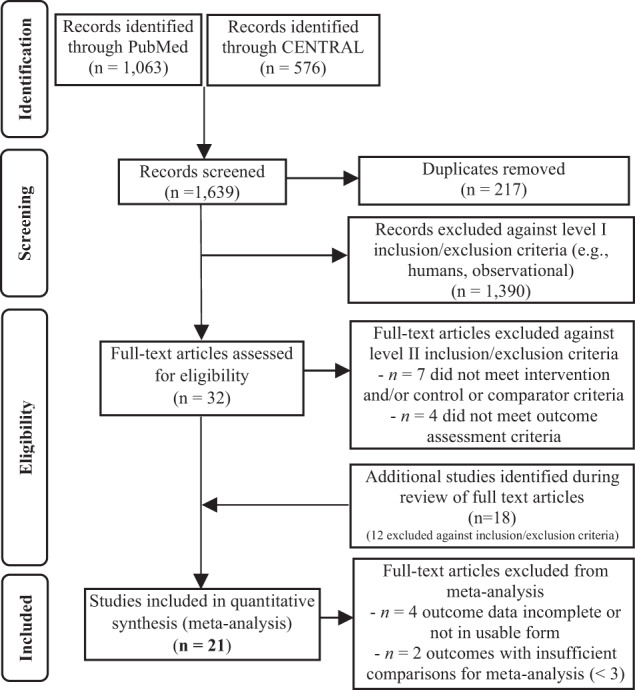
A search of PubMed and CENTRAL yielded 21 relevant RCTs. Pooled estimates were expressed as standardized mean differences (SMDs) between the red meat intervention and the comparator intervention with less or no red meat.
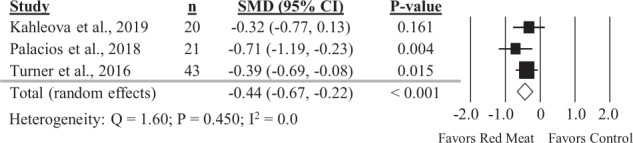
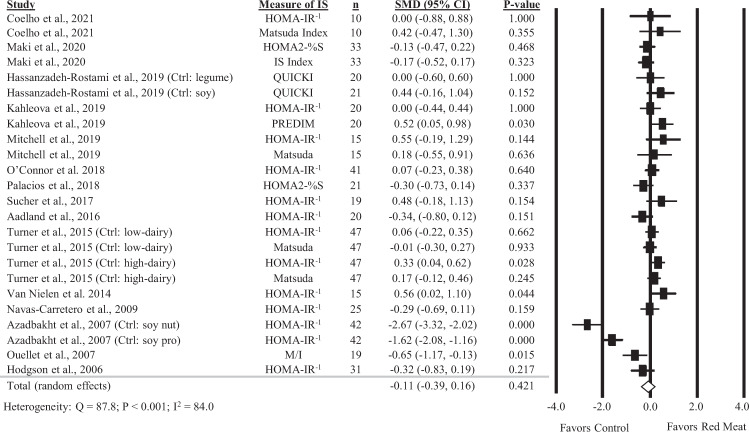
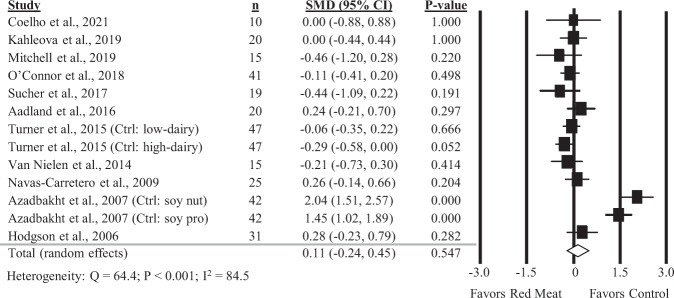
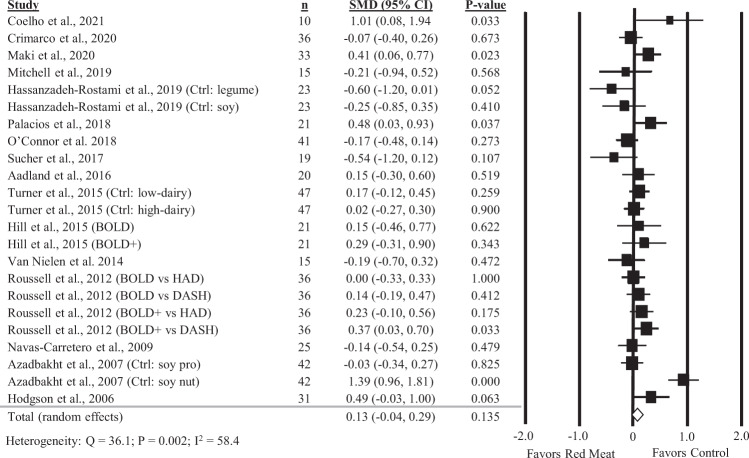
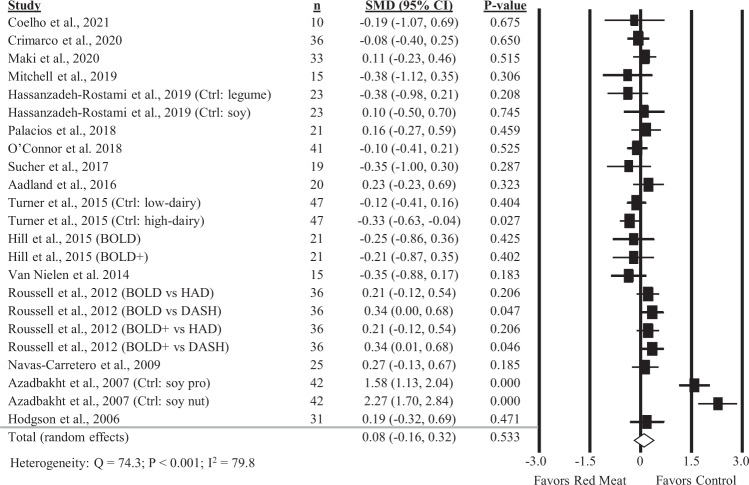
Compared to diets with reduced or no red meat intake, there was no significant impact of red meat intake on insulin sensitivity (SMD: -0.11; 95% CI: -0.39, 0.16), insulin resistance (SMD: 0.11; 95% CI: -0.24, 0.45), fasting glucose (SMD: 0.13; 95% CI: -0.04, 0.29), fasting insulin (SMD: 0.08; 95% CI: -0.16, 0.32), glycated hemoglobin (HbA1c; SMD: 0.10; 95% CI: -0.37, 0.58), pancreatic beta-cell function (SMD: -0.13; 95% CI: -0.37, 0.10), or glucagon-like peptide-1 (GLP-1; SMD: 0.10; 95% CI: -0.37, 0.58). Red meat intake modestly reduced postprandial glucose (SMD: -0.44; 95% CI: -0.67, -0.22; P < 0.001) compared to meals with reduced or no red meat intake. The quality of evidence was low to moderate for all outcomes.
The results of this meta-analysis suggest red meat intake does not impact most glycemic and insulinemic risk factors for T2D. Further investigations are needed on other markers of glucose homeostasis to better understand whether a causal relationship exists between red meat intake and risk of T2D.
CRD42020176059.
观察性研究的结果表明,摄入红色肉类与 2 型糖尿病(T2D)风险相关。然而,随机对照试验(RCT)的结果并未明确支持红色肉类摄入与 T2D 风险因素之间的机制联系。因此,我们对评估红色肉类(牛肉、猪肉、羊肉等)饮食与低红色肉类或无红色肉类饮食相比对成年人糖稳态标志物影响的 RCT 进行了系统评价和荟萃分析。
对 PubMed 和 CENTRAL 进行检索,得到 21 项相关 RCT。汇总估计值表示为红色肉类干预与低红色肉类或无红色肉类比较干预之间的标准化均数差(SMD)。
与低红色肉类或无红色肉类摄入的饮食相比,红色肉类摄入对胰岛素敏感性(SMD:-0.11;95%CI:-0.39,0.16)、胰岛素抵抗(SMD:0.11;95%CI:-0.24,0.45)、空腹血糖(SMD:0.13;95%CI:-0.04,0.29)、空腹胰岛素(SMD:0.08;95%CI:-0.16,0.32)、糖化血红蛋白(HbA1c;SMD:0.10;95%CI:-0.37,0.58)、胰岛β细胞功能(SMD:-0.13;95%CI:-0.37,0.10)或胰高血糖素样肽-1(GLP-1;SMD:0.10;95%CI:-0.37,0.58)均无显著影响。与低红色肉类或无红色肉类摄入的饮食相比,红色肉类摄入可适度降低餐后血糖(SMD:-0.44;95%CI:-0.67,-0.22;P<0.001)。所有结局的证据质量均为低到中等。
本荟萃分析结果表明,红色肉类摄入不会影响 T2D 的大多数血糖和胰岛素血症风险因素。需要进一步研究其他糖稳态标志物,以更好地了解红色肉类摄入与 T2D 风险之间是否存在因果关系。
PROSPERO 注册号:CRD42020176059。