Midwest Biomedical Research Center for Metabolic and Cardiovascular Health, Addison, IL, USA.
Department of Applied Health Science, School of Public Health, Indiana University, Bloomington, IN, USA.
J Nutr. 2020 Jul 1;150(7):1824-1833. doi: 10.1093/jn/nxaa116.
Observational evidence suggests that red meat intake is associated with type 2 diabetes (T2D) and cardiovascular disease incidence, but few randomized controlled trials have assessed effects of lean, unprocessed red meat intake on insulin sensitivity and other cardiometabolic risk factors.
This study compared the USDA Healthy US-Style Eating Pattern, low in saturated fat and red meat (<40 g/d red meat; USDA-CON), with a modified version with an additional 150 g/d lean beef as an isocaloric replacement for carbohydrate (USDA-LB) on insulin sensitivity and cardiometabolic risk markers.
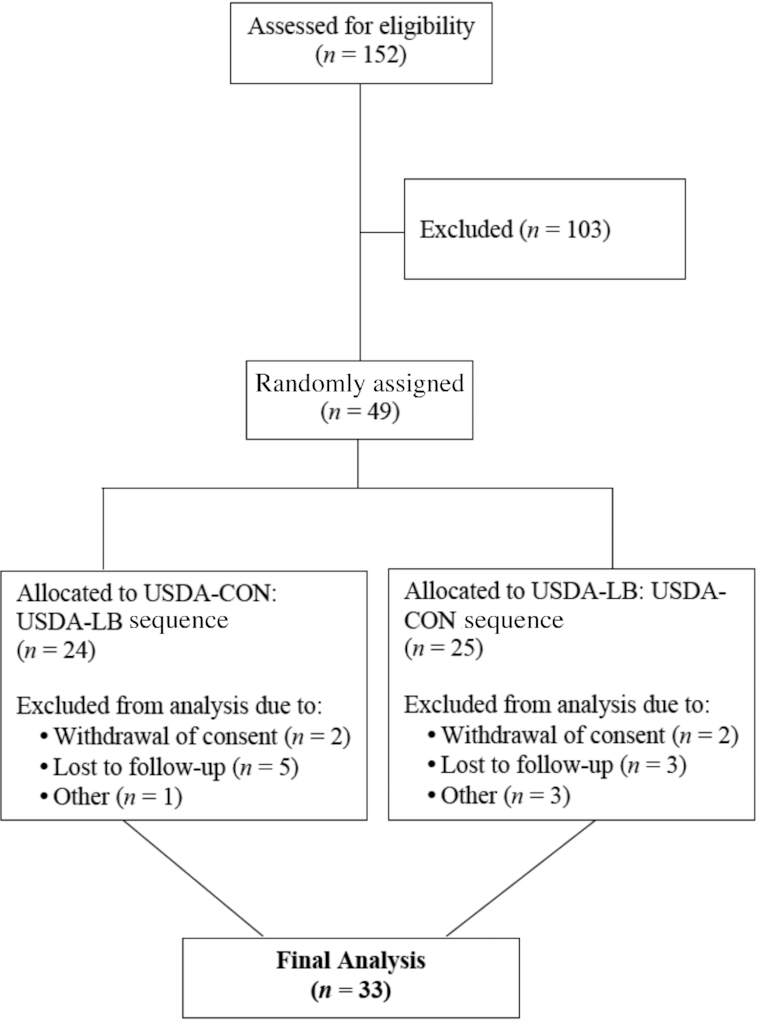
Participants (7 men, 26 women; 44.4 y old) with overweight/obesity [BMI (kg/m2) = 31.3] and prediabetes and/or metabolic syndrome completed this randomized, crossover, controlled-feeding trial consisting of two 28-d treatments (USDA-CON and USDA-LB) separated by a ≥14-day washout. Insulin sensitivity (primary outcome variable), lipoprotein lipids, apolipoproteins (apoA-I and apoB), and high-sensitivity C-reactive protein (hs-CRP) (secondary outcome variables), in plasma or serum, and blood pressures were assessed at baseline and the end of each diet period.
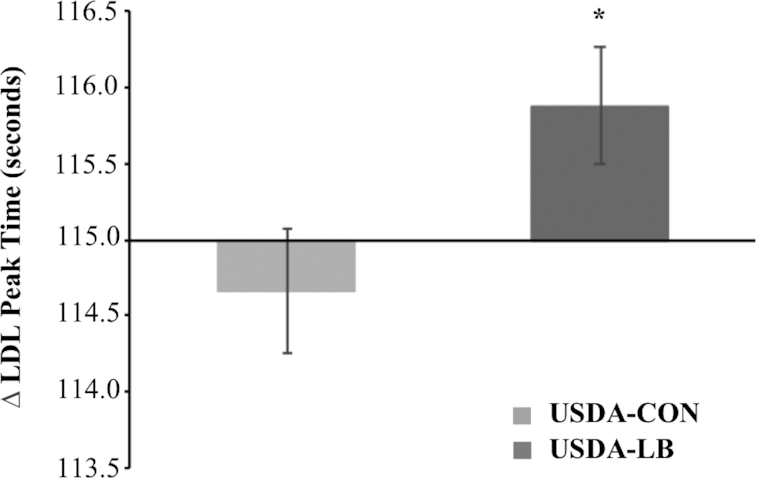
USDA-LB and USDA-CON did not differ significantly in effects on whole-body insulin sensitivity and other indicators of carbohydrate metabolism, lipoprotein lipids, apoA-I and apoB, hs-CRP, and blood pressures. USDA-LB produced a shift toward less cholesterol carried by smaller LDL subfractions compared with USDA-CON [least-squares geometric mean ratios for LDL1+2 cholesterol of 1.20 (P = 0.016) and LDL3+4 cholesterol of 0.89 (P = 0.044)] and increased peak LDL time versus USDA-CON (1.01; P = 0.008).
Substituting lean, unprocessed beef for carbohydrate in a Healthy US-Style Eating Pattern resulted in a shift toward larger, more buoyant LDL subfractions, but otherwise had no significant effects on the cardiometabolic risk factor profile in men and women with prediabetes and/or metabolic syndrome.This trial was registered at clinicaltrials.gov as NCT03202680.
观察性证据表明,摄入红色肉类与 2 型糖尿病(T2D)和心血管疾病的发病率有关,但很少有随机对照试验评估低脂肪、未加工的红色肉类摄入对胰岛素敏感性和其他心血管代谢风险因素的影响。
本研究比较了美国农业部健康的美国饮食模式(饱和脂肪和红色肉类含量低,<40g/d;USDA-CON)与改良版的饮食模式,后者用 150g/d 的瘦牛肉作为等热量的碳水化合物替代物(USDA-LB),评估它们对胰岛素敏感性和心血管代谢风险标志物的影响。
参与者(7 名男性,26 名女性;年龄 44.4 岁)超重/肥胖(BMI[kg/m2] = 31.3),患有前驱糖尿病和/或代谢综合征,完成了这项随机、交叉、对照喂养试验,包括两个 28 天的治疗期(USDA-CON 和 USDA-LB),中间间隔至少 14 天的洗脱期。在基线和每个饮食期结束时,评估胰岛素敏感性(主要观察变量)、脂蛋白脂质、载脂蛋白(apoA-I 和 apoB)和高敏 C 反应蛋白(hs-CRP)(次要观察变量)在血浆或血清中的水平以及血压。
USDA-LB 和 USDA-CON 在对全身胰岛素敏感性和其他碳水化合物代谢指标、脂蛋白脂质、apoA-I 和 apoB、hs-CRP 和血压的影响方面没有显著差异。与 USDA-CON 相比,USDA-LB 使更小的 LDL 亚组分携带的胆固醇减少[LDL1+2 胆固醇的最小二乘几何均数比为 1.20(P=0.016),LDL3+4 胆固醇的最小二乘几何均数比为 0.89(P=0.044)],并且 LDL 峰值时间比 USDA-CON 增加(1.01;P=0.008)。
在健康的美国饮食模式中用瘦的、未经加工的牛肉代替碳水化合物,会使更大、更易浮起的 LDL 亚组分增加,但在有前驱糖尿病和/或代谢综合征的男性和女性中,对心血管代谢风险因素谱没有显著影响。这项试验在 clinicaltrials.gov 上注册为 NCT03202680。