First Department of Medicine, University Medical Centre Hamburg-Eppendorf, Hamburg, Germany.
Semin Immunopathol. 2022 Jul;44(4):475-484. doi: 10.1007/s00281-022-00942-8. Epub 2022 May 5.
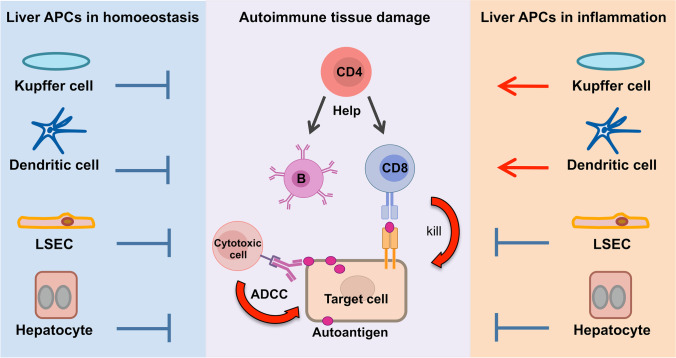
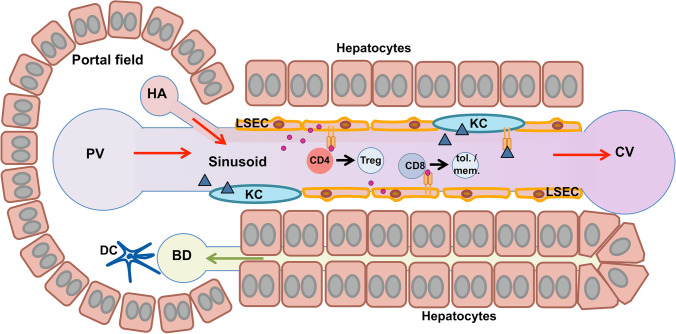
Autoimmune diseases develop when the adaptive immune system attacks the body's own antigens leading to tissue damage. At least 80 different conditions are believed to have an autoimmune aetiology, including rheumatoid arthritis, type I diabetes, multiple sclerosis or systemic lupus erythematosus. Collectively, autoimmune diseases are a leading cause of severe health impairment along with substantial socioeconomic costs. Current treatments are mostly symptomatic and non-specific, and it is typically not possible to cure these diseases. Thus, the development of more causative treatments that suppress only the pathogenic immune responses, but spare general immunity is of great biomedical interest. The liver offers considerable potential for development of such antigen-specific immunotherapies, as it has a distinct physiological capacity to induce immune tolerance. Indeed, the liver has been shown to specifically suppress autoimmune responses to organ allografts co-transplanted with the liver or to autoantigens that were transferred to the liver. Liver tolerance is established by a unique microenvironment that facilitates interactions between liver-resident antigen-presenting cells and lymphocytes passing by in the low blood flow within the hepatic sinusoids. Here, we summarise current concepts and mechanisms of liver immune tolerance, and review present approaches to harness liver tolerance for antigen-specific immunotherapy.
自身免疫性疾病是当适应性免疫系统攻击自身抗原导致组织损伤时发生的。据信,至少有 80 种不同的疾病具有自身免疫病因,包括类风湿性关节炎、1 型糖尿病、多发性硬化症或系统性红斑狼疮。自身免疫性疾病共同导致严重的健康损害,并带来巨大的社会经济成本。目前的治疗方法大多是对症治疗且非特异性的,通常无法治愈这些疾病。因此,开发更具因果关系的治疗方法,抑制仅致病性免疫反应而不影响一般免疫,具有重要的生物医学意义。肝脏在开发这种针对抗原的免疫疗法方面具有很大的潜力,因为它具有独特的生理能力来诱导免疫耐受。事实上,已经表明肝脏可以特异性地抑制与肝脏共移植的器官移植物或转移到肝脏的自身抗原的自身免疫反应。肝脏耐受是通过独特的微环境建立的,该微环境促进了在肝窦内低血流中通过的肝内驻留抗原呈递细胞和淋巴细胞之间的相互作用。在这里,我们总结了肝脏免疫耐受的当前概念和机制,并回顾了利用肝脏耐受进行抗原特异性免疫治疗的现有方法。