State Key Laboratory of Oncology in South China, Sun Yat-sen University Cancer Center, Guangzhou, 510060, P. R. China.
Department of Medical Biochemistry and Molecular Biology, School of Medicine, Jinan University, Guangzhou, 510632, Guangdong, China.
Nat Commun. 2023 Oct 23;14(1):6690. doi: 10.1038/s41467-023-42332-0.
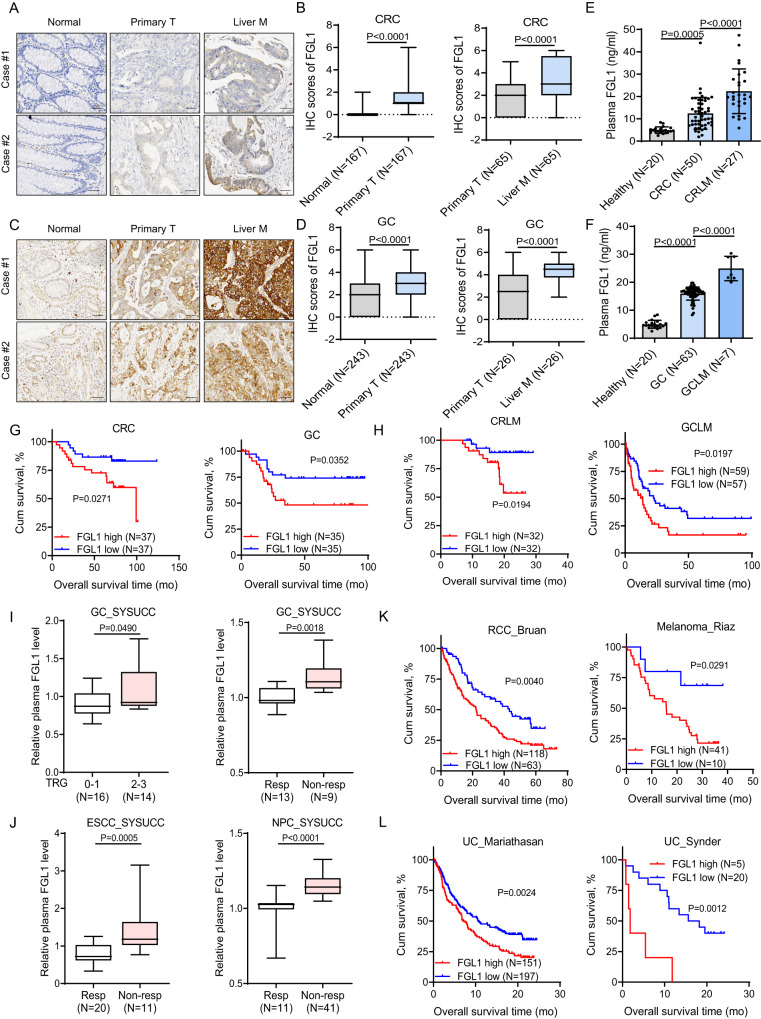
Colorectal cancer (CRC) patients with liver metastases usually obtain less benefit from immunotherapy, and the underlying mechanisms remain understudied. Here, we identify that fibrinogen-like protein 1 (FGL1), secreted from cancer cells and hepatocytes, facilitates the progression of CRC in an intraportal injection model by reducing the infiltration of T cells. Mechanistically, tumor-associated macrophages (TAMs) activate NF-ĸB by secreting TNFα/IL-1β in the liver microenvironment and transcriptionally upregulate OTU deubiquitinase 1 (OTUD1) expression, which enhances FGL1 stability via deubiquitination. Disrupting the TAM-OTUD1-FGL1 axis inhibits metastatic tumor progression and synergizes with immune checkpoint blockade (ICB) therapy. Clinically, high plasma FGL1 levels predict poor outcomes and reduced ICB therapy benefits. Benzethonium chloride, an FDA-approved antiseptics, curbs FGL1 secretion, thereby inhibiting liver metastatic tumor growth. Overall, this study uncovers the critical roles and posttranslational regulatory mechanism of FGL1 in promoting metastatic tumor progression, highlighting the TAM-OTUD1-FGL1 axis as a potential target for cancer immunotherapy.
结直肠癌(CRC)肝转移患者通常从免疫疗法中获益较少,其潜在机制仍研究不足。在这里,我们发现纤维蛋白原样蛋白 1(FGL1)可通过减少 T 细胞浸润促进 CRC 在门静脉内注射模型中的进展,该蛋白由癌细胞和肝细胞分泌。在机制上,肿瘤相关巨噬细胞(TAMs)在肝脏微环境中通过分泌 TNFα/IL-1β 激活 NF-ĸB,并通过转录上调 OTU 去泛素化酶 1(OTUD1)的表达,从而通过去泛素化增强 FGL1 的稳定性。破坏 TAM-OTUD1-FGL1 轴可抑制转移瘤的进展,并与免疫检查点阻断(ICB)治疗协同作用。临床上,高血浆 FGL1 水平预示着不良结局和降低 ICB 治疗获益。苯扎氯铵,一种 FDA 批准的防腐剂,可抑制 FGL1 的分泌,从而抑制肝转移瘤的生长。总的来说,这项研究揭示了 FGL1 在促进转移瘤进展中的关键作用和翻译后调控机制,强调了 TAM-OTUD1-FGL1 轴作为癌症免疫治疗的潜在靶点。