Tahami Monfared Amir Abbas, Lenderking William R, Savva Yulia, Ladd Mary Kate, Zhang Quanwu
Eisai Inc., 200 Metro Blvd., Nutley, NJ, 07110, USA.
McGill University, Epidemiology, Biostatistics, and Occupational Health, Montreal, QC, Canada.
Neurol Ther. 2022 Sep;11(3):1085-1100. doi: 10.1007/s40120-022-00352-w. Epub 2022 May 5.
The Alzheimer's Disease Composite Score (ADCOMS) is a tool developed to detect clinical progression and measure treatment effect in patients in early stages of Alzheimer's disease (AD). The psychometric properties of the ADCOMS have been established; however, the threshold for clinical meaningfulness has yet to be identified.
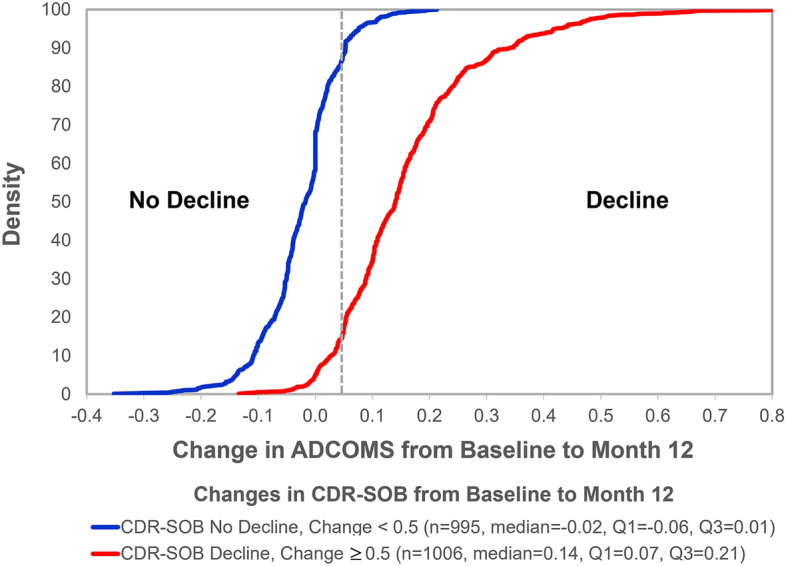
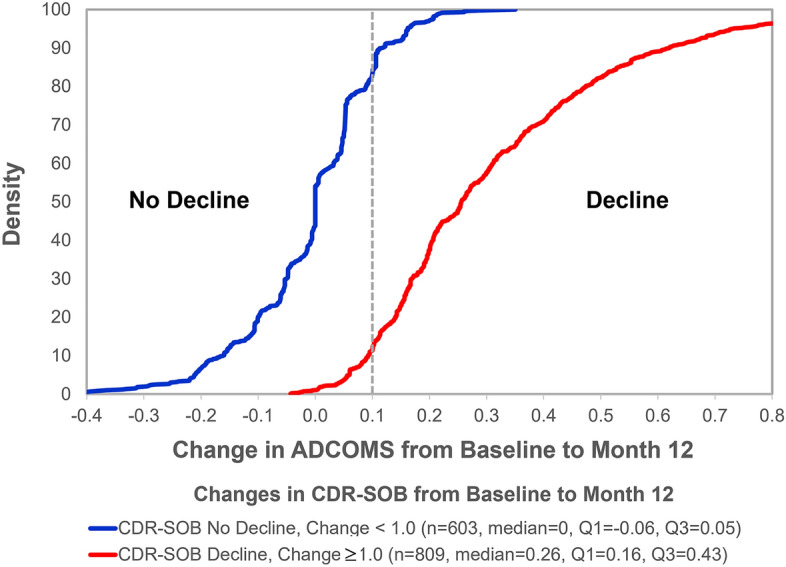
Anchor-based, distribution-based, and ROC curve analyses were used to estimate clinically meaningful thresholds for change in ADCOMS for patients with mild cognitive impairment (MCI) and AD dementia. This study included data from three sources: the Alzheimer's Disease Neuroimaging Initiative (ADNI), the National Alzheimer's Coordinating Center (NACC), and a legacy dataset that included data from four sources: the placebo group from three MCI trials and an earlier data cut from ADNI. Results were stratified by disease severity (MCI vs. dementia) and APOE ε4 carrier status.
A total of 5355 participants were included in the analysis. The ADCOMS was able to detect change for MCI and dementia patients who experienced a meaningful decline in cognition (as defined by the Clinical Dementia Rating Scale Sum of Boxes [CDR-SOB]) between baseline and month 12. The following ADCOMS cut-offs were proposed: 0.05 for MCI and 0.10 for dementia.
The ADCOMS was previously established as a valid and reliable tool for use in clinical trials for MCI due to AD and dementia populations. By defining thresholds for clinically meaningful change of ADCOMS, this work is an important step in interpreting clinical findings and estimates of treatment effects in early stage AD trials.
阿尔茨海默病综合评分(ADCOMS)是一种用于检测阿尔茨海默病(AD)早期患者临床进展并衡量治疗效果的工具。ADCOMS的心理测量特性已经确立;然而,临床意义的阈值尚未确定。
采用基于锚点、基于分布和ROC曲线分析来估计轻度认知障碍(MCI)和AD痴呆患者ADCOMS变化的临床意义阈值。本研究包括来自三个来源的数据:阿尔茨海默病神经影像倡议(ADNI)、国家阿尔茨海默病协调中心(NACC)以及一个遗留数据集,该遗留数据集包含来自四个来源的数据:三项MCI试验的安慰剂组以及ADNI早期的数据截断。结果按疾病严重程度(MCI与痴呆)和APOE ε4携带者状态分层。
共有5355名参与者纳入分析。ADCOMS能够检测出在基线和第12个月之间认知功能出现有意义下降(由临床痴呆评定量表框总和[CDR-SOB]定义)的MCI和痴呆患者的变化。提出了以下ADCOMS截断值:MCI为0.05,痴呆为0.10。
由于AD和痴呆人群,ADCOMS先前已被确立为用于MCI临床试验的有效且可靠的工具。通过定义ADCOMS临床意义变化的阈值,这项工作是解释早期AD试验临床结果和治疗效果估计的重要一步。