Premier Vision Group, Bowling Green, OH, USA.
EUPATI, Rome, Italy.
BMC Ophthalmol. 2022 May 5;22(1):204. doi: 10.1186/s12886-022-02432-9.
Presbyopia is a common progressive vision disorder characterised by an inability to focus on near objects. The emergence of newer treatment options in addition to spectacles or contact lenses highlights the importance of assessing patient/user preferences.
People with presbyopia and healthcare professionals (HCPs) took part in a moderated, structured discussion of specific questions on a virtual advisory-board platform. The objective was to better understand unmet needs and the experience of living with the condition. Closed and open questions were included.
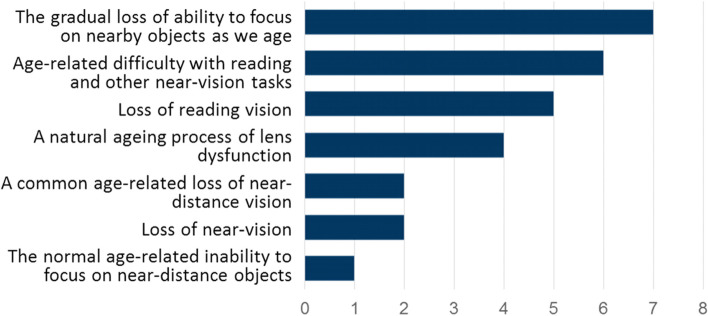
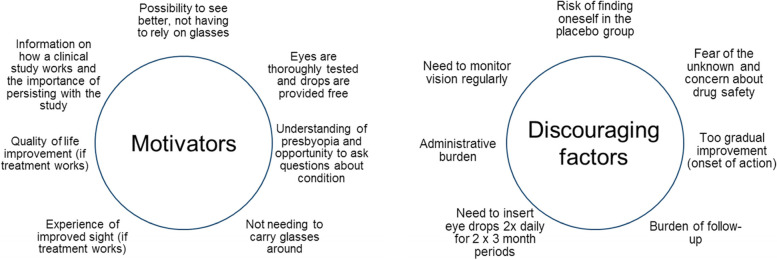
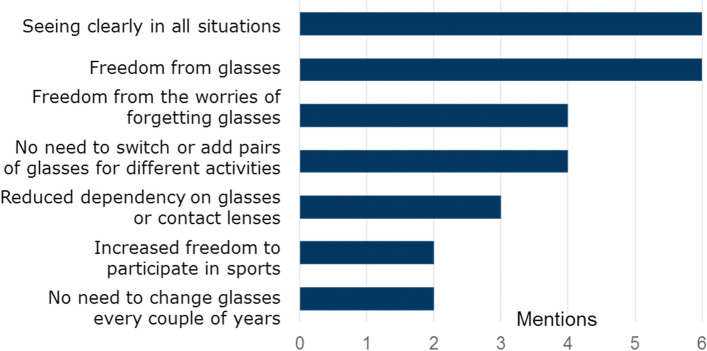
Nine individuals (age 40 to 70 years) with presbyopia participated, from Australia, China, France, Italy, Ireland, Japan and the US. One ophthalmologist and one optometrist represented the perspective of HCPs. Over two weeks, 621 posts were entered on the platform. There was widespread agreement that the often stated association between age and presbyopia was unfortunate. Some participants had developed presbyopia at 30-45 years of age. What is more, the association with age was seen as implying a natural process, reducing the incentive to treat. Instead there was a call for an action-oriented view of presbyopia as a condition which may be effectively treated in the future. All participants experienced dealing with presbyopia as burdensome, affecting quality of life to varying degrees. When considering new treatments, convenience was the most important factor. The option to administer drops when needed was considered favourable, but short-acting treatments may not reduce inconvenience compared with spectacles. Participants viewed a therapy that targets the underlying cause of the condition favourably compared with symptomatic treatment. Side effects would severely reduce the appeal of drops. For clinical trials in presbyopia, patient-reported outcomes should be mandatory and need adequately to capture quality of life. Studies in presbyopia must be designed to minimise the inconvenience to participants in order to counter the risk of high drop-out rates.
The interactive format provided insights into living with presbyopia, particularly the negative impact on quality of life, subjects' openness to new therapies, and the need to move away from considering the condition an unavoidable and intractable consequence of ageing.
远视是一种常见的进行性视力障碍,其特征是无法聚焦于近物。除了眼镜或隐形眼镜之外,出现了新的治疗选择,这凸显了评估患者/用户偏好的重要性。
远视患者和医疗保健专业人员(HCP)在虚拟顾问委员会平台上参与了针对特定问题的适度、结构化讨论。目的是更好地了解未满足的需求和生活在这种情况下的体验。包括封闭和开放问题。
来自澳大利亚、中国、法国、意大利、爱尔兰、日本和美国的 9 名年龄在 40 至 70 岁之间的远视患者参与了研究。一名眼科医生和一名视光师代表 HCP 的观点。在两周的时间里,平台上共输入了 621 条帖子。人们普遍认为,远视与年龄之间的关联常常被认为是不幸的。一些参与者在 30-45 岁时就已经出现了远视。更重要的是,与年龄的关联被视为暗示着一种自然过程,降低了治疗的动力。相反,人们呼吁将远视视为一种可以在未来得到有效治疗的疾病,采取行动导向的观点。所有参与者都经历了处理远视的负担,对生活质量产生了不同程度的影响。在考虑新的治疗方法时,便利性是最重要的因素。当需要时滴眼药水的选择被认为是有利的,但与眼镜相比,短效治疗可能不会减少不便。与对症治疗相比,参与者更倾向于针对疾病根本原因的治疗。眼药水的副作用会严重降低其吸引力。在远视临床试验中,患者报告的结果应该是强制性的,并且需要充分捕捉生活质量。为了降低高退出率的风险,在设计远视研究时,必须尽量减少对参与者的不便。
这种互动式的格式提供了对远视生活的深入了解,特别是对生活质量的负面影响、受试者对新疗法的开放性,以及需要摆脱将该疾病视为衰老不可避免和难以解决的后果的看法。