Graves Jennifer S, Thomas Marius, Li Jun, Shah Anuja R, Goodyear Alexandra, Lange Markus R, Schmidli Heinz, Häring Dieter A, Friede Tim, Gärtner Jutta
Department of Neurosciences, University of California, San Diego, Box 0662 ACTRI, 9452 Medical Center Drive, Suite 4W-222, San Diego, CA 92037, USA.
Novartis Pharma AG, Basel, Switzerland.
Ther Adv Neurol Disord. 2022 May 1;15:17562864211070449. doi: 10.1177/17562864211070449. eCollection 2022.
To support innovative trial designs in a regulatory setting for pediatric-onset multiple sclerosis (MS), the study aimed to perform a systematic literature review and meta-analysis of relapse rates with interferon β (IFN β), fingolimod, and natalizumab and thereby demonstrate potential benefits of Bayesian and non-inferiority designs in this population.
We conducted a literature search in MEDLINE and EMBASE from inception until 17 June 2020 of all studies reporting annualized relapse rates (ARR) in IFN β-, fingolimod-, or natalizumab-treated patients with pediatric-onset relapsing-remitting MS. These interventions were chosen because the literature was mainly available for these treatments, and they are currently used for the treatment of pediatric MS. Two researchers independently extracted data and assessed study quality using the Cochrane Effective Practice and Organization of Care - Quality Assessment Tool. The meta-analysis estimates were obtained by Bayesian random effects model. Data were summarized as ARR point estimates and 95% credible intervals.
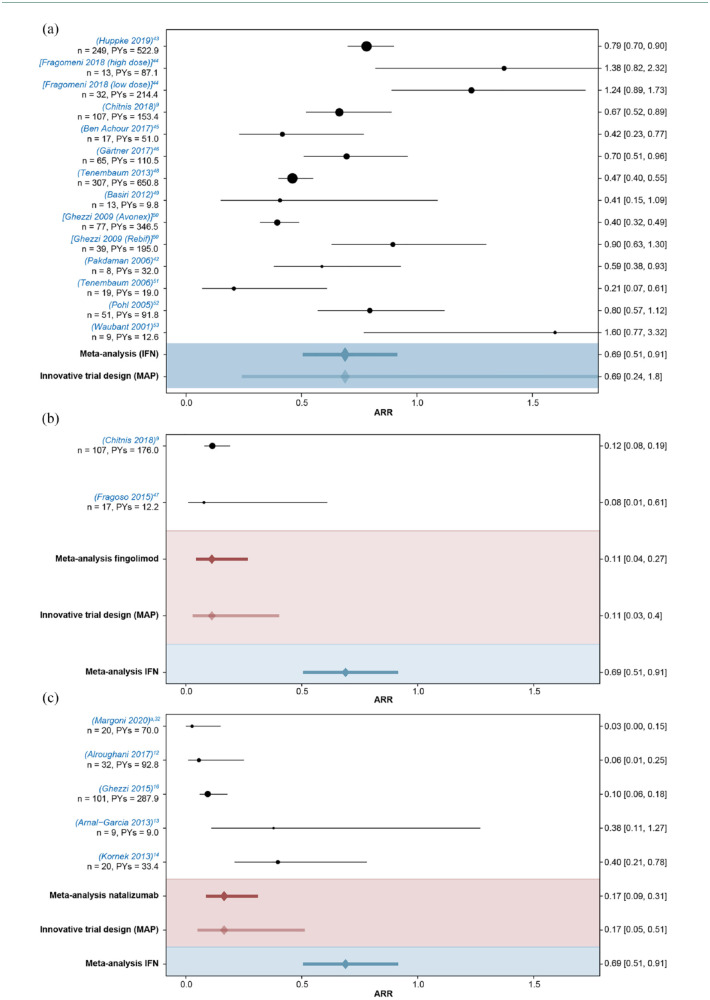
We found 19 articles, including 2 randomized controlled trials. The baseline ARR reported was between 1.4 and 3.7. The meta-analysis-based ARR was significantly higher in IFN β-treated patients (0.69, 95% credible interval: 0.51-0.91) versus fingolimod (0.11, 0.04-0.27) and natalizumab (0.17, 0.09-0.31). Based on the meta-analysis results, an appropriate non-inferiority margin versus fingolimod could be in the range of 2.29-2.67 and for natalizumab 1.72-2.29 on the ARR ratio scale. A Bayesian design, which uses historical information for a fingolimod or natalizumab control arm, could reduce the sample size of a new trial by 18 or 14 patients, respectively.
This meta-analysis provides evidence that relapse rates are considerably higher with IFNs versus fingolimod or natalizumab. The results support the use of innovative Bayesian or non-inferiority designs to avoid exposing patients to less effective comparators in trials and bringing new medications to patients more efficiently.
为支持儿科多发性硬化症(MS)监管环境下的创新试验设计,本研究旨在对干扰素β(IFNβ)、芬戈莫德和那他珠单抗的复发率进行系统的文献综述和荟萃分析,从而证明贝叶斯设计和非劣效性设计在该人群中的潜在益处。
我们在MEDLINE和EMBASE数据库中进行文献检索,检索时间从数据库建立至2020年6月17日,纳入所有报告IFNβ、芬戈莫德或那他珠单抗治疗的儿科复发缓解型MS患者年化复发率(ARR)的研究。选择这些干预措施是因为关于这些治疗的文献资料较为丰富,且它们目前用于儿科MS的治疗。两名研究人员独立提取数据,并使用Cochrane有效实践与护理组织质量评估工具评估研究质量。荟萃分析估计值通过贝叶斯随机效应模型获得。数据总结为ARR点估计值和95%可信区间。
我们找到19篇文章,包括2项随机对照试验。报告的基线ARR在1.4至3.7之间。基于荟萃分析,IFNβ治疗的患者的ARR显著高于芬戈莫德(0.69,95%可信区间:0.51 - 0.91)和那他珠单抗(0.17,0.09 - 0.31)治疗的患者。根据荟萃分析结果,在ARR比值尺度上,与芬戈莫德相比合适的非劣效界值范围可能在2.29 - 2.67之间,与那他珠单抗相比在1.72 - 2.29之间。采用贝叶斯设计,将芬戈莫德或那他珠单抗作为对照臂并利用历史信息,可分别减少新试验样本量18例或14例患者。
这项荟萃分析提供的证据表明,与芬戈莫德或那他珠单抗相比,IFN类药物的复发率要高得多。结果支持采用创新的贝叶斯或非劣效性设计,以避免在试验中让患者接触疗效较差的对照药物,并更高效地为患者带来新药物。