Deng Dingmei, Ye Xian, Wang Xiyue, He Guangning
Department of Breast Surgery, Affiliated Dongguan People's Hospital, Southern Medical University No. 3, South Wandao Road, Wanjiang District 523059 Dongguan Guangdong P. R. China
RSC Adv. 2019 Jul 1;9(35):20385-20394. doi: 10.1039/c9ra00016j. eCollection 2019 Jun 25.
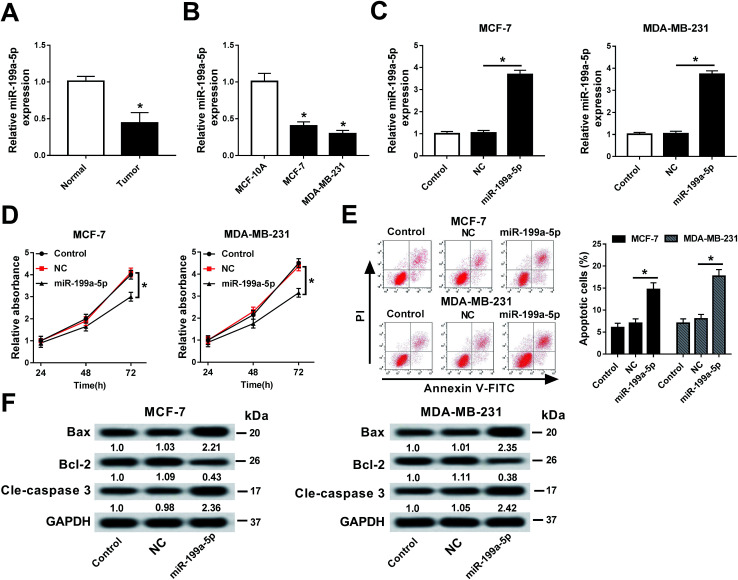
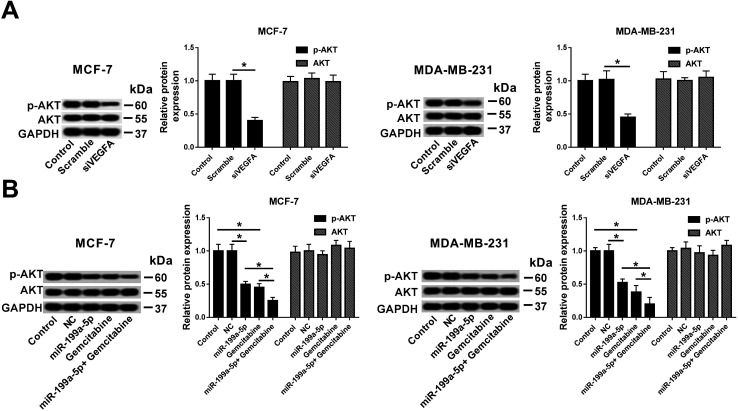
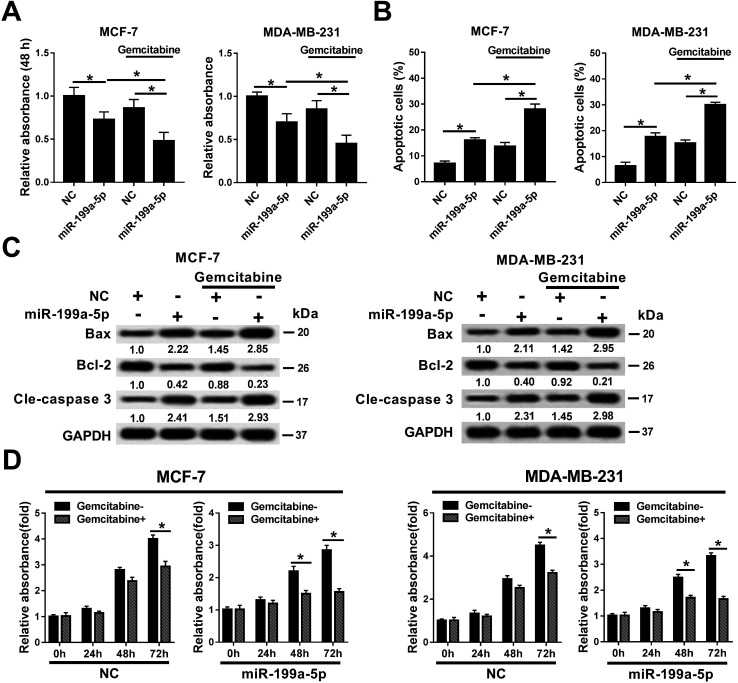
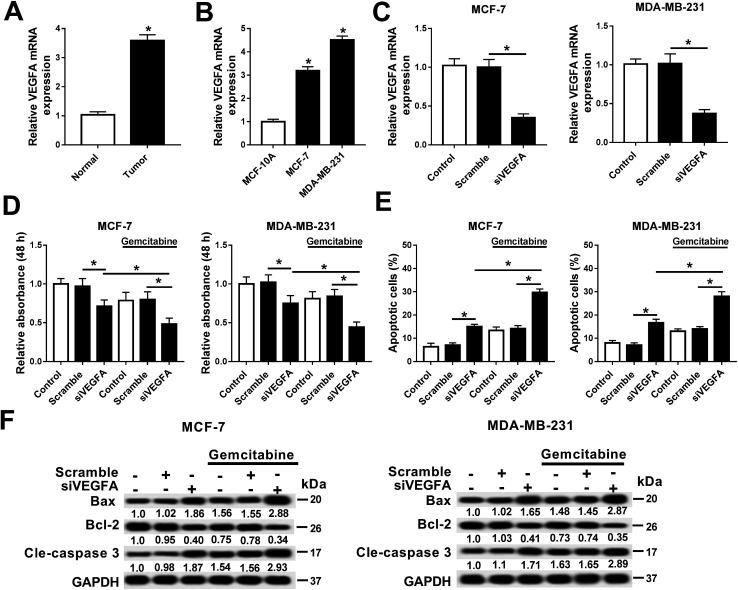
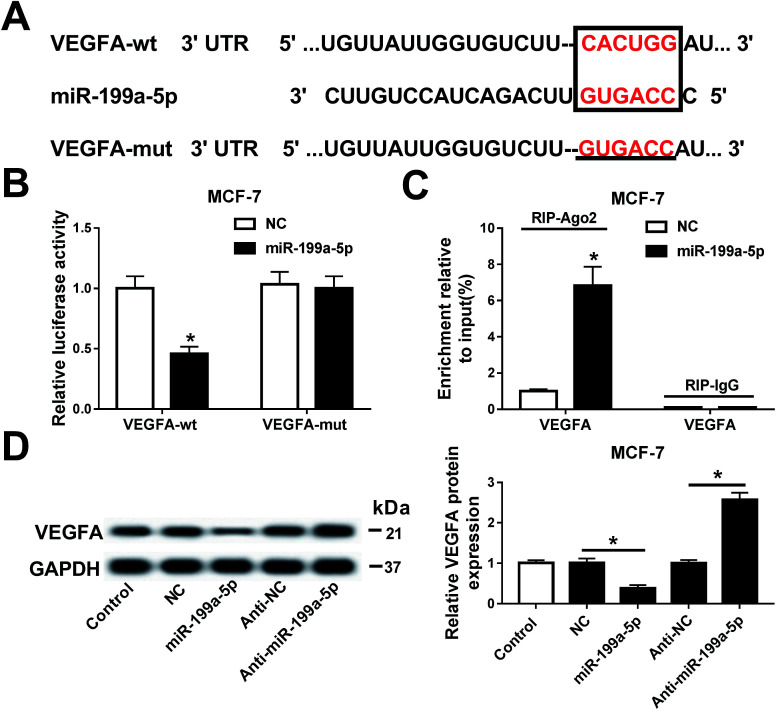
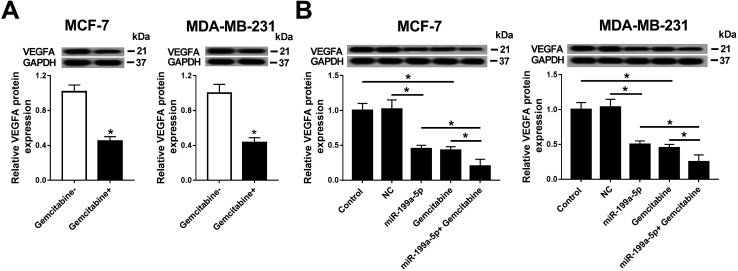
Breast cancer is the most frequent malignancy diagnosed in women, and Gemcitabine-based therapy is frequently used to treat late-stage breast cancer. miR-199a-5p plays a tumor-suppressive role in breast cancer. This work aimed to explore the mechanism of miR-199a-5p plus Gemcitabine in breast cancer cells. Expression of miR-199a-5p was measured by RT-qPCR, while expression of vascular endothelial growth factor A (VEGFA) was measured by Western blot and RT-qPCR. Overexpression of miR-199a-5p and/or silencing of VEGFA was obtained using transfection in breast cancer cells (MCF-7 and MDA-MB-231). Functional experiments were performed to explore cell viability, apoptosis rate, and expressions of apoptosis-related genes: cell viability was assessed by MTT staining, apoptosis rate was recorded by flow cytometry, and Western blot was used to evaluate the expressions of Bcl-2, Bax and cleaved caspase 3. The signaling pathway was studied with respect to AKT activity determination of p-AKT expression levels. Our study found that miR-199a-5p was downregulated and VEGFA was upregulated in breast cancer tissues and cells. Overexpression of miR-199a-5p and/or silencing of VEGFA contributed to cell apoptosis and inhibited cell viability, which was promoted by Gemcitabine. VEGFA was a downstream target of miR-199a-5p, and was negatively regulated by Gemcitabine. Moreover, Gemcitabine aggravated the miR-199a-5p-induced suppression of the VEGFA level and AKT activity in breast cancer cells. Our data show that Gemcitabine aggravates miR-199a-5p-mediated VEGFA downregulation and apoptosis inactivating the AKT signaling pathway in breast cancer cells, indicating a novel promising combined therapy of miR-199a-5p overexpression and Gemcitabine.
乳腺癌是女性中最常被诊断出的恶性肿瘤,基于吉西他滨的疗法常用于治疗晚期乳腺癌。miR-199a-5p在乳腺癌中发挥肿瘤抑制作用。这项研究旨在探究miR-199a-5p联合吉西他滨在乳腺癌细胞中的作用机制。通过RT-qPCR检测miR-199a-5p的表达,同时通过蛋白质免疫印迹法和RT-qPCR检测血管内皮生长因子A(VEGFA)的表达。在乳腺癌细胞(MCF-7和MDA-MB-231)中通过转染实现miR-199a-5p的过表达和/或VEGFA的沉默。进行功能实验以探究细胞活力、凋亡率以及凋亡相关基因的表达:通过MTT染色评估细胞活力,通过流式细胞术记录凋亡率,并用蛋白质免疫印迹法评估Bcl-2、Bax和裂解的半胱天冬酶3的表达。关于AKT活性测定p-AKT表达水平来研究信号通路。我们的研究发现,在乳腺癌组织和细胞中miR-199a-5p表达下调而VEGFA表达上调。miR-199a-5p的过表达和/或VEGFA的沉默促进细胞凋亡并抑制细胞活力,吉西他滨可增强这种作用。VEGFA是miR-199a-5p的下游靶点,并且受吉西他滨负调控。此外,吉西他滨加剧了miR-199a-5p诱导的乳腺癌细胞中VEGFA水平和AKT活性的抑制。我们的数据表明,吉西他滨通过使乳腺癌细胞中的AKT信号通路失活,加剧了miR-199a-5p介导的VEGFA下调和凋亡,这表明miR-199a-5p过表达与吉西他滨联合治疗具有新的前景。