Singh Neelima, Bakhshi Hadi, Meyer Wolfdietrich
Department of Functional Polymer Systems, Fraunhofer Institute for Applied Polymer Research IAP Geiselbergstraße 69 14476 Potsdam Germany
RSC Adv. 2020 Dec 15;10(72):44103-44110. doi: 10.1039/d0ra06388f. eCollection 2020 Dec 9.
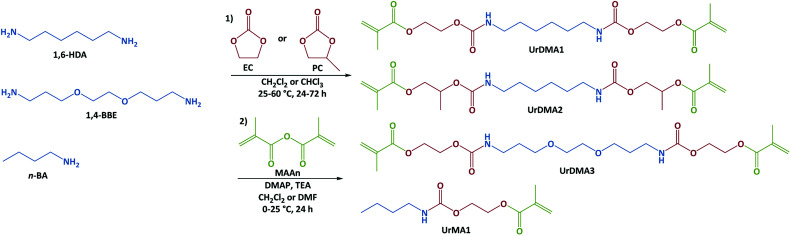
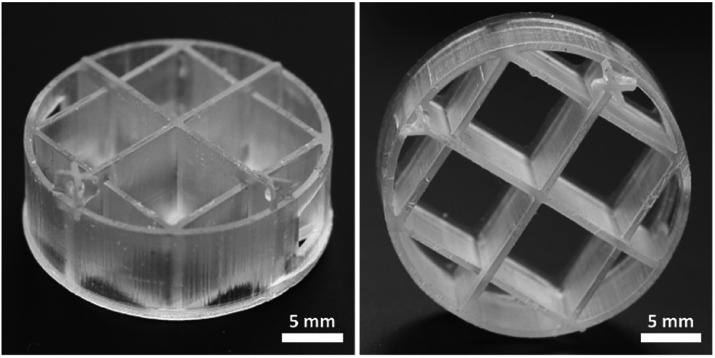
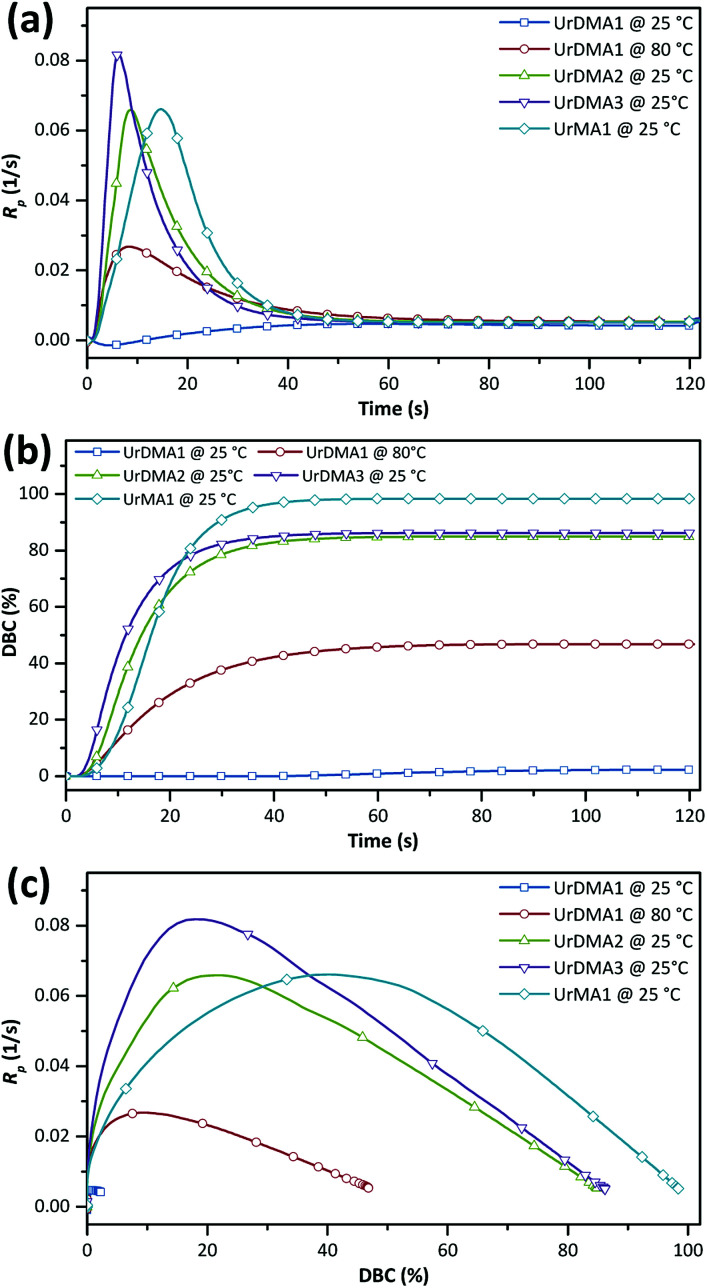
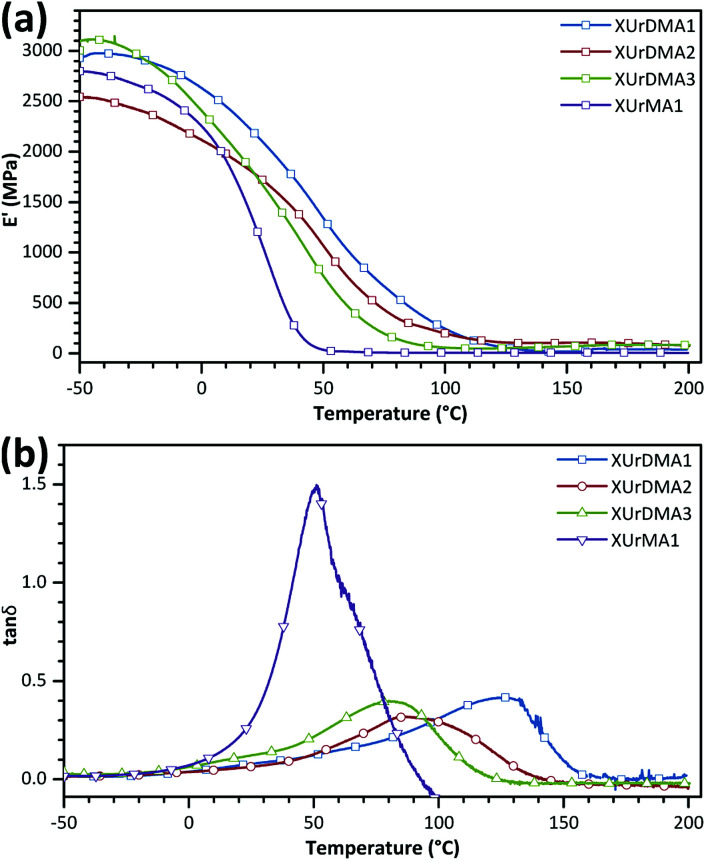
Urethane-methacrylate photo-monomers were prepared a non-isocyanate route for the 3D printing application. The monomers were synthesized through reacting aliphatic amines, 1,6-hexanediamine, 1,4-butanediol bis(3-aminopropyl) ether, or -butylamine, with cyclic carbonates, ethylene carbonate or propylene carbonate, followed by the methacrylation of the generated hydroxylurethanes. The effects of the chemical structure of monomers on their photo-reactivity and physicomechanical properties of the cured samples were studied. Propylene carbonate generated side methyl groups within the urethane block, which significantly limited the crystallization of the monomers resulting in high photo-reactivity ( = 6.59 × 10 s) and conversion (DBC = 85%). The ether bonds of 1,4-butanediol bis(3-aminopropyl) ether decreased the intermolecular hydrogen bonding between urethane blocks, which not only improved the photo-reactivity ( = 8.18 × 10 s) and conversion (DBC = 86%) of the monomer but led to a high crosslinking density ( = 5140 mol m) and more flexibility for the cured sample. An ink was developed based on the monomers and successfully 3D printed on a digital light processing machine. In the absence of toxic isocyanates and tin compounds, the non-isocyanate route can be employed to develop urethane-methacrylates with desirable photo-reactivity and physicomechanical properties as good candidates to formulate inks for 3D printing of biomedical materials.
通过非异氰酸酯路线制备了用于3D打印应用的聚氨酯 - 甲基丙烯酸酯光引发单体。这些单体是通过使脂肪族胺(1,6 - 己二胺、1,4 - 丁二醇双(3 - 氨丙基)醚或正丁胺)与环状碳酸酯(碳酸亚乙酯或碳酸亚丙酯)反应,然后对生成的羟基聚氨酯进行甲基丙烯酸酯化而合成的。研究了单体化学结构对其光反应性以及固化样品物理机械性能的影响。碳酸亚丙酯在聚氨酯嵌段内产生侧甲基,这显著限制了单体的结晶,从而导致高光反应性(k = 6.59×10⁻⁵ s⁻¹)和转化率(DBC = 85%)。1,4 - 丁二醇双(3 - 氨丙基)醚的醚键减少了聚氨酯嵌段之间的分子间氢键,这不仅提高了单体的光反应性(k = 8.18×10⁻⁵ s⁻¹)和转化率(DBC = 86%),还导致了高交联密度(ν = 5140 mol/m³)以及固化样品具有更大的柔韧性。基于这些单体开发了一种油墨,并成功在数字光处理机器上进行了3D打印。在不存在有毒异氰酸酯和锡化合物的情况下,非异氰酸酯路线可用于开发具有理想光反应性和物理机械性能的聚氨酯 - 甲基丙烯酸酯,作为用于生物医学材料3D打印油墨配方的良好候选物。