Dong Shuju, Li Yanbo, Guo Jian, Luo Yaxi, Fang Jinghuan, Tang Li, He Li
Department of Neurology, West China Hospital, Sichuan University, Chengdu, China.
Front Neurol. 2022 Apr 19;13:694418. doi: 10.3389/fneur.2022.694418. eCollection 2022.
Whether endovascular treatment (EVT) can further improve the prognosis of patients with posterior circulation ischemic stroke (PCIS) is unclear. This meta-analysis aims to compare the efficacy and safety of PCIS patients treated with EVT plus standard medical treatment (SMT) and SMT alone.
We systematically searched for relevant randomized controlled trials (RCTs) and prospective cohort trials in MEDLINE, EMBASE, and the Cochrane Library up to February 2022. The primary outcome was favorable functional outcome of the modified Rankin Scale (mRS) with scores of 0-2 or 0-3; secondary outcomes included successful recanalization rate, intracranial hemorrhage (ICH), or symptomatic intracranial hemorrhage (sICH) after treatment and 90-day mortality.
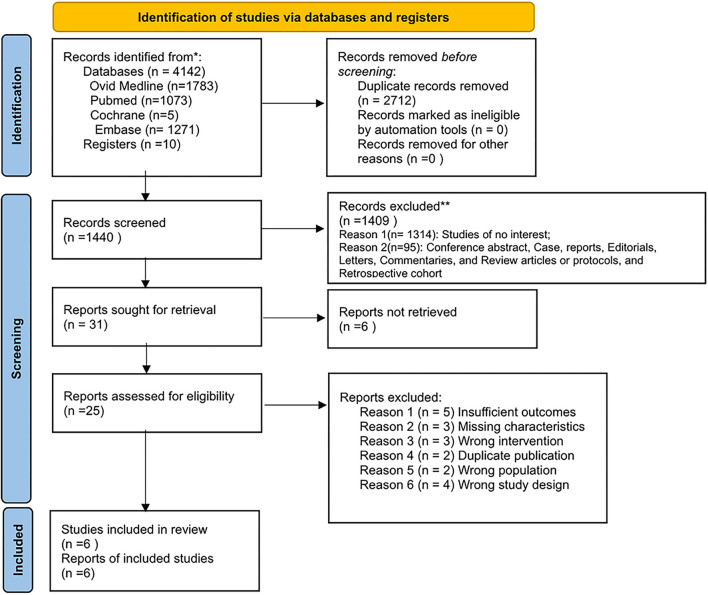
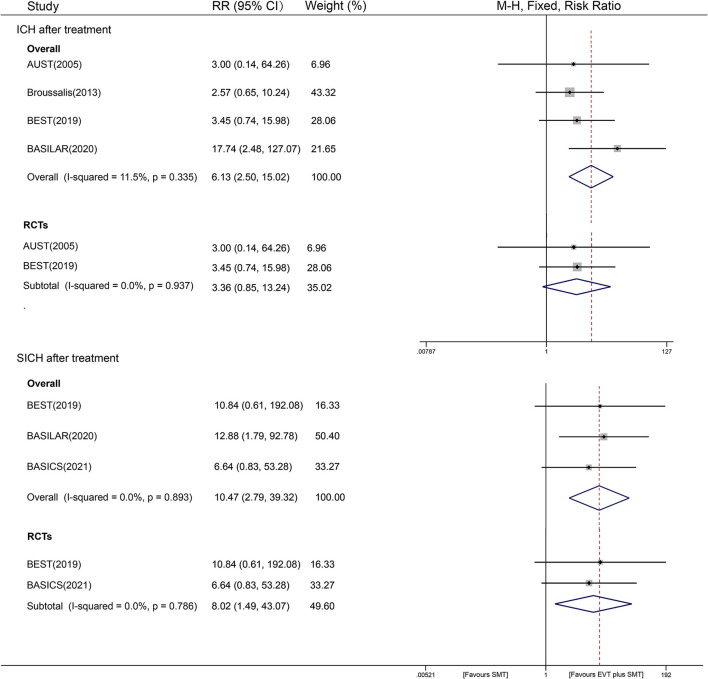
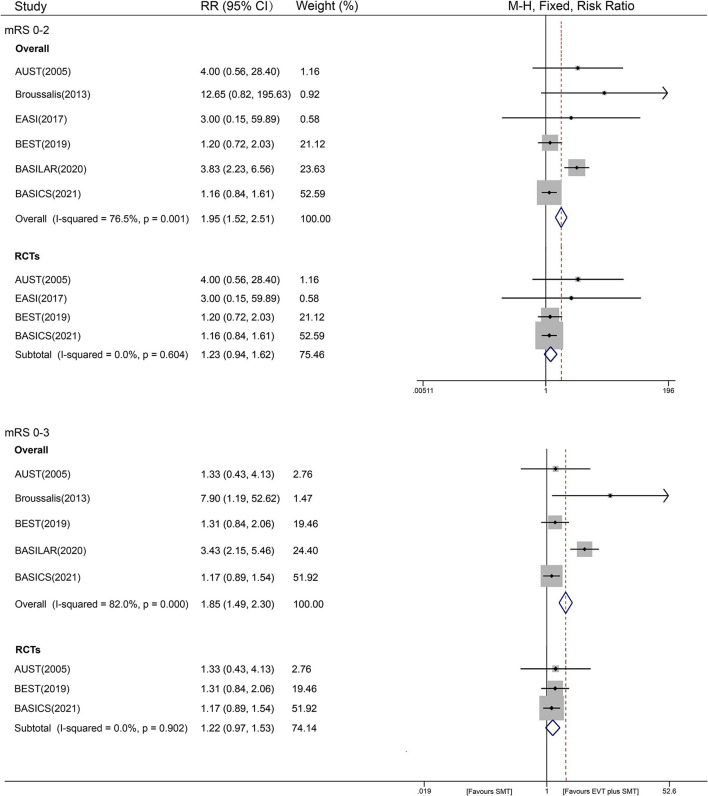
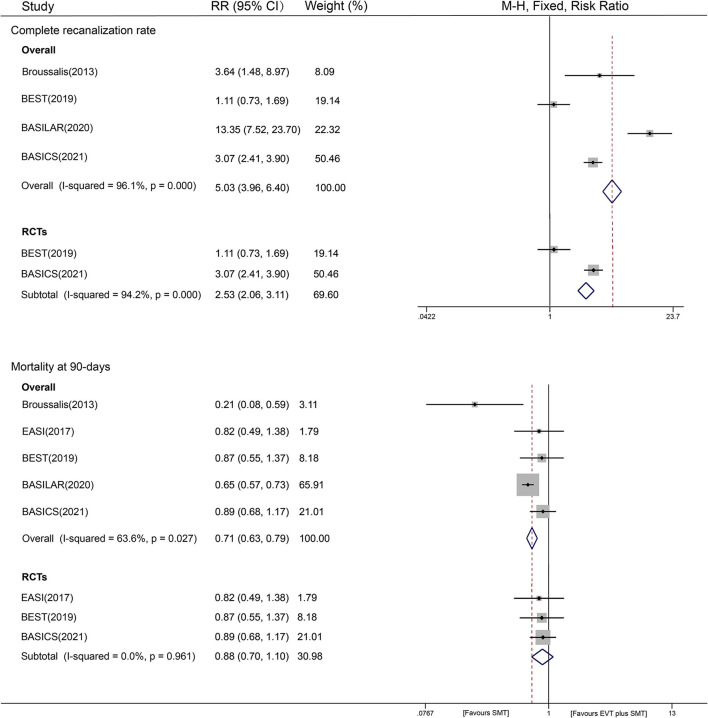
We identified six studies including 1, 385 PCIS patients (957 with EVT plus SMT; 428 with SMT alone). EVT plus SMT substantially improved 90-day functional outcomes compared with SMT alone [mRS score of 0-2: RR=1.95, 95% CI (1.52 - 2.51), < 0.001; mRS score of 0-3: RR = 1.85, 95% CI (1.49 - 2.30), < 0.001, respectively]. Moreover, compared with SMT, combined treatment significantly improved the rate of successful recanalization [RR = 5.03, 95% CI (3.96-6.40), < 0.001] and reduced 90-day mortality [RR = 0.71, 95% CI (0.63-0.79), < 0.001] despite a higher risk of ICH [RR = 6.13, 95% CI (2.50-15.02), < 0.001] and sICH [RR = 10.47, 95% CI [2.79-39.32), = 0.001].
Low-to-moderate evidence from RCTs and non-RCTs showed that increased ICH and sICH risk of EVT plus SMT did not translate to a higher risk of unfavorable outcomes compared with SMT and could even promote independence at 90 days in a real-world cohort.
血管内治疗(EVT)能否进一步改善后循环缺血性卒中(PCIS)患者的预后尚不清楚。本荟萃分析旨在比较接受EVT联合标准药物治疗(SMT)与单纯SMT治疗的PCIS患者的疗效和安全性。
我们系统检索了截至2022年2月MEDLINE、EMBASE和Cochrane图书馆中的相关随机对照试验(RCT)和前瞻性队列试验。主要结局是改良Rankin量表(mRS)评分为0-2或0-3的良好功能结局;次要结局包括治疗后成功再通率、颅内出血(ICH)或症状性颅内出血(sICH)以及90天死亡率。
我们纳入了6项研究,共1385例PCIS患者(957例接受EVT联合SMT;428例单纯接受SMT)。与单纯SMT相比,EVT联合SMT显著改善了90天功能结局[mRS评分为0-2:RR=1.95,95%CI(1.52-2.51),P<0.001;mRS评分为0-3:RR=1.85,95%CI(1.49-2.30),P<0.001]。此外,与SMT相比,联合治疗显著提高了成功再通率[RR=5.03,95%CI(3.96-6.40),P<0.001],并降低了90天死亡率[RR=0.71,95%CI(0.63-0.79),P<0.001],尽管ICH[RR=6.13,95%CI(2.50-15.02),P<0.001]和sICH[RR=10.47,95%CI(2.79-39.32),P=0.001]风险更高。
来自RCT和非RCT的低至中等证据表明,与SMT相比,EVT联合SMT增加的ICH和sICH风险并未转化为不良结局的更高风险,甚至可能促进现实世界队列中90天时的独立性。