Liang Shaohua, Wang Shukun, Meng Yannan, Sun Cong
College of Food Science and Engineering, Henan University of Technology Lianhua Road 100 Zhengzhou 450001 Henan Province P. R. China
RSC Adv. 2020 Oct 21;10(64):38727-38735. doi: 10.1039/d0ra07012b.
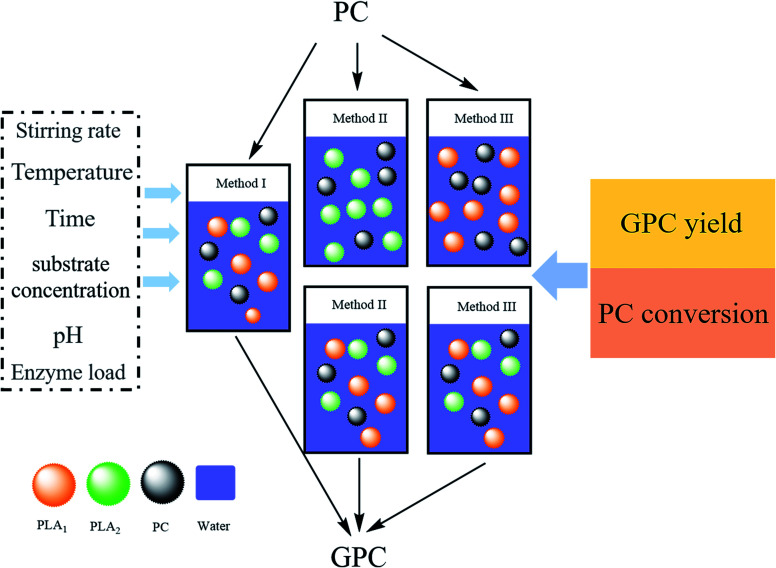
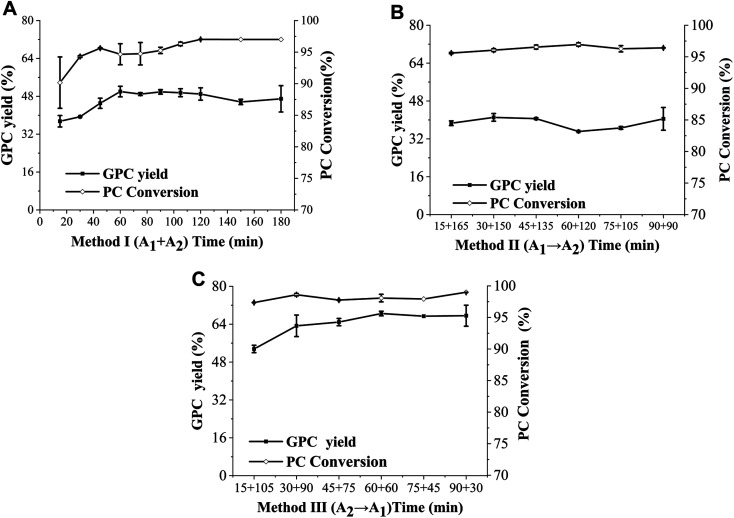
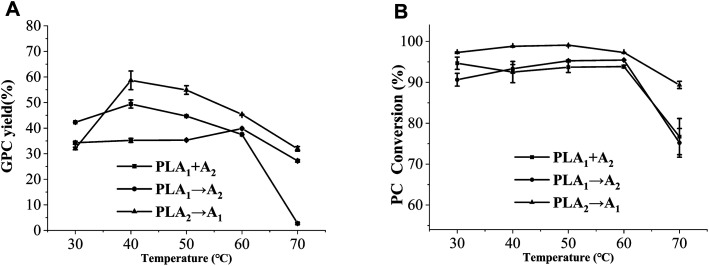
Glycerophosphatilcholine (GPC) is widely applied in medical, pharmaceutical, food and cosmetic industries. Due to the lack of natural resources, enzymatic preparation of GPC has been explored in recent years. This study aimed to investigate and compare the effects of different addition methods of combinational phospholipases (PLA and PLA) and various process parameters (time, temperature, pH, substrate concentrate, enzyme load, and stirring rate) on the preparation of GPC. The results showed that compared with concerted catalysis, the catalytic efficiency of adding PLA and then PLA (PLA → A) was higher, whereas that of adding PLA and then PLA was lower. The main reason might be that the method of PLA → A could reduce acyl migration and the competition between PLA and PLA, which was beneficial to improve the GPC yield and shorten the reaction time. This paper could provide a novel approach for the future preparation of GPC catalyzed by combinational phospholipases.
甘油磷脂胆碱(GPC)广泛应用于医疗、制药、食品和化妆品行业。由于天然资源匮乏,近年来人们对GPC的酶法制备进行了探索。本研究旨在研究和比较组合磷脂酶(PLA和PLA)不同添加方式以及各种工艺参数(时间、温度、pH值、底物浓度、酶负载量和搅拌速率)对GPC制备的影响。结果表明,与协同催化相比,先添加PLA再添加PLA(PLA→A)的催化效率更高,而先添加PLA再添加PLA的催化效率较低。主要原因可能是PLA→A的方法可以减少酰基迁移以及PLA和PLA之间的竞争,这有利于提高GPC产率并缩短反应时间。本文可为未来组合磷脂酶催化制备GPC提供一种新方法。