Handing Elizabeth P, Strobl Carolin, Jiao Yuqin, Feliciano Leilani, Aichele Stephen
Department of Human Development and Family Studies, Colorado State University, 410 W Pitkin St, Fort Collins, CO 80523, USA.
Department of Psychology, University of Zurich, Switzerland.
Lancet Reg Health Eur. 2022 Apr 29;18:100391. doi: 10.1016/j.lanepe.2022.100391. eCollection 2022 Jul.
The high prevalence of depression in a growing aging population represents a critical public health issue. It is unclear how social, health, cognitive, and functional variables rank as risk/protective factors for depression among older adults and whether there are conspicuous differences among men and women.
We used random forest analysis (RFA), a machine learning method, to compare 56 risk/protective factors for depression in a large representative sample of European older adults (N = 67,603; ages 45-105y; 56.1% women; 18 countries) from the Survey of Health, Ageing and Retirement in Europe (SHARE Wave 6). Depressive symptoms were assessed using the EURO-D questionnaire: Scores ≥ 4 indicated depression. Predictors included a broad array of sociodemographic, relational, health, lifestyle, and cognitive variables.
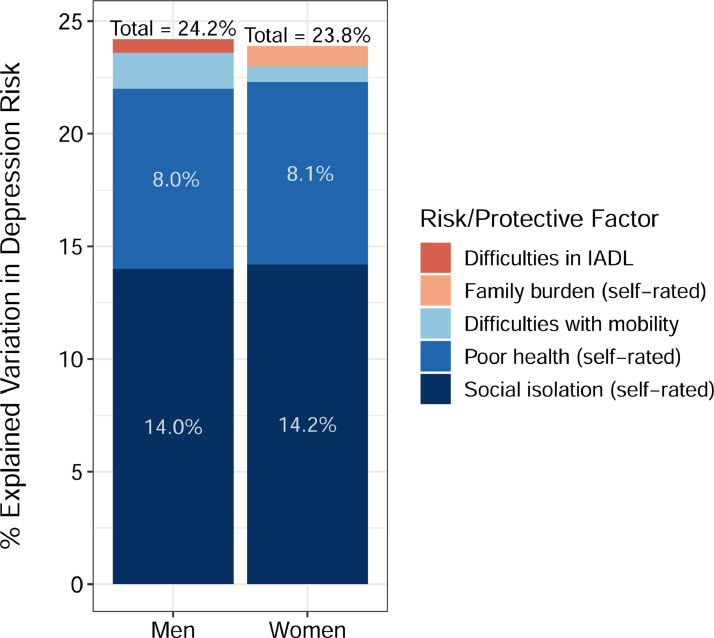
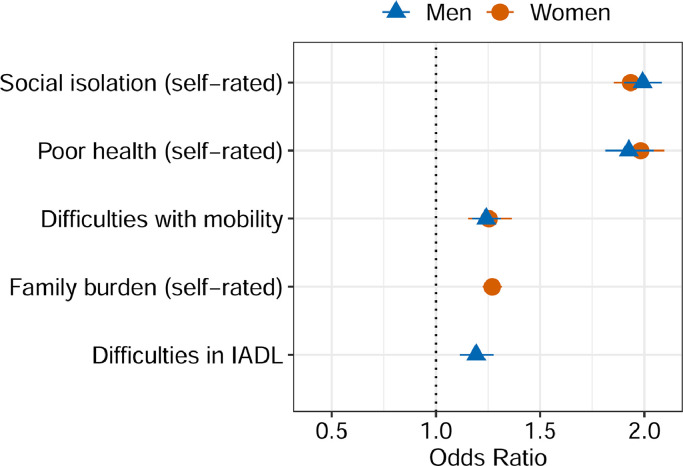
Self-rated social isolation and self-rated poor health were the strongest risk factors, accounting for 22.0% (in men) and 22.3% (in women) of variability in depression. Odds ratios (OR) per +1SD in social isolation were 1.99x, 95% CI [1.90,2.08] in men; 1.93x, 95% CI [1.85,2.02] in women. OR for self-rated poor health were 1.93x, 95% CI [1.81,2.05] in men; 1.98x, 95% CI [1.87,2.10] in women. Difficulties in mobility (in both sexes), difficulties in instrumental activities of daily living (in men), and higher self-rated family burden (in women) accounted for an additional but small percentage of variance in depression risk (2.2% in men, 1.5% in women).
Among 56 predictors, self-perceived social isolation and self-rated poor health were the most salient risk factors for depression in middle-aged and older men and women. Difficulties in instrumental activities of daily living (in men) and increased family burden (in women) appear to differentially influence depression risk across sexes.
This study was internally funded by Colorado State University through research start-up monies provided to Stephen Aichele, Ph.D.
在不断增长的老年人口中,抑郁症的高患病率是一个关键的公共卫生问题。目前尚不清楚社会、健康、认知和功能变量在老年人抑郁症风险/保护因素中的排序情况,以及男性和女性之间是否存在显著差异。
我们使用随机森林分析(RFA)这一机器学习方法,对来自欧洲健康、老龄化和退休调查(SHARE第6波)的大量具有代表性的欧洲老年人样本(N = 67,603;年龄45 - 105岁;女性占56.1%;18个国家)中的56个抑郁症风险/保护因素进行比较。使用EURO - D问卷评估抑郁症状:得分≥4表明患有抑郁症。预测因素包括一系列社会人口统计学、人际关系、健康、生活方式和认知变量。
自我评定的社会隔离和自我评定的健康状况不佳是最强的风险因素,分别解释了男性抑郁症变异性的22.0%和女性的22.3%。社会隔离每增加1个标准差,男性的优势比(OR)为1.99倍,95%置信区间[1.90, 2.08];女性为1.93倍,95%置信区间[1.85, 2.02]。自我评定健康状况不佳的OR,男性为1.93倍,95%置信区间[1.81, 2.05];女性为1.98倍,95%置信区间[1.87, 2.10]。行动困难(男女皆有)、日常生活工具性活动困难(男性)以及自我评定的家庭负担较重(女性)在抑郁症风险变异中占额外但较小的比例(男性为2.2%,女性为1.5%)。
在56个预测因素中,自我感知的社会隔离和自我评定的健康状况不佳是中老年男性和女性抑郁症最突出的风险因素。日常生活工具性活动困难(男性)和家庭负担增加(女性)似乎对不同性别的抑郁症风险有不同影响。
本研究由科罗拉多州立大学通过提供给斯蒂芬·艾歇尔博士的研究启动资金内部资助。