Hlekelele Lerato, Nomadolo Nomvuyo E, Setshedi Katlego Z, Mofokeng Lethula E, Chetty Avashnee, Chauke Vongani P
Polymers and Composites, Materials Science and Manufacturing, Council for Scientific and Industrial Research PO Box 395 0001 Pretoria South Africa
Molecular Sciences Institute, School of Chemistry, University of the Witwatersrand (Wits) Private Bag X3 Johannesburg 2050 South Africa.
RSC Adv. 2019 May 9;9(25):14531-14543. doi: 10.1039/c9ra01666j. eCollection 2019 May 7.
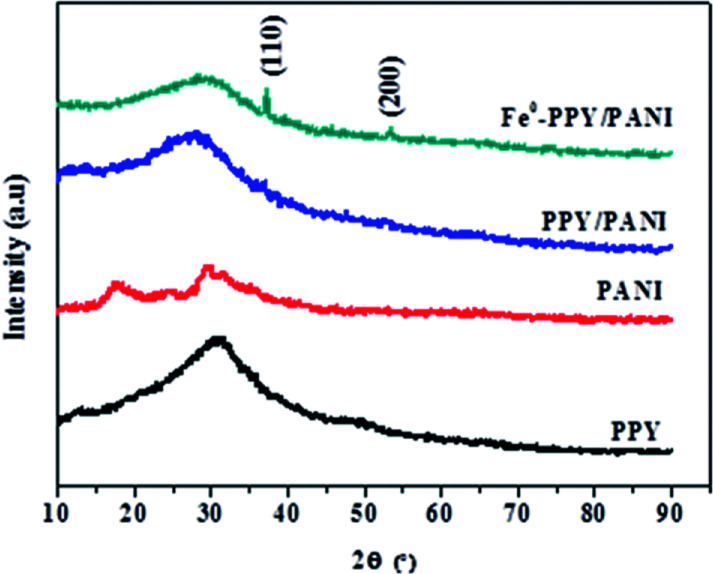
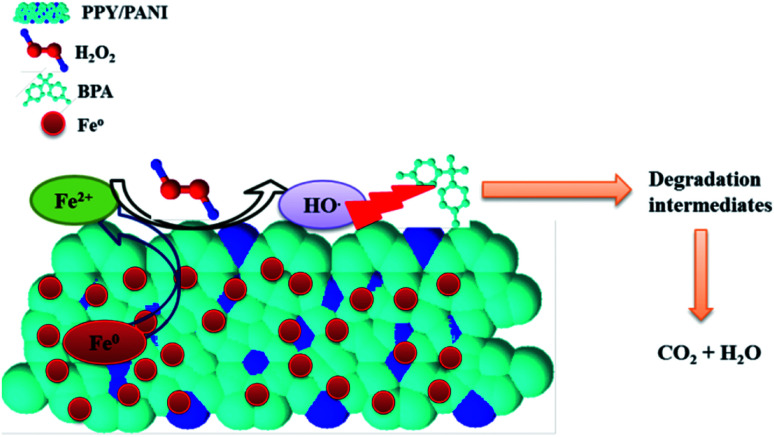
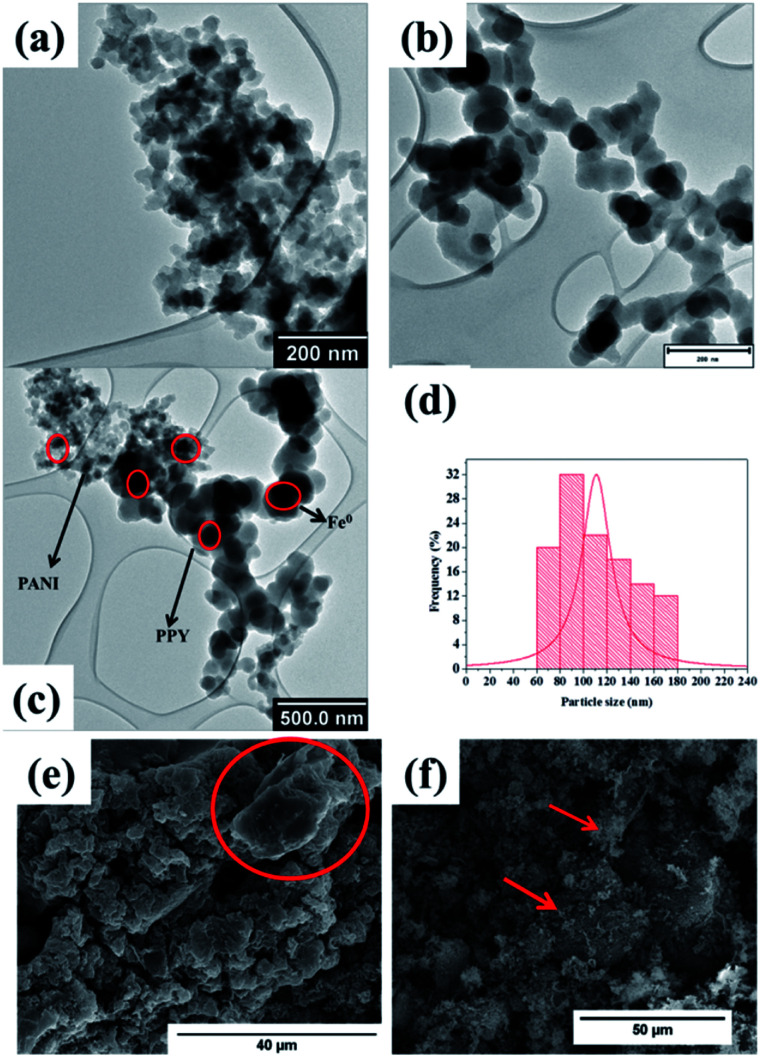
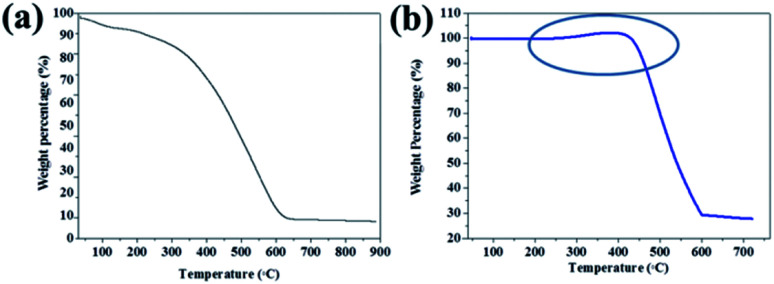
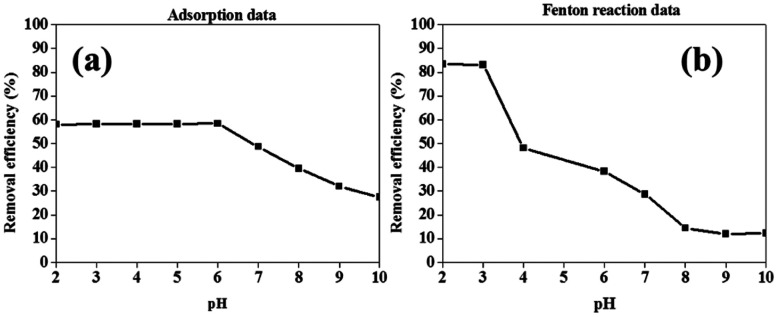
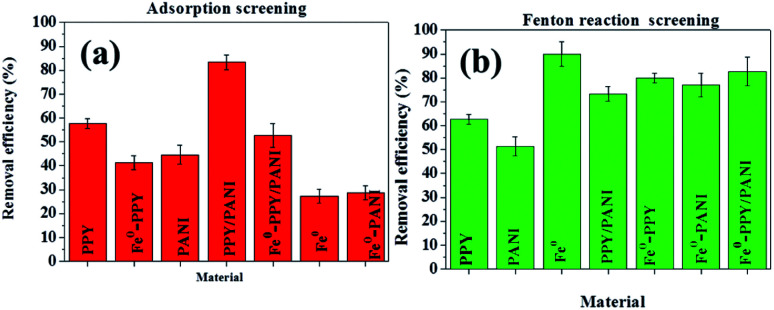
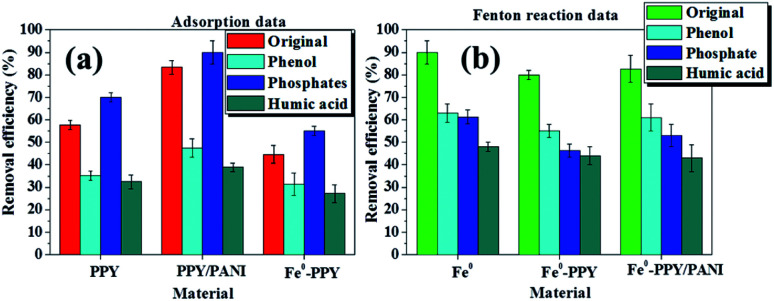
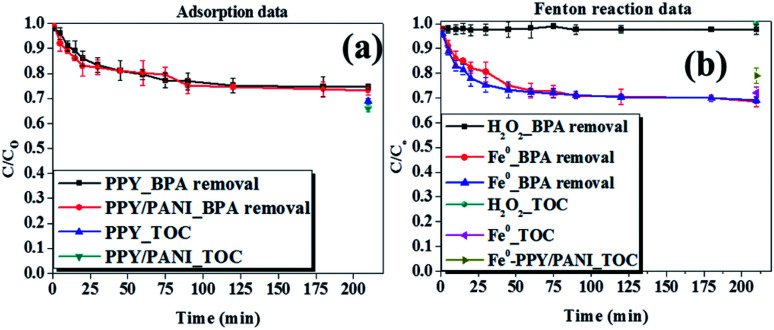
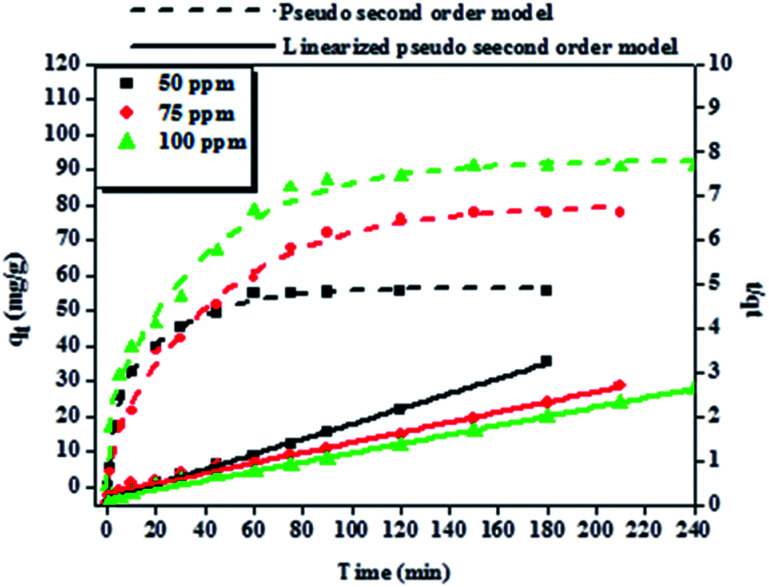
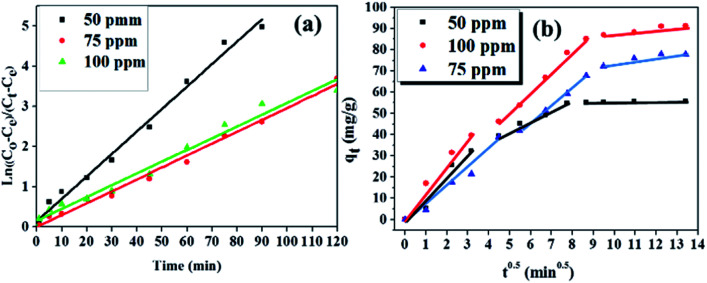
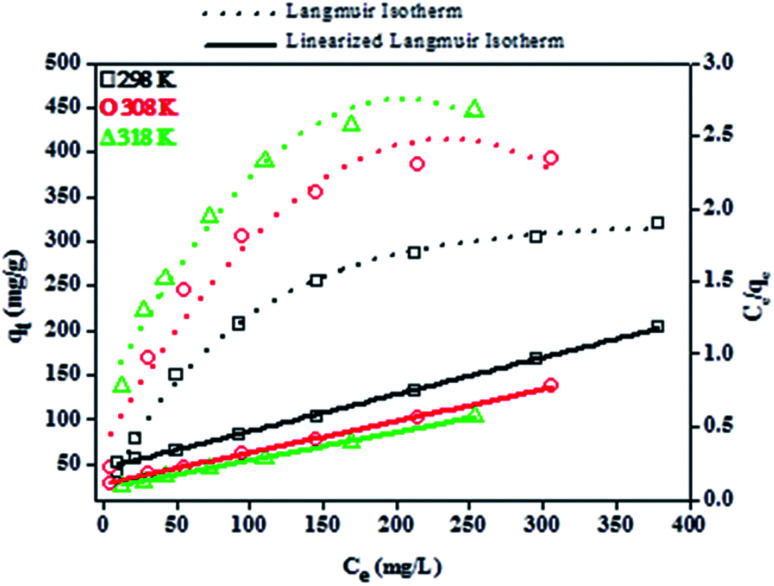
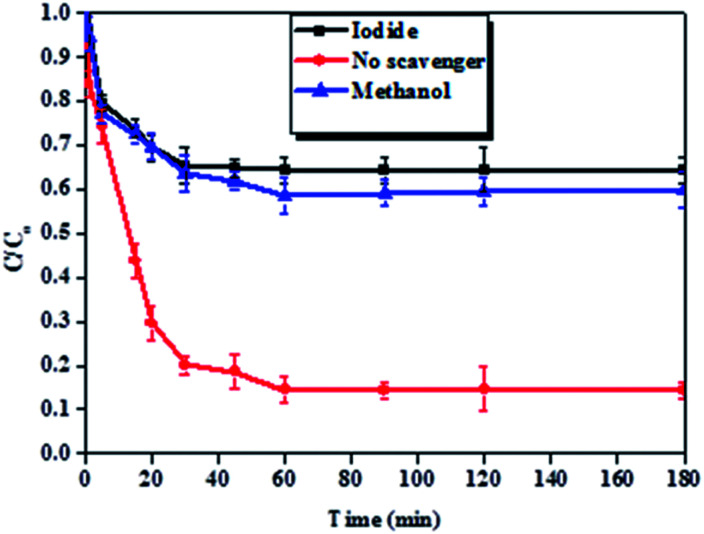
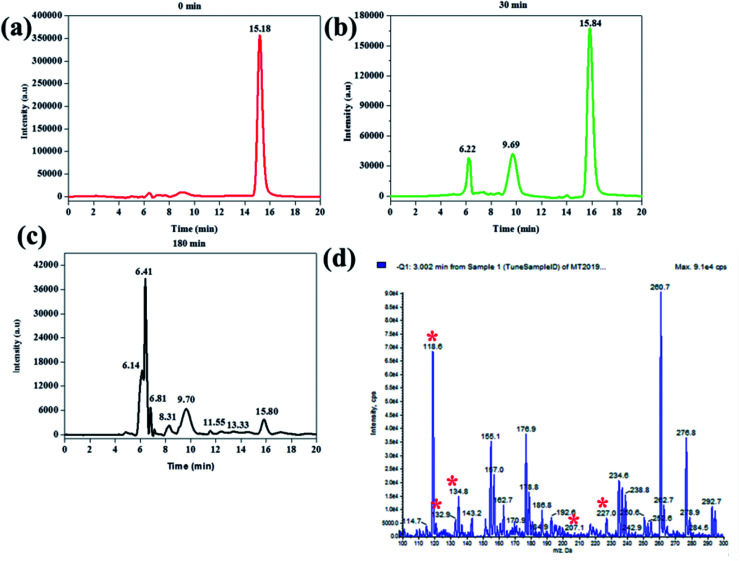
One pot synthesis of a polypyrrole, polyaniline and Fe nano-composite (Fe-PPY/PANI) was achieved by polymerizing aniline and pyrrole with FeCl followed by the reduction of Fe to Fe with NaBH. PPY/PANI was synthesized the same way as Fe-PPY/PANI, except that all the FeCl was removed by rinsing. The presence of Fe was demonstrated using several analytical techniques; this was shown in comparison to materials that are without Fe. A series of materials were screened as both adsorbents and catalyst for the activation of HO towards bisphenol A (BPA) removal in batch experiments. Polymers performed better than composites containing Fe at adsorption, whereas Fe based materials were better catalysts for the activation of HO. BPA samples were then spiked with other contaminants including sewage water to test the performance of the various adsorbents and Fenton catalysts. PPY/PANI was found to be a better adsorbent than the rest, whereas Fe-PPY/PANI was the best Fenton catalyst. The adsorption kinetics of BPA onto PPY/PANI was studied; it was found that the process was governed by the pseudo-second-order kinetic model. The adsorption isotherms revealed that the amount of BPA taken up by PPY/PANI increased with increasing temperature and was governed by the Langmuir adsorption isotherm. The mechanism in which Fe-PPY/PANI and HO degraded BPA was studied, it was found that surface-bound hydroxyl radicals were responsible for the degradation of BPA. It was also shown that the degradation process included the formation of smaller compounds leading to the reduction of the total organic content by 57%.
通过用FeCl使苯胺和吡咯聚合,随后用NaBH将Fe还原为Fe,实现了聚吡咯、聚苯胺和Fe纳米复合材料(Fe-PPY/PANI)的一锅合成。PPY/PANI的合成方法与Fe-PPY/PANI相同,只是通过冲洗除去了所有的FeCl。使用几种分析技术证明了Fe的存在;与不含Fe的材料相比显示了这一点。在分批实验中,筛选了一系列材料作为吸附剂和用于活化HO以去除双酚A(BPA)的催化剂。在吸附方面,聚合物的性能优于含Fe的复合材料,而铁基材料是活化HO的更好催化剂。然后向BPA样品中加入包括污水在内的其他污染物,以测试各种吸附剂和芬顿催化剂的性能。发现PPY/PANI是比其他材料更好的吸附剂,而Fe-PPY/PANI是最好的芬顿催化剂。研究了BPA在PPY/PANI上的吸附动力学;发现该过程受伪二级动力学模型控制。吸附等温线表明,PPY/PANI吸附的BPA量随温度升高而增加,且受朗缪尔吸附等温线控制。研究了Fe-PPY/PANI和HO降解BPA的机制,发现表面结合的羟基自由基是BPA降解的原因。还表明,降解过程包括形成较小的化合物,导致总有机含量降低57%。