Wu Jian-Feng, Gao Xin, Ge Ling, Zhao Guang-Chao, Wang Guang-Feng
Anhui Provincial Engineering Laboratory of Water and Soil Pollution Control and Remediation, College of Environmental Science and Engineering, Anhui Normal University Wuhu China
RSC Adv. 2019 Jun 25;9(34):19813-19818. doi: 10.1039/c9ra02475a. eCollection 2019 Jun 19.
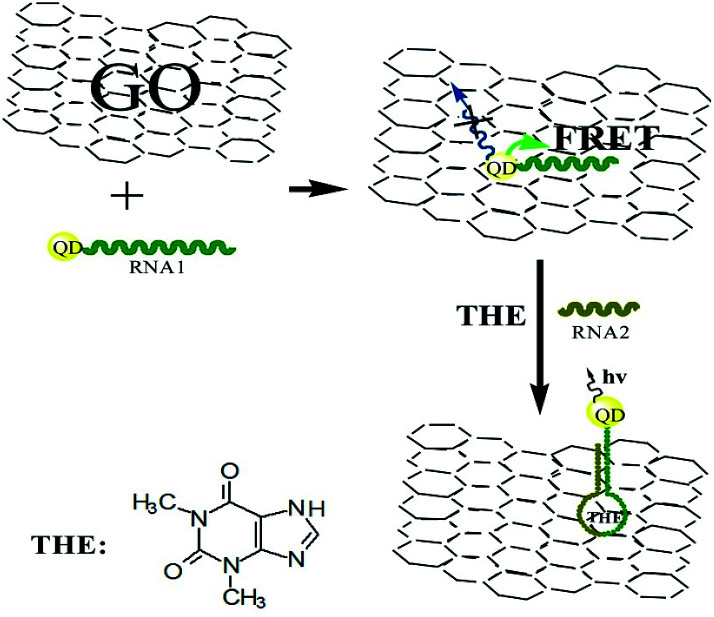
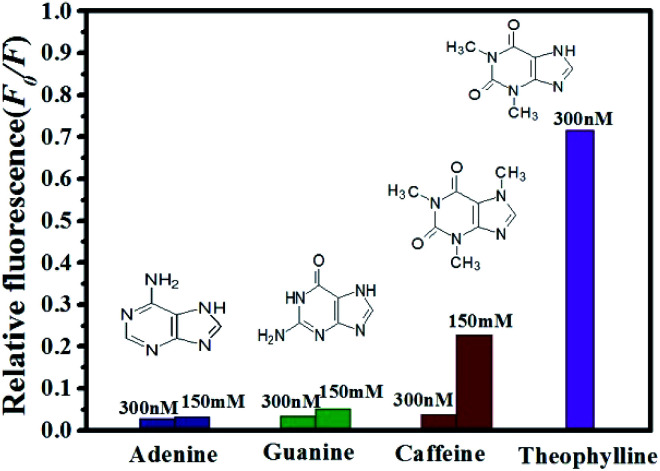
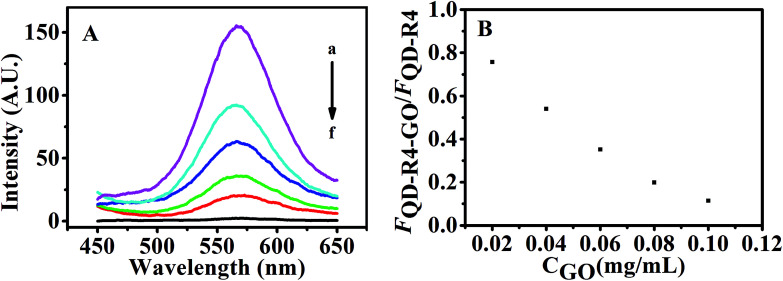
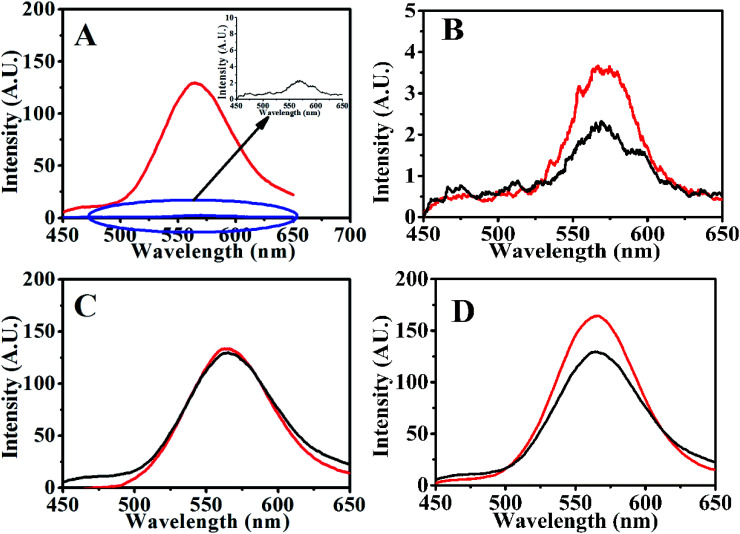
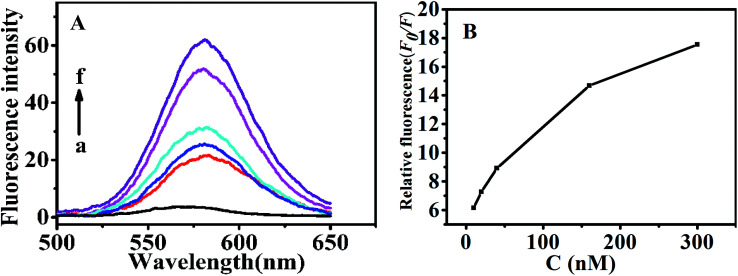
RNA, with a structure similar to DNA, should exhibit similar behaviors when it interacts with graphene. In this work, we designed a sensing platform of theophylline based on the interaction of an RNA aptamer with graphene oxide (GO) using the fluorescence as a sensing signal. Firstly, quantum dots (QDs) were modified with the selected ssRNA that can be used as an aptamer to recognize the theophylline. The fluorescence of QDs will be quenched in the presence of GO due to the noncovalent assembly between ssRNA aptamer and GO, leading to fluorescence resonance energy transfer (FRET) from QDs to GO, fluorescence "turn-off". Then, in the presence of theophylline, the ssRNA aptamer recognizes theophylline to form a dsRNA-theophylline complex. The weak affinity between the complex and GO makes QDs move away from the GO surface, leading to the fluorescence recovery of QDs, fluorescence "turn-on". Because of the high fluorescence quenching efficiency, unique structure of GO and specificity of the RNA aptamer, the proposed sensing platform exhibits high sensitivity and excellent selectivity for the determination of theophylline. The excellent performance of the sensor based on GO provides new opportunities for sensitive and selective detection of biorecognition events.
RNA的结构与DNA相似,因此在与石墨烯相互作用时应表现出相似的行为。在这项工作中,我们设计了一种基于RNA适配体与氧化石墨烯(GO)相互作用的茶碱传感平台,以荧光作为传感信号。首先,用选定的可作为识别茶碱的适配体的单链RNA修饰量子点(QDs)。由于单链RNA适配体与GO之间的非共价组装,在GO存在的情况下QDs的荧光将被淬灭,导致从QDs到GO的荧光共振能量转移(FRET),即荧光“关闭”。然后,在茶碱存在的情况下,单链RNA适配体识别茶碱形成双链RNA - 茶碱复合物。该复合物与GO之间的弱亲和力使QDs从GO表面移开,导致QDs的荧光恢复,即荧光“开启”。由于高荧光淬灭效率、GO的独特结构和RNA适配体的特异性,所提出的传感平台对茶碱的测定具有高灵敏度和优异的选择性。基于GO的传感器的优异性能为生物识别事件的灵敏和选择性检测提供了新的机会。