Pei Bei, Wei Shuangming, Chen Liwei, Pan Rongkun, Yu Minggao, Jing Guoxun
Collaborative Innovation Center of Coal Safety Production of Henan Province, Henan Polytechnic University Jiaozuo Henan 454003 PR China.
State Key Laboratory of Coal Mine Disaster Dynamics and Control, Chongqing University Chongqing 400044 PR China.
RSC Adv. 2019 May 7;9(24):13940-13948. doi: 10.1039/c9ra01148j. eCollection 2019 Apr 30.
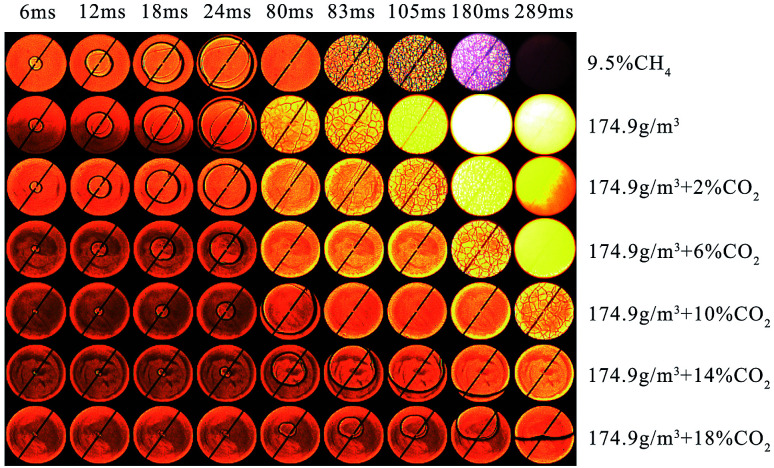
Cellular instability is responsible for the self-acceleration of a flame, and such acceleration might cause considerable damage. This paper presents an experimental study on the inhibition effect of CO and an ultrafine water mist on the self-acceleration characteristics of a spherical flame in the initial stage of a 9.5% methane/air explosion in a constant volume combustion bomb. Results showed that insufficient water mist enhanced the self-acceleration of the spherical flame and the intensity of the explosion; nevertheless, the synergistic inhibition effect of CO and ultrafine water mist prevented enhancement of the explosion and significantly mitigated the self-acceleration of spherical flames, which observably delayed the appearance time of a cellular flame, and reduced the flame propagation speed, overpressure and the mean rate of pressure rise, indicating that suppression of flame self-acceleration could effectively mitigate the damage from a methane/air explosion. The reason for the synergistic effect was a result of a combination of physical suppression and chemical suppression: due to the preferential diffusion dilution effect of CO, the initial flame speed was reduced, and the flame became thicker, which increased the evaporation time and quantity of droplets around the flame front, accordingly enhancing the cooling effect on the flame front. The increased flame thickness could withstand greater disturbance and inhibit the formation and development of a cellular flame. Meanwhile, CO and HO can also reduce the concentration of active radicals (O, H and OH) and reduce the reaction rate and combustion rate of a methane/air explosion.
胞状不稳定性是火焰自加速的原因,这种加速可能会造成相当大的破坏。本文针对在定容燃烧弹中9.5%甲烷/空气爆炸初始阶段,一氧化碳和超细水雾对球形火焰自加速特性的抑制作用开展了一项实验研究。结果表明,水雾不足会增强球形火焰的自加速以及爆炸强度;然而,一氧化碳和超细水雾的协同抑制作用阻止了爆炸增强,并显著减轻了球形火焰的自加速,这明显延迟了胞状火焰的出现时间,并降低了火焰传播速度、超压和平均压力上升速率,表明抑制火焰自加速可有效减轻甲烷/空气爆炸造成的破坏。协同效应的原因是物理抑制和化学抑制相结合的结果:由于一氧化碳的优先扩散稀释作用,初始火焰速度降低,火焰变厚,这增加了火焰前沿周围液滴的蒸发时间和蒸发量,从而增强了对火焰前沿的冷却效果。增加的火焰厚度能够承受更大的扰动并抑制胞状火焰的形成和发展。同时,一氧化碳和羟基还能降低活性自由基(氧原子、氢原子和羟基)的浓度,降低甲烷/空气爆炸的反应速率和燃烧速率。