Amara Vedaghosh, Vishwas P, Maddani Sagar S, Natarajan Srikant, Chaudhuri Souvik
Department of Critical Care Medicine, Kasturba Medical College, Manipal, Manipal Academy of Higher Education, Manipal, Karnataka, India.
Department of Oral Pathology and Microbiology, Manipal College of Dental Sciences, Mangaluru, Manipal Academy of Higher Education, Manipal, Karnataka, India.
Indian J Crit Care Med. 2022 Mar;26(3):307-313. doi: 10.5005/jp-journals-10071-24125.
The expiratory muscles are an indispensable component of respiratory function in critically ill patients, yet is often overlooked. We evaluated the association of abdominal expiratory muscles thickness pattern with weaning.
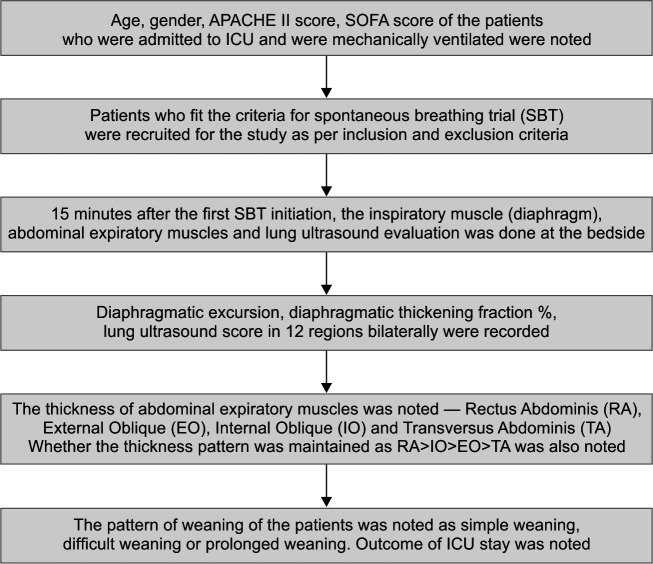
This was a single-center, prospective observational study done on 81 adult mechanically ventilated patients who underwent the weaning process.
Sixteen patients had simple weaning and 65 patients had either difficult or prolonged weaning. The mean and standard deviation (SD) of the thickness of expiratory abdominal muscles-rectus abdominis (RA), internal oblique (IO), external oblique (EO), and transversus abdominis (TA) were significantly more in patients with simple weaning than those with difficult or prolonged weaning. The receiver operating curve (ROC) of expiratory muscles showed RA, IO, EO, TA cut-offs 0.638, 0.492, 0.315, and 0.253 cm, respectively, to predict simple weaning. The pattern of expiratory muscle thickness RA > IO > EO > TA was maintained in both simple and difficult/prolonged weaning groups ( = 0.362). The ROC of diaphragmatic excursion (DE) for predicting simple weaning had cut-off 1.79 cm. The lung ultrasound score (LUS) was 5.75 ± 3.32 in the simple weaning group, compared to 9.71 ± 5.18 in the difficult/prolonged weaning group ( = 0.005).
Abdominal expiratory muscles were significantly thicker in patients with simple weaning compared to those with difficult or prolonged weaning. The pattern of expiratory muscle thickness followed the pattern of RA > IO > EO > TA in both simple weaning and difficult or prolonged weaning groups. DE >1.79 cm predicted simple weaning and LUS was significantly lesser in patients with simple weaning (CTRI/2020/11/028895).
Amara V, Vishwas P, Maddani SS, Natarajan S, Chaudhuri S. Evaluation of Abdominal Expiratory Muscle Thickness Pattern, Diaphragmatic Excursion, and Lung Ultrasound Score in Critically Ill Patients and Their Association with Weaning Patterns: A Prospective Observational Study. Indian J Crit Care Med 2022;26(3):307-313.
呼气肌是危重症患者呼吸功能不可或缺的组成部分,但常常被忽视。我们评估了腹部呼气肌厚度模式与撤机的相关性。
这是一项在81例接受撤机过程的成年机械通气患者中进行的单中心前瞻性观察性研究。
16例患者撤机顺利,65例患者撤机困难或撤机时间延长。撤机顺利的患者,其呼气腹部肌肉(腹直肌、腹内斜肌、腹外斜肌和腹横肌)厚度的平均值及标准差显著高于撤机困难或撤机时间延长的患者。呼气肌的受试者工作特征曲线(ROC)显示,腹直肌、腹内斜肌、腹外斜肌、腹横肌预测撤机顺利的截断值分别为0.638、0.492、0.315和0.253 cm。在撤机顺利组和撤机困难/撤机时间延长组中,呼气肌厚度模式均为腹直肌>腹内斜肌>腹外斜肌>腹横肌(P = 0.362)。预测撤机顺利的膈肌移动度(DE)的ROC截断值为1.79 cm。撤机顺利组的肺部超声评分(LUS)为5.75±3.32,撤机困难/撤机时间延长组为9.71±5.18(P = 0.005)。
与撤机困难或撤机时间延长的患者相比,撤机顺利的患者腹部呼气肌明显更厚。在撤机顺利组和撤机困难或撤机时间延长组中,呼气肌厚度模式均为腹直肌>腹内斜肌>腹外斜肌>腹横肌。膈肌移动度>1.79 cm预测撤机顺利,撤机顺利的患者肺部超声评分显著更低(CTRI/2020/11/028895)。
阿马拉·V、维什瓦斯·P、马达尼·S·S、纳塔拉詹·S、乔杜里·S。危重症患者腹部呼气肌厚度模式、膈肌移动度及肺部超声评分的评估及其与撤机模式的相关性:一项前瞻性观察性研究。《印度重症监护医学杂志》2022;26(3):307 - 313。