Yanyan Sun, Guangxin Wang, Guoqing Sun, Yaming Wang, Wuhui Li, Osaka Akiyoshi
Department of Materials Science and Engineering, Henan University of Science and Technology Luoyang Henan Province 471023 China
School of Vehicle Engineering, Luoyang Institute of Technology Luoyang Henan Province 471023 China.
RSC Adv. 2020 Oct 7;10(61):37005-37013. doi: 10.1039/d0ra07636h.
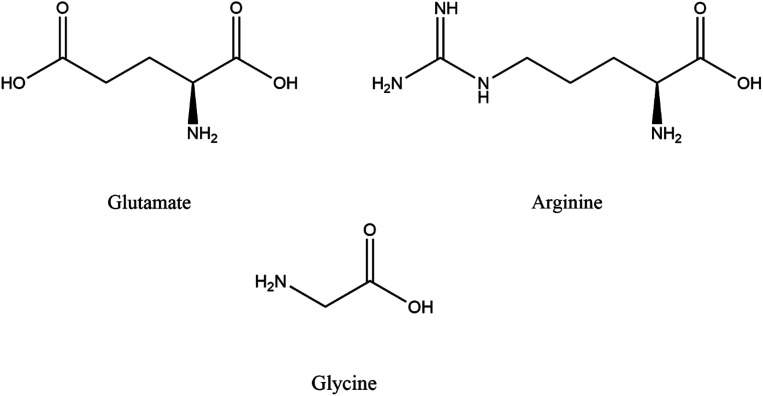
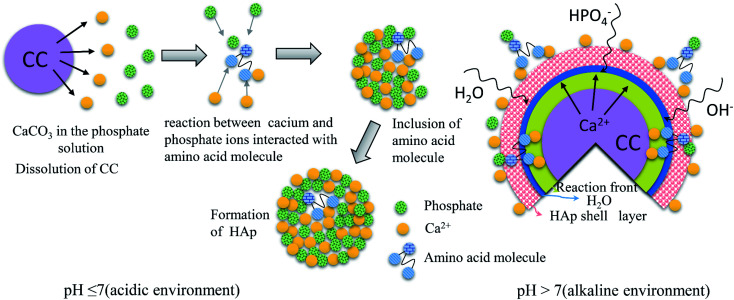
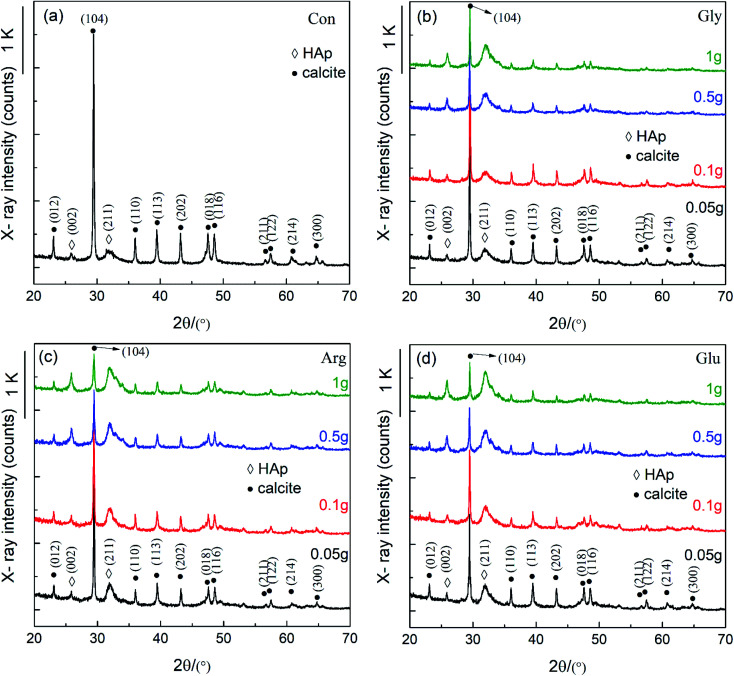
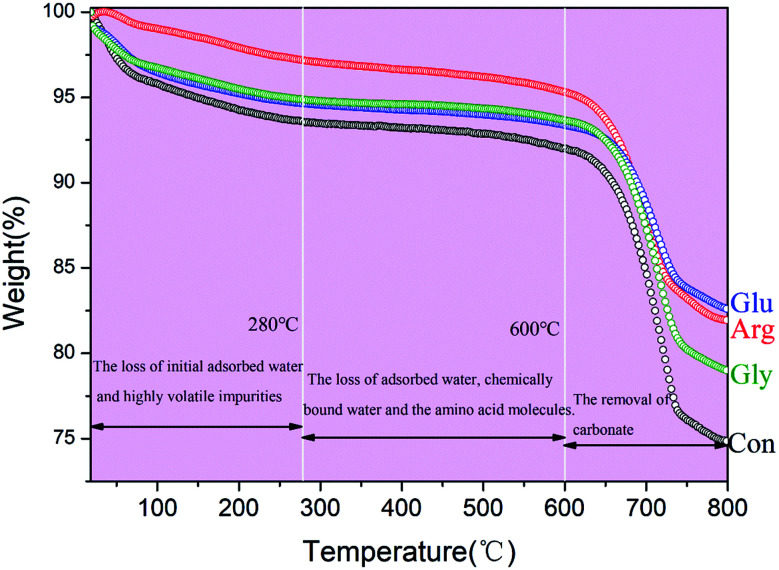
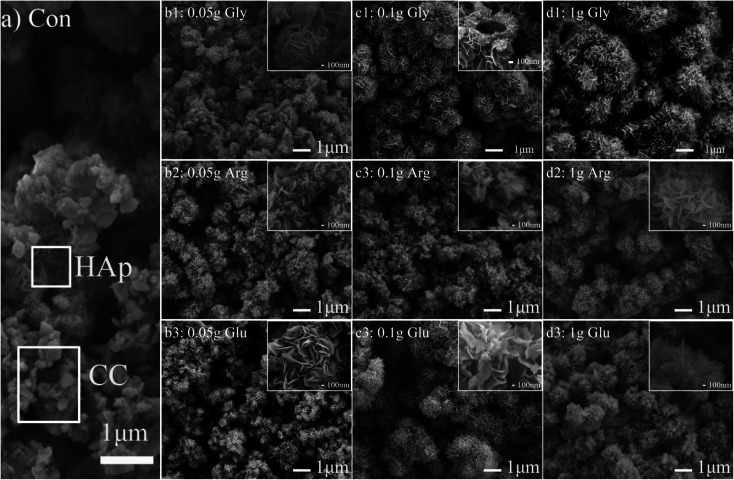
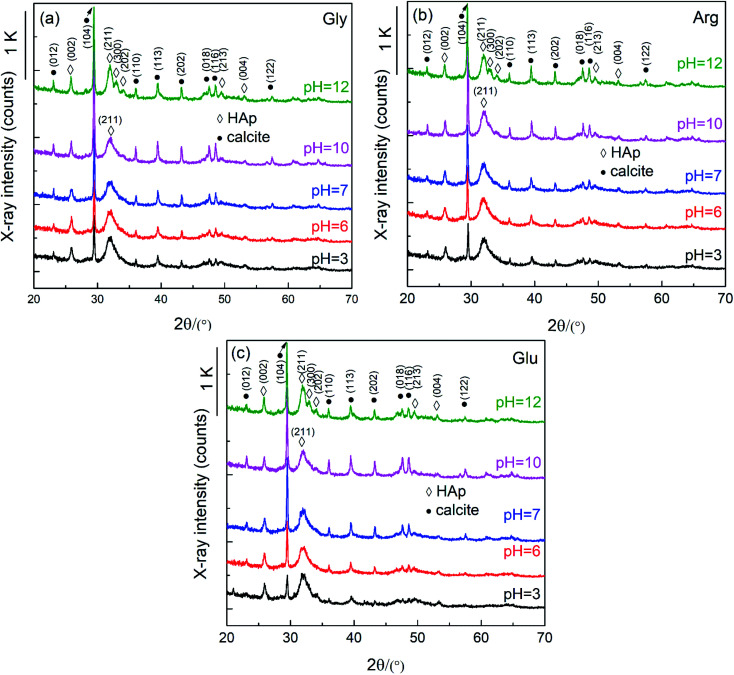
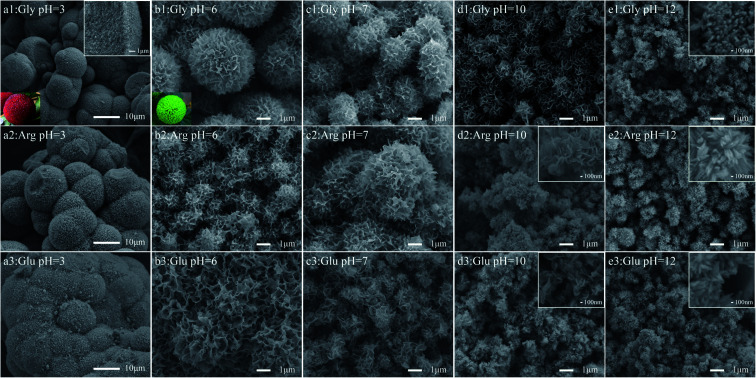
Conversion of calcium carbonate (calcite; CC) to hydroxyapatite (HAp) was examined when the CC particles of sub μm size were soaked at 37 °C for up to 10 d in 0.15 M KHPO (20 ml), whose pH was set to 3-12. Here, the solution contained amino acids, such as glutamine (Glu), arginine (Arg), and glycine (Gly), and their content varied from 0-1.0 g per ml of solution. From the X-ray diffraction (XRD) intensity of the 104 and 211 diffractions of calcite and apatite, respectively, it was seen that the presence of the amino acids promoted the conversion. This was supported by the thermogravimetry (TG) results. The highest promotion was observed at 0.5 g addition of amino acids to the phosphate solution, while Glu showed the highest promotion among the amino acids and Gly the lowest. A scanning electron microscopy study indicated that petal-like HAp nano-crystallites covered the entire surface of the CC particles when they were soaked in the phosphate solution with 0.1 g or more of amino acid for 10 d. The XRD intensity ratio 104(CC)/211(HAp) indicated greater CC to HAp conversion in the solutions at pH 3 and 6 than in the more alkaline solutions. This was attributed to the dissolution of CC in the acidic solutions, which was confirmed by bubbling in these solutions.
当将亚微米尺寸的碳酸钙颗粒(方解石;CC)在37°C下于0.15 M KHPO₄(20毫升)中浸泡长达10天,其pH值设定为3至12时,研究了碳酸钙向羟基磷灰石(HAp)的转化。在此,溶液中含有氨基酸,如谷氨酰胺(Glu)、精氨酸(Arg)和甘氨酸(Gly),它们的含量在每毫升溶液0至1.0克之间变化。从方解石和磷灰石分别在104和211衍射处的X射线衍射(XRD)强度可以看出,氨基酸的存在促进了转化。热重分析(TG)结果也支持了这一点。在向磷酸盐溶液中添加0.5克氨基酸时观察到促进作用最强,而在这些氨基酸中,Glu的促进作用最强,Gly的促进作用最弱。扫描电子显微镜研究表明,当CC颗粒在含有0.1克或更多氨基酸的磷酸盐溶液中浸泡10天时,花瓣状的HAp纳米微晶覆盖了CC颗粒的整个表面。XRD强度比104(CC)/211(HAp)表明,在pH值为3和6的溶液中,CC向HAp的转化率高于碱性更强的溶液。这归因于CC在酸性溶液中的溶解,这通过在这些溶液中鼓泡得到了证实。