Department of Basic Medical Sciences, Medical College, Qinghai University, Xining, PR, China.
Cardiovascular Medicine Department, Xuzhou Medical University affiliated Hospital, Xuzhou, PR China.
PLoS One. 2022 May 6;17(5):e0267513. doi: 10.1371/journal.pone.0267513. eCollection 2022.
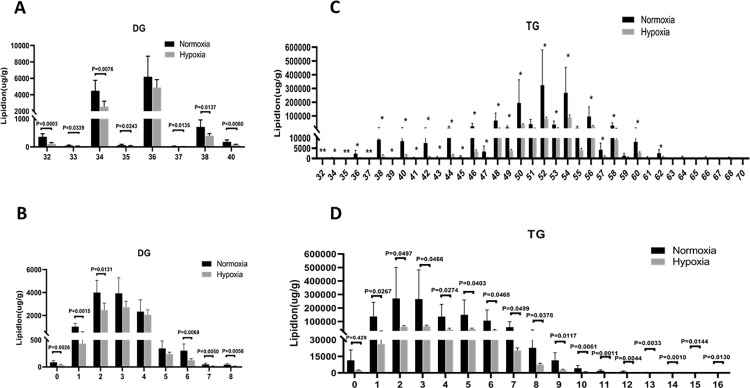
Adipose tissue plays a central role in energy substrate homeostasis and is a key regulator of lipid flow throughout these processes. As hypoxia affects lipid metabolism in adipose tissue, we aimed to investigate the effects of high-altitude chronic hypoxia on lipid metabolism in the adipose tissue of rats using a lipidomic analysis approach. Visceral adipose tissues from rats housed in a high-altitude hypoxia environment representing 4,300 m with 14.07% oxygen (hypoxia group) and from rats housed in a low-altitude normoxia environment representing 41 m with 20.95% oxygen (normoxia group) for 8 weeks were analyzed using an ultra-performance liquid chromatography-Orbitrap mass spectrometry system. After 8 weeks, the body weight and visceral adipose tissue weight of the hypoxia group were significantly decreased compared to those of the normoxia group (p < 0.05). The area and diameter of visceral adipose cells in the hypoxia group were significantly smaller than those of visceral adipose cells in the normoxia group (p < 0.05). The results of lipidomic analysis showed a total of 21 lipid classes and 819 lipid species. The total lipid concentration of the hypoxia group was lower than that in the normoxia group (p < 0.05). Concentrations of diacylglycerols and triacylglycerols in the hypoxia group were significantly lower than those in the normoxia group (p < 0.05). Using univariate and multivariate analyses, we identified 74 lipids that were significantly altered between the normoxia and hypoxia groups. These results demonstrate that high-altitude chronic hypoxia changes the metabolism of visceral adipose glycerides, which may potentially modulate other metabolic processes.
脂肪组织在能量底物稳态中起着核心作用,是调节这些过程中脂质流动的关键调节剂。由于缺氧会影响脂肪组织中的脂质代谢,我们旨在使用脂质组学分析方法研究高海拔慢性缺氧对大鼠脂肪组织脂质代谢的影响。用超高效液相色谱-轨道阱质谱系统分析了在代表 4300 米、氧含量为 14.07%的高海拔缺氧环境中饲养 8 周的大鼠内脏脂肪组织(缺氧组)和在代表 41 米、氧含量为 20.95%的低海拔常氧环境中饲养 8 周的大鼠内脏脂肪组织(常氧组)。8 周后,与常氧组相比,缺氧组的体重和内脏脂肪组织重量显著降低(p<0.05)。缺氧组内脏脂肪细胞的面积和直径明显小于常氧组(p<0.05)。脂质组学分析的结果显示共有 21 种脂质类别和 819 种脂质种类。缺氧组的总脂质浓度低于常氧组(p<0.05)。缺氧组的二酰基甘油和三酰基甘油浓度明显低于常氧组(p<0.05)。通过单变量和多变量分析,我们确定了 74 种在常氧和缺氧组之间显著改变的脂质。这些结果表明,高海拔慢性缺氧改变了内脏脂肪甘油酯的代谢,这可能潜在地调节其他代谢过程。