Department of Analytical Chemistry, Nutrition and Food Sciences, Institute of Research on Chemical and Biological Analysis (IAQBUS), Universidade de Santiago de Compostela, Constantino Candeira S/N, 15782 Santiago de Compostela, Spain.
Environmental and Public Health Analytical Chemistry, Research Institute for Pesticides and Water, University Jaume I, Avda Sos Baynat s/n, 12071 Castellón, Spain.
Sci Total Environ. 2022 Aug 25;836:155697. doi: 10.1016/j.scitotenv.2022.155697. Epub 2022 May 4.
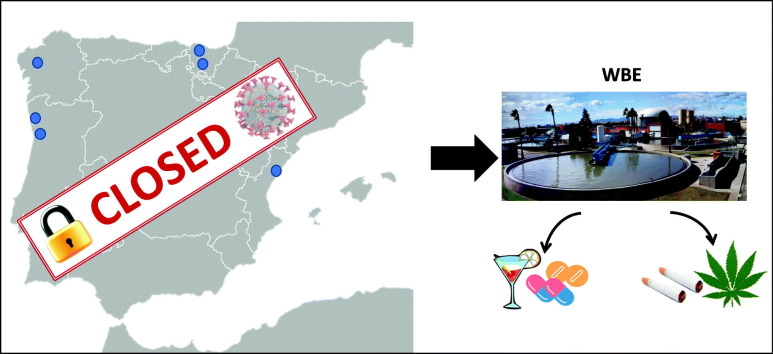
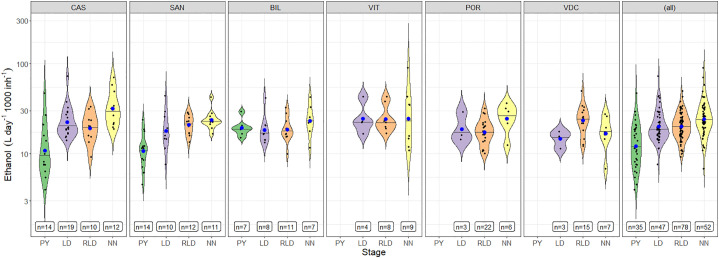
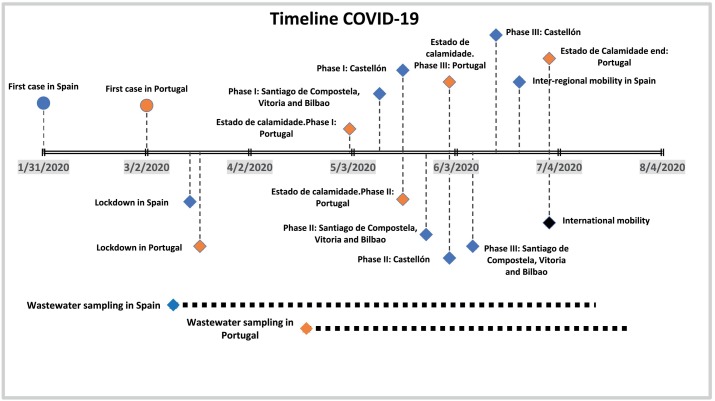
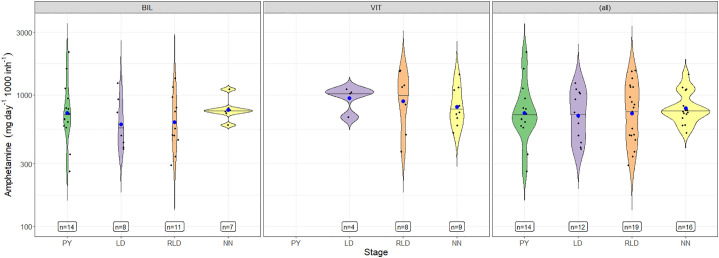
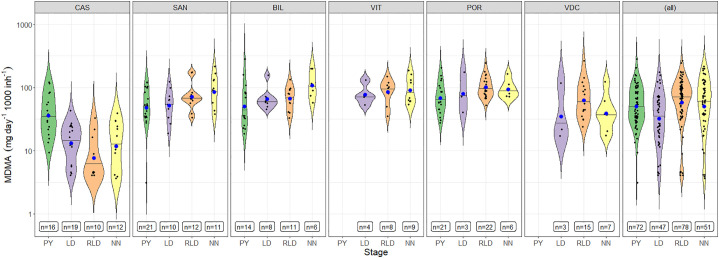
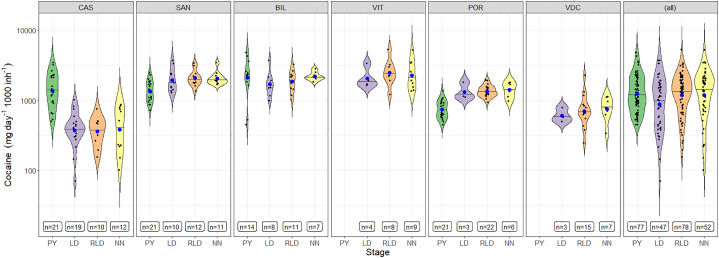
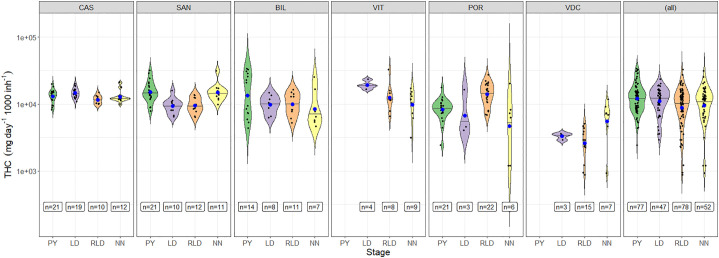
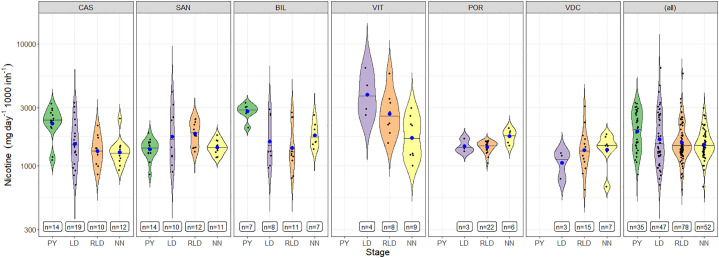
The COVID-19 pandemic spread rapidly worldwide in the year 2020, which was initially restrained by drastic mobility restrictions. In this work, we investigated the use of illicit drugs (amphetamine, methamphetamine, ecstasy, cocaine and cannabis), and licit substances of abuse (alcohol and tobacco) during the earlier months (March-July 2020) of the pandemic restrictions in four Spanish (Bilbao and its metropolitan area, Vitoria-Gasteiz, Castellón and Santiago de Compostela) and two Portuguese (Porto and Vila do Conde) locations by wastewater-based epidemiology (WBE). The results show that no methamphetamine was detected in any of the locations monitored, while amphetamine use was only detectable in the two locations from the Basque Country (Bilbao and its metropolitan area and Vitoria-Gasteiz), with high estimated average usage rates (700-930 mg day 1000 inhabitant). The remaining substances were detected in all the investigated catchment areas. In general, no remarkable changes were found in population normalized loads compared to former years, except for cocaine (i.e. its main metabolite, benzoylecgonine). For this drug, a notable decrease in use was discernible in Castellón, while its usage in Porto and Santiago de Compostela seemed to continue in a rising trend, already initiated in former years. Furthermore, two events of ecstasy (3,4-methylenedioxymethamphetamine, MDMA) dumping in the sewage network were confirmed by enantiomeric analysis, one in Santiago de Compostela just prior the lockdown and the second one in the Bilbao and its metropolitan area in July after relieving the more stringent measures. The latter could also be associated with a police intervention. The comparison of WBE with (web) survey data, which do not provide information at a local level, points towards contradictory conclusions for some of the substances, thereby highlighting the need for stable WBE networks capable of near real-time monitoring drug use.
2020 年,COVID-19 疫情在全球迅速蔓延,最初通过严格的限制流动性得到了控制。在这项工作中,我们通过基于污水的流行病学(WBE)调查了西班牙四个城市(毕尔巴鄂及其大都市区、维多利亚-加斯泰兹、卡塔赫纳和圣地亚哥-德孔波斯特拉)和葡萄牙两个城市(波尔图和维拉-杜康)在疫情限制的前几个月(2020 年 3 月至 7 月)非法药物(安非他命、甲基苯丙胺、摇头丸、可卡因和大麻)和合法药物(酒精和烟草)的使用情况。结果表明,在所监测的地点均未检测到甲基苯丙胺,而安非他命仅在巴斯克地区的两个地点(毕尔巴鄂及其大都市区和维多利亚-加斯泰兹)可检测到,估计平均使用率较高(700-930mg·天-1·1000 居民)。其余物质在所有调查的集水区都有检测到。一般来说,与前几年相比,人口归一化负荷没有明显变化,除了可卡因(即其主要代谢物苯甲酰爱康宁)。对于这种药物,在卡塔赫纳发现其使用量明显减少,而在波尔图和圣地亚哥-德孔波斯特拉,其使用量似乎仍在继续上升,这一趋势在前几年就已经开始。此外,通过对映体分析确认了污水管网中发生了两次摇头丸(3,4-亚甲二氧基甲基苯丙胺,MDMA)倾倒事件,一次发生在圣地亚哥-德孔波斯特拉,就在封锁之前,另一次发生在毕尔巴鄂及其大都市区,是在放宽更严格的措施后 7 月发生的。后者也可能与警方的干预有关。WBE 与(网络)调查数据的比较,后者无法提供地方层面的信息,对于某些物质得出了相互矛盾的结论,因此突出了需要建立能够实时监测药物使用情况的稳定的 WBE 网络。