Department of Psychiatry, University of Vermont Larner College of Medicine, Burlington, VT, USA.
Psychiatry Department, University of Rennes 1, Rennes, France.
Transl Psychiatry. 2022 May 6;12(1):188. doi: 10.1038/s41398-022-01956-4.
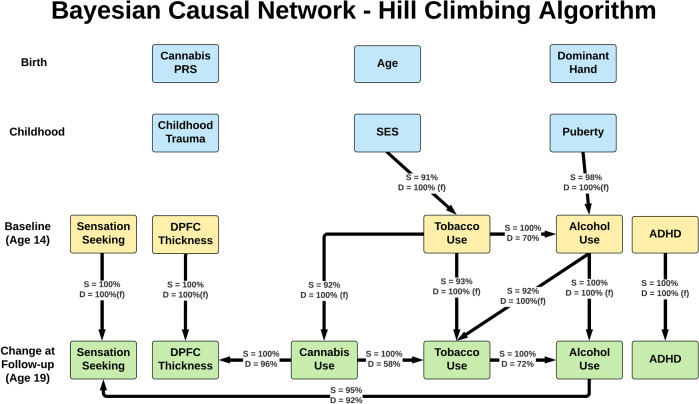
While there is substantial evidence that cannabis use is associated with differences in human brain development, most of this evidence is correlational in nature. Bayesian causal network (BCN) modeling attempts to identify probable causal relationships in correlational data using conditional probabilities to estimate directional associations between a set of interrelated variables. In this study, we employed BCN modeling in 637 adolescents from the IMAGEN study who were cannabis naïve at age 14 to provide evidence that the accelerated prefrontal cortical thinning found previously in adolescent cannabis users by Albaugh et al. [1] is a result of cannabis use causally affecting neurodevelopment. BCNs incorporated data on cannabis use, prefrontal cortical thickness, and other factors related to both brain development and cannabis use, including demographics, psychopathology, childhood adversity, and other substance use. All BCN algorithms strongly suggested a directional relationship from adolescent cannabis use to accelerated cortical thinning. While BCN modeling alone does not prove a causal relationship, these results are consistent with a body of animal and human research suggesting that adolescent cannabis use adversely affects brain development.
虽然有大量证据表明大麻使用与人类大脑发育的差异有关,但这些证据大多是相关性质的。贝叶斯因果网络(BCN)建模试图利用条件概率从相关数据中识别可能的因果关系,以估计一组相关变量之间的方向关联。在这项研究中,我们在来自 IMAGEN 研究的 637 名 14 岁时大麻无经验的青少年中使用了 BCN 建模,以提供证据表明,Albaugh 等人之前在青少年大麻使用者中发现的前额叶皮层加速变薄[1]是大麻使用对神经发育产生因果影响的结果。BCN 纳入了关于大麻使用、前额叶皮层厚度以及与大脑发育和大麻使用相关的其他因素的数据,包括人口统计学、精神病理学、童年逆境和其他物质使用。所有 BCN 算法都强烈表明,从青少年大麻使用到加速皮层变薄存在一种方向性关系。虽然 BCN 建模本身并不能证明因果关系,但这些结果与大量动物和人类研究一致,这些研究表明青少年大麻使用会对大脑发育产生不利影响。