Bioreactors Laboratory, Center for Genetic Engineering and Biotechnology, Havana, Cuba.
Plant Biotechnology Department, Center for Genetic Engineering and Biotechnology, PO Box 6162, 10600, Havana, Cuba.
Mol Biol Rep. 2022 Jul;49(7):6113-6123. doi: 10.1007/s11033-022-07402-4. Epub 2022 May 8.
The COVID-19 pandemic caused by the SARS-CoV-2 coronavirus has currently affected millions of people around the world. To combat the rapid spread of COVID-19 there is an urgent need to implement technological platforms for the production of vaccines, drugs and diagnostic systems by the scientific community and pharmaceutical companies. The SARS-CoV-2 virus enters the cells by the interaction between the receptor-binding domain (RBD) present in the viral surface spike protein and its human receptor ACE2. The RBD protein is therefore considered as the target for potential subunit-based vaccines.
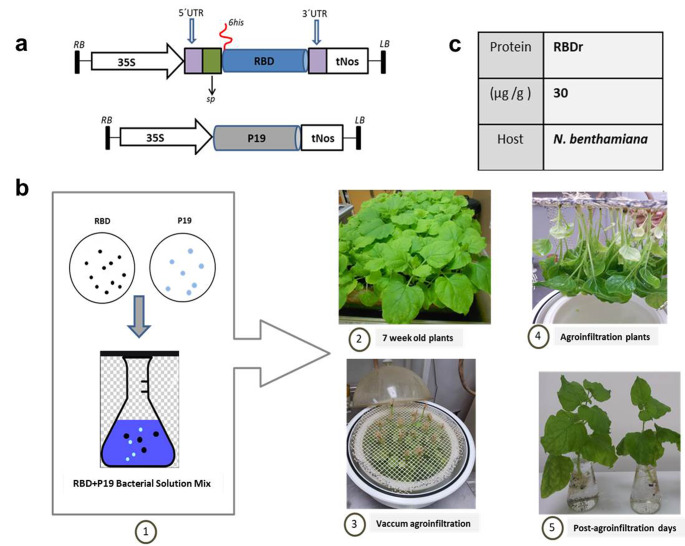
We evaluate the use of Nicotiana benthamiana plants as the host to transiently-producing recombinant RBD (RBDr) protein. The identity of the plant-produced RBDr was confirmed by immune assays and mass spectrometry. Immunogenicity was confirmed through the specific antibodies generated in all of the immunized mice compared to the PBS treated group.
In conclusions, the immunogenicity of the RBDr produced in N. benthamiana was confirmed. These findings support the use of plants as an antigen expression system for the rapid development of vaccine candidates.
由严重急性呼吸系统综合征冠状病毒 2 型(SARS-CoV-2)引起的 COVID-19 大流行目前已影响到全球数百万人。为了应对 COVID-19 的迅速传播,科学界和制药公司急需利用技术平台生产疫苗、药物和诊断系统。SARS-CoV-2 病毒通过其表面刺突蛋白上存在的受体结合结构域(RBD)与人类受体 ACE2 之间的相互作用进入细胞。因此,RBD 蛋白被认为是潜在亚单位疫苗的靶标。
我们评估了利用黄花烟作为瞬时生产重组 RBD(RBDr)蛋白的宿主。通过免疫测定和质谱法确认了植物产生的 RBDr 的身份。与 PBS 处理组相比,所有免疫小鼠均产生了特异性抗体,证实了其免疫原性。
总之,证实了在黄花烟中产生的 RBDr 的免疫原性。这些发现支持将植物用作抗原表达系统,以快速开发疫苗候选物。