Piscazzi Annamaria, Condelli Valentina, Crispo Fabiana, Coda Anna Rita Daniela, Calice Giovanni, Bruno Giuseppina, Venuto Santina, Tibullo Daniele, Giordano Guido, Pietrafesa Michele, Liso Arcangelo, Landriscina Matteo
Department of Medical and Surgical Sciences, University of Foggia, I-71122 Foggia, Italy.
Laboratory of Pre-Clinical and Translational Research, Scientific Institute for Research, Hospitalization and Healthcare-Referral Cancer Center of Basilicata (IRCCS-CROB), I-85028 Potenza, Italy.
Oncol Lett. 2022 Jun;23(6):185. doi: 10.3892/ol.2022.13305. Epub 2022 Apr 21.
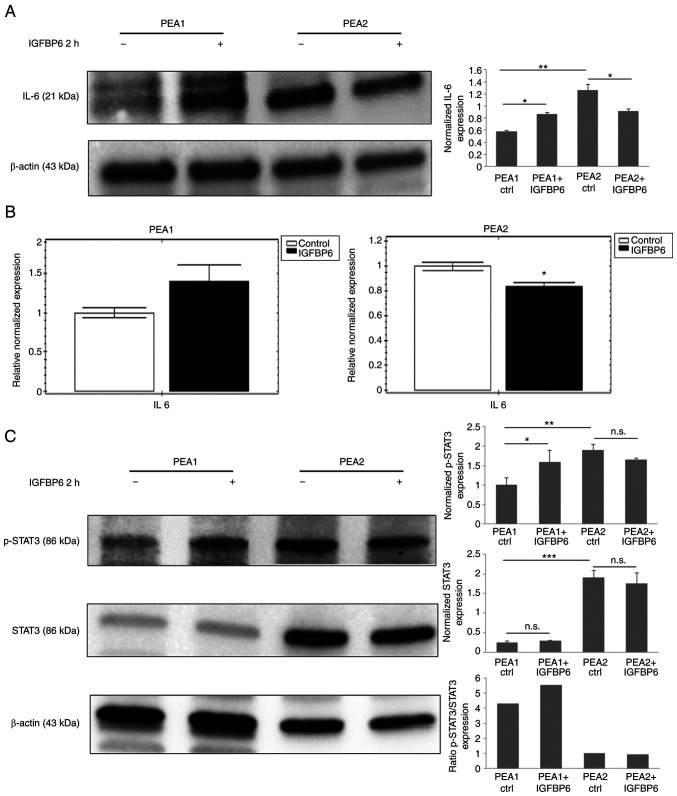
Insulin-like growth factor binding protein 6 (IGFBP6) is a secreted protein with a controversial role in human malignancies, being downregulated in most types of human cancer, but upregulated in selected tumors. Ovarian cancer (OC) is a human malignancy characterized by IGFBP6 downregulation; however, the significance of its low expression during ovarian carcinogenesis is still poorly understood. In the present study, IGFBP6 expression and activation of its associated signaling pathway were evaluated in two matched OC cell lines derived from a high-grade serous OC before and after platinum resistance (PEA1 and PEA2 cells, respectively). A whole genome gene expression analysis was comparatively performed in both cell lines upon IGFBP6 stimulation using Illumina technology. IGFBP6 gene expression data from human OC cases were obtained from public datasets. Gene expression data from public datasets confirmed the downregulation of IGFBP6 in primary and metastatic OC tissues compared with in normal ovarian tissues. The comparative analysis of platinum-sensitive (PEA1) and platinum-resistant (PEA2) cell lines showed quantitative and qualitative differences in the activation of IGFBP6 signaling. Notably, IGFBP6 enhanced ERK1/2 phosphorylation only in PEA1 cells, and induced more evident and significant gene expression reprogramming in PEA1 cells compared with in PEA2 cells. Furthermore, the analysis of selected genes modulated by IGFBP6 (i.e., and ) exhibited an inverse regulation in PEA1 versus PEA2 cells. In addition, selected hallmarks (TNFA_signaling_via_NFKB, TGF_beta_signaling, P53_pathway) and IL-6 signaling were positively regulated in PEA1 cells, whereas they were inhibited in PEA2 cells in response to IGFBP6. These data suggested that dysregulation of IGFBP6 signaling may serve a role in the progression of OC, and is likely associated with the development of platinum resistance.
胰岛素样生长因子结合蛋白6(IGFBP6)是一种分泌蛋白,在人类恶性肿瘤中的作用存在争议,在大多数人类癌症类型中表达下调,但在某些肿瘤中上调。卵巢癌(OC)是一种以IGFBP6下调为特征的人类恶性肿瘤;然而,其在卵巢癌发生过程中低表达的意义仍知之甚少。在本研究中,在铂耐药前后源自高级别浆液性OC的两个匹配的OC细胞系(分别为PEA1和PEA2细胞)中评估了IGFBP6的表达及其相关信号通路的激活情况。使用Illumina技术在IGFBP6刺激后对这两个细胞系进行了全基因组基因表达分析比较。从公共数据集获得了来自人类OC病例的IGFBP6基因表达数据。来自公共数据集的基因表达数据证实,与正常卵巢组织相比,原发性和转移性OC组织中IGFBP6表达下调。铂敏感(PEA1)和铂耐药(PEA2)细胞系的比较分析显示,IGFBP6信号激活存在定量和定性差异。值得注意的是,IGFBP6仅在PEA1细胞中增强ERK1/2磷酸化,并且与PEA2细胞相比,在PEA1细胞中诱导了更明显和显著的基因表达重编程。此外,对受IGFBP6调节的选定基因(即 和 )的分析显示,PEA1细胞与PEA2细胞中存在反向调节。此外,选定的特征(通过NFKB的TNFA信号传导、TGF_beta信号传导、P53途径)和IL-6信号在PEA1细胞中受到正向调节,而在PEA2细胞中,它们在IGFBP6刺激下受到抑制。这些数据表明,IGFBP6信号失调可能在OC进展中起作用,并且可能与铂耐药的发展有关。